Subsection scope: Magnetic fields and electromagnets: both courses and tiers. Motor effect/F = BIl/motors: both courses Higher. Moving-coil loudspeaker: Physics Higher.
Learn · practise · improve
Start here
The revision snapshot
Start with the field made by a magnet or current, then distinguish it from the force on a current in an external magnetic field.
By the end, you should be able to:
Distinguish permanent and induced magnets.
Map a field with a compass and interpret Earth evidence.
Higher: explain motor force; Physics Higher: explain a speaker.
Before you revise
Diagnostic question
Choose an answer from memory. Your result tells you what to watch for in the guide.
Core revision guide
Learn the model, then use it
Start with the field made by a magnet or current, then distinguish it from the force on a current in an external magnetic field.
01
Permanent and induced magnets
Scope: 8463 and 8464 · Foundation and Higher
A permanent magnet produces its own magnetic field. Iron, steel, nickel and cobalt are magnetic materials. In an applied field, an unmagnetised piece of iron becomes an induced magnet and is attracted to the source magnet. It loses most or all of that induced magnetisation when the field is removed. Two permanent magnets can attract or repel: unlike poles attract and like poles repel. The forces are strongest near the poles and act without contact. Attraction alone does not prove that an object was already a permanent magnet.
02
Plot a field with a compass and use Earth evidence
Scope: 8463 and 8464 · Foundation and Higher
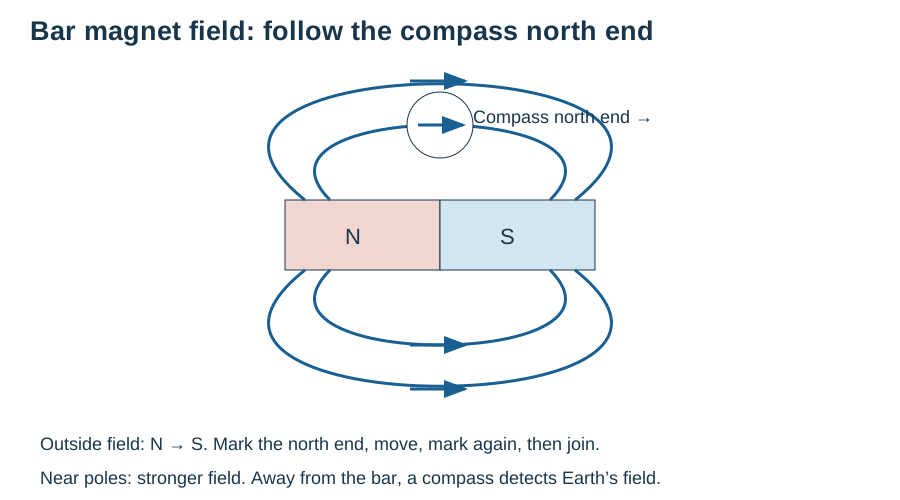
Fix a bar magnet on paper and draw its outline. Place a small plotting compass nearby; mark the positions of both needle ends, identifying the north end. Move the compass so its south end lies on the previous north-end mark, mark the new north end and repeat. Join the successive marks with a smooth line and add arrows in the direction of the compass north end, from N to S outside the magnet. Begin at other positions to map several lines; closer line spacing represents greater field strength, especially near the poles. Keep other magnets away. Far from the bar magnet, a freely turning compass aligns with Earth’s magnetic field. This consistent alignment is evidence that Earth is magnetic; its core is the origin of its field, rather than the compass needing a nearby bar magnet.
03
Map fields and make an electromagnet
Scope: 8463 and 8464 · Foundation and Higher
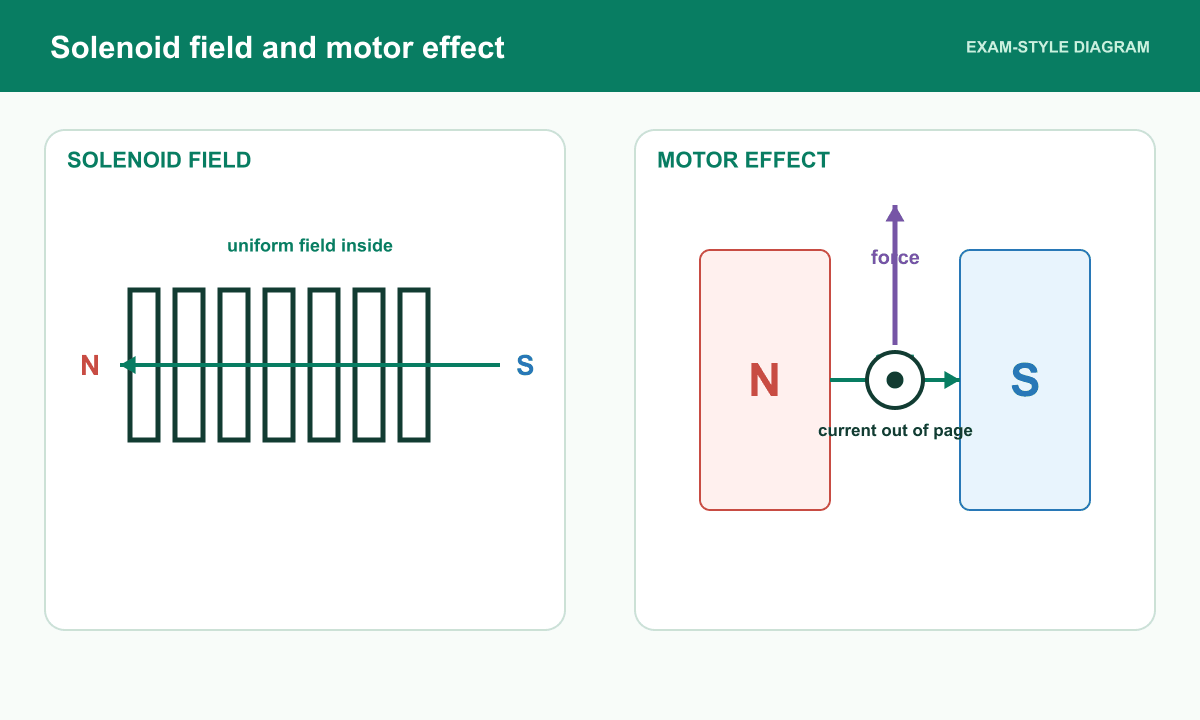
Outside a bar magnet field lines point north to south; closer lines indicate greater strength. A plotting compass points along the local field. Current in a straight wire creates concentric field lines: use the right-hand grip convention for conventional current. Reversing current reverses field direction; increasing current strengthens the field. A solenoid combines coil fields to give a strong approximately uniform field inside. An iron core strengthens the electromagnet.
04
Motor force and turning
Scope: 8463 and 8464 · Higher only
For a wire perpendicular to the external field, F = BIl. Fleming’s left hand relates field (first finger), conventional current (second finger) and force (thumb). Reversing either field or current reverses force; reversing both preserves it. Opposite currents on opposite sides of a coil produce forces that turn it. A split-ring commutator reverses coil current each half-turn to maintain turning direction.
05
Moving-coil loudspeaker
Scope: 8463 Physics only · Higher only
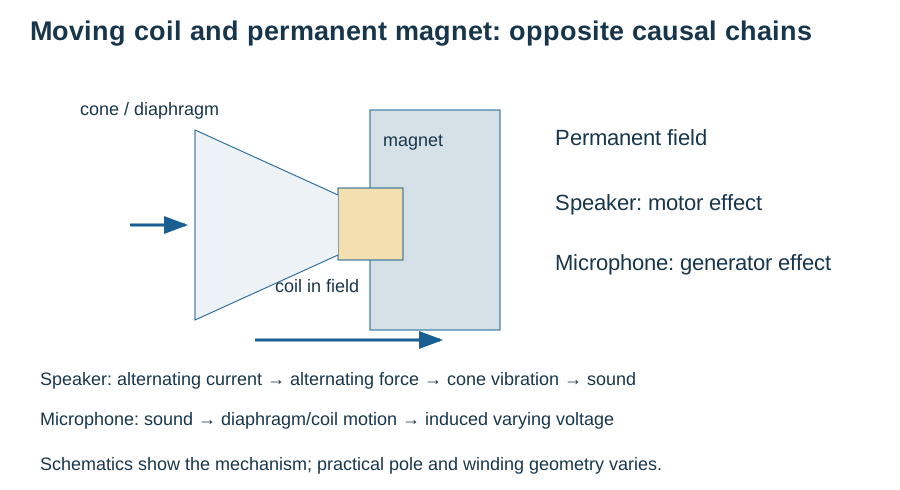
A coil fixed to a cone lies in a permanent magnet’s field. An alternating electrical signal produces a motor force that reverses as current reverses. The coil and cone vibrate, creating compressions and rarefactions in the air. Signal frequency sets vibration frequency/pitch; greater current amplitude gives larger force and vibration amplitude. It converts electrical signal variations into sound pressure variations.
For the motor effect, field is left to right, current is out of the page and force is upward.Open the full-size exam diagram
Both courses and tiers: compass mapping, pole direction and induced attraction.
Both courses Higher: perpendicular conductorF = BIlN, T, A, m
Misconception clinic
Replace the tempting answer
Read each belief, say what is wrong with it, then compare your correction.
Tempting idea: The core becomes non-magnetic forever.
Use instead: Iron can be magnetised in the other direction. Field direction follows current direction.
Tempting idea: The air carries charge through the cone.
Use instead: Sound transmits mechanical vibrations. Current reversals reverse motor force.
Retrieval practice
Quick checks
Worked examples
See the method being built
Apply permanent and induced magnets in the worked reasoning, then try the changed-context questions below.
Example 1 · Field around wire
Scope: 8463 and 8464 · Foundation and Higher
Describe the field around a straight current-carrying wire.
State field shape.
State effect of increasing current.
Use concentric circles.
Show the answer
The field forms concentric circles around the wire; greater current produces a stronger field.
Example 2 · Electromagnet
Scope: 8463 and 8464 · Foundation and Higher
Give two changes that strengthen an electromagnet.
Change coil turns/current/core.
State direction of change.
Link to field strength.
Show the answer
Increase current or turns, and use a soft iron core to strengthen the electromagnet.
Example 3 · Motor force
Scope: 8463 and 8464 · Higher only
A wire in a magnetic field has its current reversed. State force change.
Keep field fixed.
Reverse current.
Use motor effect rule.
Show the answer
The force direction reverses.
Exam precision
Use the physics precisely
Do this: Use compass north-end marks to show direction. For motors or speakers, connect current and field to force and then to motion under the labelled Higher scope.
Independent practice
Exam-style questions
Write an answer before opening the marking guidance. Then edit the exact phrase or step that would gain the next mark.
1. Explain how an iron-core solenoid acts as a controllable electromagnet.
[3 marks]
Scope: 8463 and 8464 · Foundation and Higher
Show marking guidance and model answer
Original PhysicsUK mark scheme: Point 1 (1 mark): Current through coil creates a magnetic field. Point 2 (1 mark): The coil fields combine and magnetise the iron, strengthening the field. Point 3 (1 mark): Switching current off removes the driven field; reversing it reverses polarity. Award each distinct point once. Accept equivalent scientifically correct wording. No half marks.
Current through coil creates a magnetic field. (1 mark)
The coil fields combine and magnetise the iron, strengthening the field. (1 mark)
Switching current off removes the driven field; reversing it reverses polarity. (1 mark)
Model answer: The coil current makes a field that magnetises the iron. Switching current controls the field and reversing current reverses its polarity.
2. Physics Higher: explain how a moving-coil loudspeaker produces sound from an alternating current.
[4 marks]
Scope: 8463 Physics only · Higher only
Show marking guidance and model answer
Original PhysicsUK mark scheme: Point 1 (1 mark): The coil is in a permanent magnetic field and attached to a cone. Point 2 (1 mark): Current causes a motor force on the coil. Point 3 (1 mark): Alternating current reverses force, vibrating coil and cone. Point 4 (1 mark): Cone motion produces pressure variations/compressions and rarefactions in air. Award each distinct point once. Accept equivalent scientifically correct wording. No half marks.
The coil is in a permanent magnetic field and attached to a cone. (1 mark)
Current causes a motor force on the coil. (1 mark)
Alternating current reverses force, vibrating coil and cone. (1 mark)
Cone motion produces pressure variations/compressions and rarefactions in air. (1 mark)
Model answer: The coil experiences a motor force in the magnet’s field. Alternating current reverses the force, making the attached cone vibrate and generate sound pressure variations.
3. An unmagnetised iron nail is attracted by either pole of a bar magnet and loses most of its magnetism when the bar is removed. Explain these observations, and describe how to mark the field direction with a plotting compass.
[4 marks]
Scope: 8463 and 8464 · Foundation and Higher
Show marking guidance and model answer
Original PhysicsUK mark scheme: Point 1 (1 mark): The bar’s field induces magnetism in the iron; induced magnetism causes attraction to either pole. Point 2 (1 mark): Most/all induced magnetisation is lost after removing the applied field, unlike a permanent magnet retaining its own field. Point 3 (1 mark): Mark the compass needle’s north end and move the compass to extend the marked line. Point 4 (1 mark): Join successive marks with arrows following the north end; outside the bar magnet direction is N to S. Award each distinct point once. Accept equivalent scientifically correct wording. No half marks.
The bar’s field induces magnetism in the iron; induced magnetism causes attraction to either pole. (1 mark)
Most/all induced magnetisation is lost after removing the applied field, unlike a permanent magnet retaining its own field. (1 mark)
Mark the compass needle’s north end and move the compass to extend the marked line. (1 mark)
Join successive marks with arrows following the north end; outside the bar magnet direction is N to S. (1 mark)
Model answer: The bar induces magnetism in the iron, causing attraction at either pole. Most induced magnetism is lost when the bar is removed. Place a compass beside the bar, mark the north end, then move and repeat to trace a line. Join the marks with arrows following the north end, N to S outside the magnet.
Questions pupils ask
Magnetic Fields, Electromagnets and the Motor Effect FAQs
Why does reversing a speaker current reverse its motion?
The motor-effect force reverses when current direction reverses in the same magnetic field, making the cone oscillate.