The National Grid’s purpose is common course content. Both courses Higher use ideal-transformer power equality; transformer construction, induction and turns ratio are Physics Higher.
Subsection scope: National Grid and efficient transmission: both courses, both tiers. Ideal-transformer power equality: both courses Higher. Transformer mechanism and turns ratio: Physics Higher only.
Learn · practise · improve
Start here
The revision snapshot
The National Grid’s purpose is common course content. Both courses Higher use ideal-transformer power equality; transformer construction, induction and turns ratio are Physics Higher.
By the end, you should be able to:
Explain high-voltage transmission through the Grid.
Higher: use ideal-transformer power equality.
Physics Higher: explain transformer action and turns ratio.
Before you revise
Diagnostic question
Choose an answer from memory. Your result tells you what to watch for in the guide.
Core revision guide
Learn the model, then use it
The National Grid’s purpose is common course content. Both courses Higher use ideal-transformer power equality; transformer construction, induction and turns ratio are Physics Higher.
01
National Grid and high-voltage transfer
Scope: 8463 and 8464 · Foundation and Higher
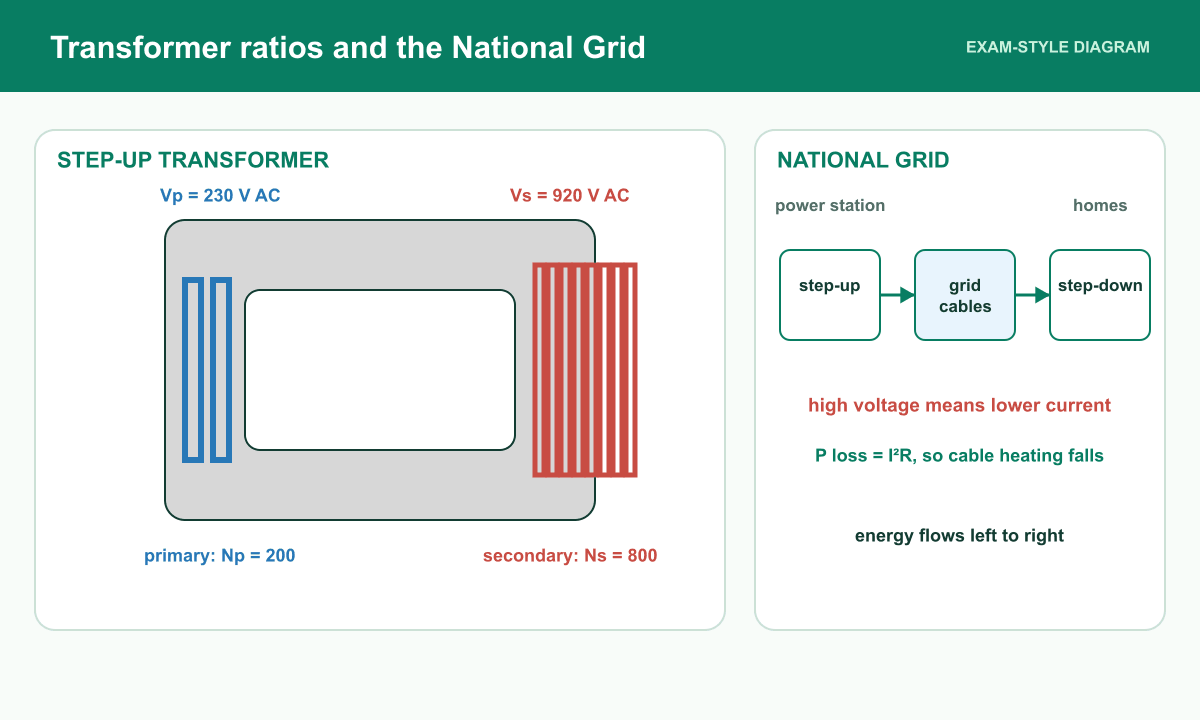
The Grid links generators and consumers through cables and transformers. Step-up transformers raise transmission voltage; step-down transformers lower it for users. At fixed transmitted power P = VI, raising V lowers I. For the same cable resistance, Pheat = I²R then decreases. Raising voltage is useful for efficient transmission but requires insulation and step-down stages for use.
02
Transformer mechanism
Scope: 8463 Physics only · Higher only
An alternating current in the primary coil creates a changing magnetic field in an iron core. This changing field reaches the secondary and induces p.d. A steady direct current creates no continuously changing field, so no continuous secondary output. Vₛ/Vₚ = Nₛ/Nₚ; the larger-turn coil has the larger p.d. The iron core links fields and is easily magnetised.
03
Ideal-transformer power and current
Scope: 8463 and 8464 · Higher only
For an ideal transformer, VₚIₚ = VₛIₛ. Both Physics and Trilogy Higher use this equality. Stepping voltage up steps current down for equal power. If input is 12 V and secondary output is 6 V at 0.50 A, output power is 3 W and ideal primary current is 3/12 = 0.25 A. No turns data are needed for this calculation. Real transformers have losses, so input power exceeds output.
A higher transmission voltage gives a lower current for the same power, reducing heating losses in cables.Open the full-size exam diagram
Lower current reduces energy transferred to thermal stores of cables due to resistance.
Example 3 · AC requirement
Scope: 8463 Physics only · Higher only
Explain why a transformer does not work on steady d.c.
Transformer needs changing magnetic field.
Steady d.c. makes constant field.
No induced secondary p.d.
Show the answer
A steady current does not continually change the magnetic field, so no continuous p.d. is induced in the secondary coil.
Exam precision
Use the physics precisely
Do this: For Grid losses hold transmitted power and cable resistance fixed. Check the course label before using power equality or the Physics turns ratio.
Independent practice
Exam-style questions
Write an answer before opening the marking guidance. Then edit the exact phrase or step that would gain the next mark.
1. Explain why the National Grid uses high transmission voltage.
[3 marks]
Scope: 8463 and 8464 · Foundation and Higher
Show marking guidance and model answer
Original PhysicsUK mark scheme: Point 1 (1 mark): For fixed power, P = VI means higher V permits lower I. Point 2 (1 mark): Lower I reduces heating loss in the same resistive cables. Point 3 (1 mark): Step-down transformers then reduce voltage for consumers. Award each distinct point once. Accept equivalent scientifically correct wording. No half marks.
For fixed power, P = VI means higher V permits lower I. (1 mark)
Lower I reduces heating loss in the same resistive cables. (1 mark)
Step-down transformers then reduce voltage for consumers. (1 mark)
Model answer: High voltage lowers current for the required power and reduces cable heating. Step-down transformers make the voltage suitable for consumers.
2. Physics Higher: a transformer has 600 primary turns, 150 secondary turns and 12 V input. Find ideal secondary p.d.
[3 marks]
Scope: 8463 Physics only · Higher only
Show marking guidance and model answer
Original PhysicsUK mark scheme: Point 1 (1 mark): Vs/Vp = Ns/Np. Point 2 (1 mark): Vs = 12 × 150/600. Point 3 (1 mark): Vs = 3.0 V. Award each distinct point once. Accept equivalent scientifically correct wording. No half marks.
Vs/Vp = Ns/Np. (1 mark)
Vs = 12 × 150/600. (1 mark)
Vs = 3.0 V. (1 mark)
Model answer: Vs/Vp = Ns/Np. Vs = 12 × 150/600. Vs = 3.0 V.
Acceptable answers: Expected result: Vs = 3.0 V. Accept the unrounded value or a correctly rounded equivalent to two or more significant figures; accept equivalent units if converted correctly. No additional measurement interval is implied.
Marking notes: Method marks remain available after an arithmetic error. Carry an earlier numerical error into a later valid step; award that method point if the unit conversion and physics are correct. A fully correct answer with unit earns all marks unless working is expressly requested.
3. Higher: an ideal transformer has 12 V primary p.d. and 6 V secondary p.d. with 0.50 A secondary current. Calculate primary current.
[3 marks]
Scope: 8463 and 8464 · Higher only
Show marking guidance and model answer
Original PhysicsUK mark scheme: Point 1 (1 mark): VpIp = VsIs; Ip = VsIs/Vp. Point 2 (1 mark): Ip = 6 × 0.50/12. Point 3 (1 mark): Ip = 0.25 A. Award each distinct point once. Accept equivalent scientifically correct wording. No half marks.
VpIp = VsIs; Ip = VsIs/Vp. (1 mark)
Ip = 6 × 0.50/12. (1 mark)
Ip = 0.25 A. (1 mark)
Model answer: VpIp = VsIs; Ip = VsIs/Vp. Ip = 6 × 0.50/12. Ip = 0.25 A.
Acceptable answers: Expected result: Ip = 0.25 A. Accept the unrounded value or a correctly rounded equivalent to two or more significant figures; accept equivalent units if converted correctly. No additional measurement interval is implied.
Marking notes: Method marks remain available after an arithmetic error. Carry an earlier numerical error into a later valid step; award that method point if the unit conversion and physics are correct. A fully correct answer with unit earns all marks unless working is expressly requested.
Questions pupils ask
Transformers and the National Grid FAQs
Why are transformers used before electricity enters long cables?
Raising voltage lowers current for the same transmitted power, reducing resistive I²R heating of the cables.