

When is Saturn at opposition in 2026?
Saturn reaches opposition on Sunday 4 October 2026, according to the National Astronomical Observatory of Japan's planetary calendar. For UK observers, early October is a good opportunity to find the planet and, with a telescope, look for its rings.
Start with an open view towards the east after dark. Near opposition, Saturn rises around sunset and is above the horizon for much of the night. It is higher towards the south around the middle of the night, which usually gives you a better view through less of the atmosphere.
That is a broad observing guide, not a rise time for every town. Your latitude, horizon and local weather change what you can see. Use a current sky map set to your location to identify Saturn, rather than assuming the brightest object nearby must be it. A hill or a row of houses can hide a planet that is technically above the horizon.
You do not have to wait for Sunday. A clear evening just before or after opposition is more useful than a cloud-covered view on the exact date. Saturn changes its position and apparent size gradually.
What does opposition mean?
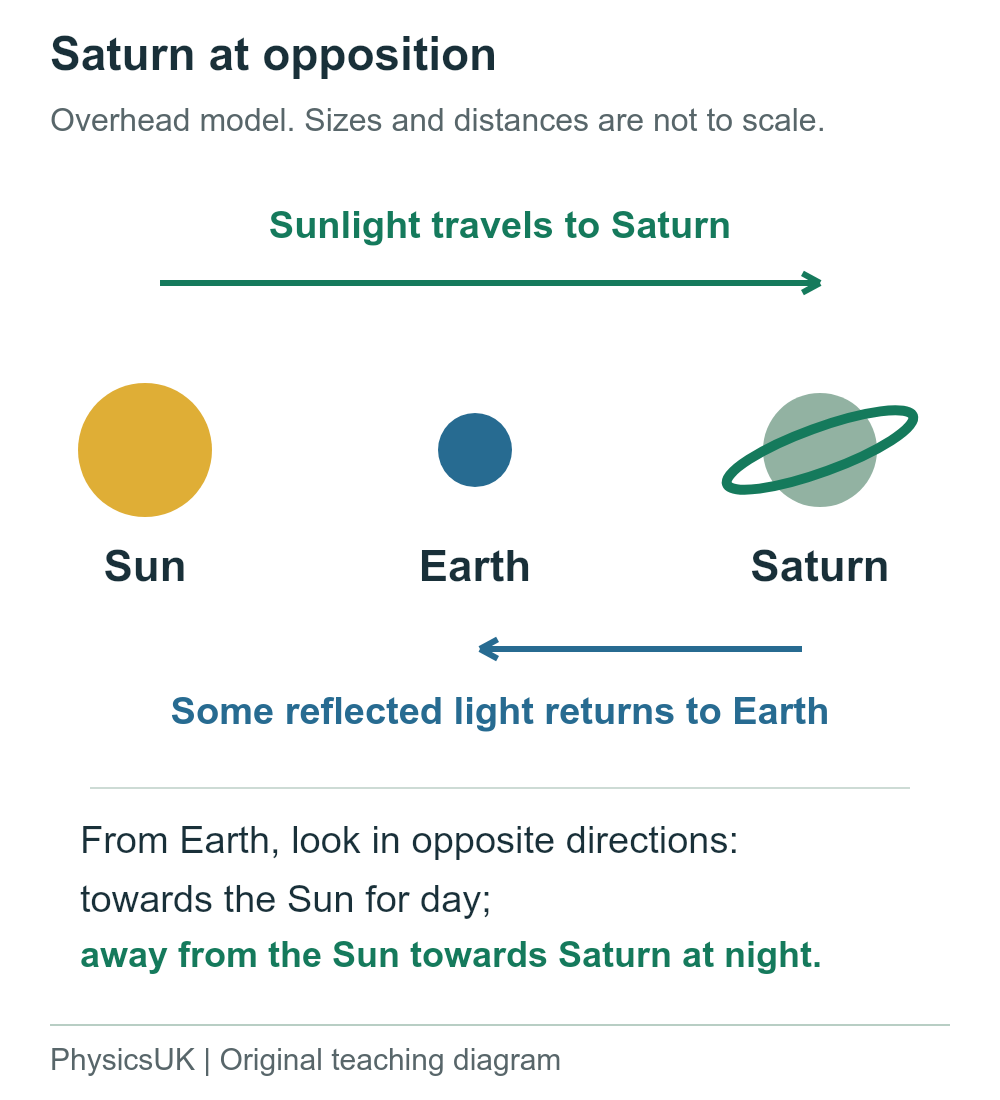
At opposition, Saturn and the Sun lie in opposite directions in Earth's sky. In a simplified overhead view, the order is Sun, Earth, Saturn. As your part of Earth rotates away from the Sun into night, it faces roughly towards Saturn.
Earth travels around the Sun faster than Saturn does, so the two planets repeatedly reach this arrangement. Opposition happens near the time of their closest approach for that year. The orbits are not perfect circles, so opposition and minimum distance are not precisely the same thing.
Saturn has not switched on a light. The visible light reaching your eye started at the Sun, travelled to Saturn and was reflected or scattered towards us. Its rings also scatter sunlight. Being relatively close makes the planet appear a little larger than when it is farther away, but it still looks like a point to an unaided eye.
This is not an eclipse. The overhead drawing leaves out the inclinations of the real orbits. A near-alignment in a flat drawing does not mean that Earth blocks the sunlight reaching Saturn.
Can you see Saturn's rings without a telescope?
You can see Saturn itself without optical equipment when the sky is clear. To distinguish the rings from the planet, you normally need a telescope. Ordinary handheld binoculars are useful for finding your way around the sky, but do not promise a clear ring system.
A small telescope can reveal a recognisable ringed shape. Begin with low magnification, centre Saturn, then increase magnification only while the image remains clear. A steady mount and calm air often make a bigger difference than a very large magnification number on the box.
Expect a small, pale object, not the colourful close-ups taken by spacecraft. The apparent tilt of the rings changes as Earth and Saturn orbit. A thin-looking ring system has not disappeared: we are seeing a different angle on a very flat structure.
An astronomy club or public observing session can be a good way to try this without buying equipment. If you photograph through an eyepiece, support the phone and keep the bright planet from becoming an overexposed blob. A phone photograph alone is unlikely to show the detail your eye can see through a carefully focused telescope.
The GCSE physics behind the view
This is a real example of solar system and orbital motion. Gravity continually changes the direction of a planet's velocity. Even an object moving at constant speed around a circle is accelerating because velocity includes direction.
The light reaching you connects to reflection and refraction. The ring particles are not a continuous solid disc; they are separate pieces, mainly ice, orbiting Saturn. Light scattered from those particles can enter a telescope and form an image.
Our revision page on lenses and image formation explains the next step: an objective lens or mirror collects light and forms an image, and an eyepiece lets you examine it. Enlarging that image does not automatically add new detail.
An astrophysicist uses the same basic idea in a more demanding setting: collect light, measure it carefully and test what it tells us about a distant object. Keeping notes about the telescope, time and sky conditions turns a quick look into a useful observation.
A Level stretch: why more magnification is not always better
Two nearby details in an image can blur together because light diffracts at the telescope aperture. At the same wavelength, a larger aperture can resolve smaller angular separations. Magnification can make an already blurred image bigger without separating those details.
The atmosphere adds another limit. Moving layers of air bend the light by changing amounts, making a planet shimmer. This is why observing above a warm roof, or just above the horizon, can disappoint even with good optics.
Saturn's rings can also brighten near opposition. When we look back towards the direction from which sunlight arrives, shadows between ring particles are less visible; scattering effects also contribute. This changes apparent brightness, not the amount of ice in the rings.
For the orbital side, revisit gravitational fields and orbits. Keep the two explanations separate: gravity controls where Saturn is, while light and the telescope determine what its image looks like.
Key words
Quick pupil questions
When is Saturn at opposition in 2026?
Saturn reaches opposition on 4 October 2026. The neighbouring nights are also good opportunities; it is not a momentary spectacle.
What time should I look for Saturn in the UK?
Look towards the east after dark in early October. Saturn is generally higher towards the south around the middle of the night. Check a sky map for your location, because there is no single UK-wide rise time.
Can I see Saturn's rings without a telescope?
You can see Saturn as a point of light with the naked eye, but normally need a telescope to distinguish its rings. Ordinary handheld binoculars should not be relied on to show them clearly.