
Will you get a GCSE Physics equation sheet in 2027?
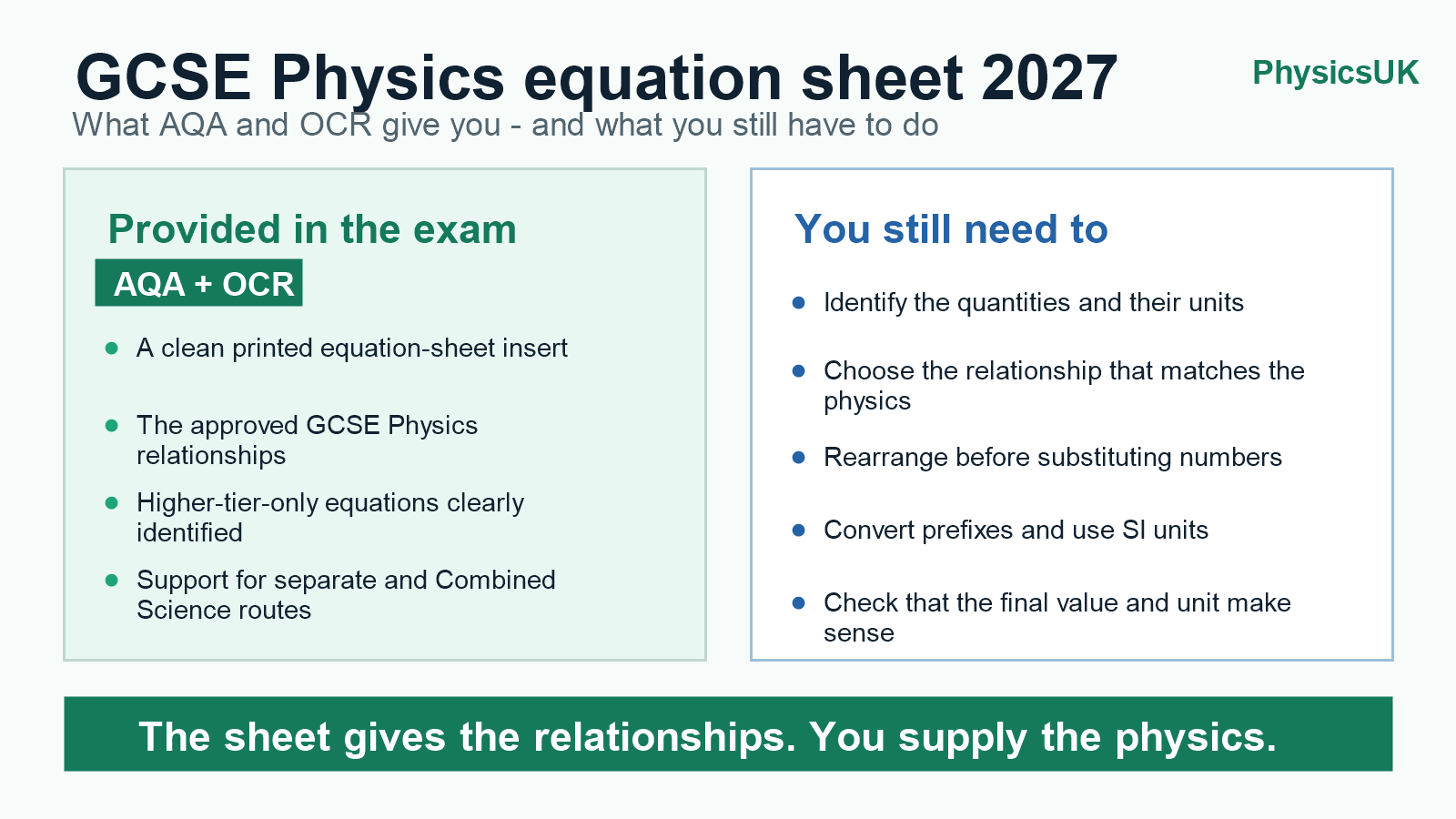
The short answer is yes. Pupils sitting GCSE Physics or Combined Science exams in England in summer 2027 will be given an equation sheet. AQA has confirmed full Physics Equations Sheets for its 2027 GCSE exams, and OCR says its 2027 data/equation sheets will be published on or before 1 September 2026.
Ofqual requires exam boards to provide a clean copy with the relevant exam papers. The support sets out equations pupils would previously have been expected to recall from memory. It does not contain worked answers, and boards must avoid questions that can be answered simply by copying a line from the sheet.
There is also an important update for younger pupils. In May 2026, Ofqual confirmed that formula and equation sheets will continue from 2028 for the remaining lifetime of the current GCSE specifications. The arrangement is therefore no longer scheduled to stop after the 2027 exams.
This page is about GCSE Physics and GCSE Combined Science in England. A-level Physics uses a different data and formula booklet, while qualifications in Wales, Northern Ireland, Scotland and international GCSE courses can have different arrangements.
What is on the 2027 GCSE Physics equation sheet?
An equation sheet is a list of relationships you are allowed to use. For example, it can remind you that power is energy transferred divided by time. The question still expects you to recognise that energy and time are the useful quantities and that the answer should be in watts.
AQA calls its insert the Physics Equations Sheet. OCR uses both equation sheet and data/equation sheet in its guidance because some science inserts also carry data. Pupils often search for a formula sheet, but the board documents normally use equation sheet for GCSE Physics.
The sheet covers both accessible and Higher-tier relationships. Equations that apply only to Higher Tier are identified on the board material. Your teacher should use the sheet for your exact qualification, route and tier when preparing mocks.
Do not wait until the real exam to unfold the insert for the first time. Use the official sheet during class questions and timed practice so you learn where relationships are placed and which similar-looking equations belong to different situations.
Which AQA and OCR GCSE papers receive an equation sheet in 2027?
Use the qualification code on your timetable or statement of entry. Similar course names can use different papers.
| Qualification | Code | Where the sheet is provided |
|---|---|---|
| AQA GCSE Physics | 8463 | Physics Papers 1 and 2 |
| AQA Combined Science: Trilogy | 8464 | Physics Papers 1 and 2 |
| AQA Combined Science: Synergy | 8465 | All four Synergy papers |
| OCR GCSE Physics A | J249 | Physics A papers 01, 02, 03 and 04 |
| OCR Combined Science A | J250 | Physics papers 05, 06, 11 and 12 |
OCR also confirms equation-sheet support for Physics B J259 and Combined Science B J260. This guide concentrates on the AQA and OCR A routes most commonly used on PhysicsUK.
Worked equations
A short example: choosing power rather than guessing
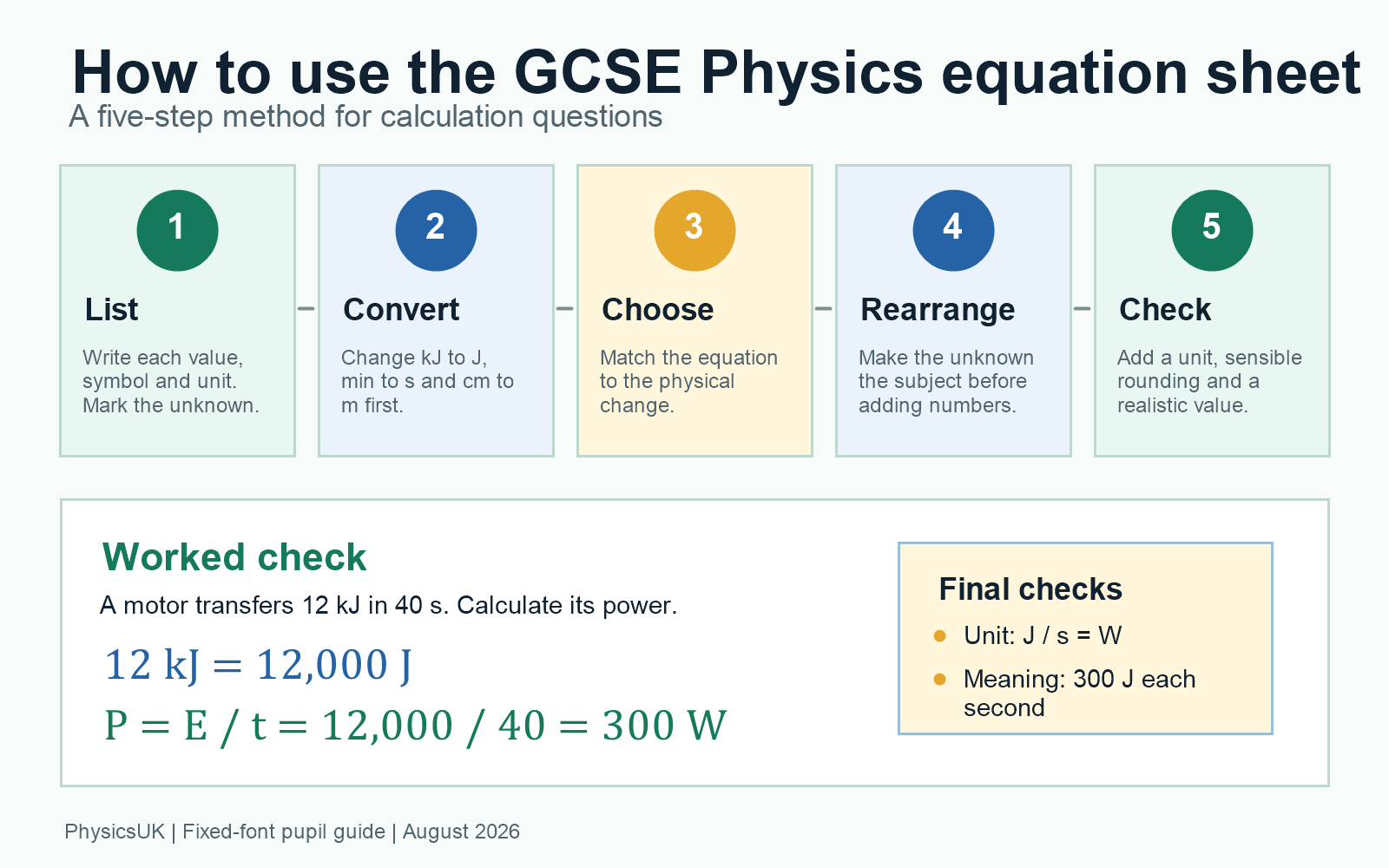
A motor transfers 12 kJ in 40 s. The sheet supplies the relationship, but the pupil must convert 12 kJ to 12,000 J, select the power equation and attach the watt unit.
- Unit check: J / s = W
- Meaning check: 300 joules transferred each second
How to use the GCSE Physics equation sheet
A consistent method earns more marks than scanning the sheet for a formula containing the same letter as the question. Work from the physics situation first, then use the insert.
1. List the quantities
Write each value beside its symbol and unit. Include the quantity the question asks you to find.
2. Convert before substituting
Change prefixes and non-SI values first: kilojoules to joules, minutes to seconds, centimetres to metres and milliamps to amps.
3. Choose from the situation
Height suggests gravitational potential energy; speed suggests kinetic energy; energy and time suggest power. Do not choose from letters alone.
4. Rearrange with symbols
Make the unknown the subject before putting numbers in. This keeps the structure visible and reduces calculator mistakes.
5. Check the result
Add the unit, use sensible significant figures and ask whether the size and direction of the answer fit the situation.
Why the equation sheet does not make calculations automatic
Providing equations changes what must be recalled, but it does not remove the physics from a calculation. A pupil can have every relationship in front of them and still lose marks by choosing an equation for the wrong process, mixing units or confusing an input with a useful output.
Exam questions can combine more than one relationship. You might calculate energy first, use that result to calculate power, then compare useful and total power to find efficiency. The sheet contains the pieces; you have to build the chain.
This is why GCSE Physics equations and maths skills remain worth revising. Familiarity should come from using the real board sheet alongside questions, not from trying to memorise the page as a picture.
How to use a Physics equation sheet in an exam
Start with meaning. Energy calculations and power are easier when you ask what is changing: height, speed, temperature, charge, time or another measurable quantity. That clue narrows the equation choices before you look at the sheet.
Practise how to answer calculation questions by showing the relationship, rearrangement, substitution and answer with units. A correct final number may earn fewer marks if the examiner cannot see a valid method.
Efficiency and unwanted energy transfers require careful labels. The numerator must be the useful output and the denominator must be the total input. Reversing them produces an impossible efficiency greater than one or 100%.
The equation sheet does not replace units knowledge. Newtons, joules, watts, volts and amperes describe different quantities. Units can also reveal an incorrect equation or a missed conversion before you move on.
Science ideas to understand
The equation is provided
You are not expected to reproduce every listed equation from memory in the 2027 GCSE examinations.
The method is assessed
Selecting, rearranging, converting units and applying the relationship remain part of the examination demand.
Use your board version
AQA and OCR arrange and label their inserts differently. Practise with the sheet for your exact qualification.
2027 PDFs are still arriving
Use the current official board material for familiarisation, then replace it with the checked 2027 download when your board publishes it.
Why exams can still test Physics when equations are provided
Ofqual requires boards not to set questions that can be answered solely by transferring information from the sheet. That encourages assessment of selection, application, rearrangement, interpretation and linked reasoning rather than a memory test alone.
Dimensional thinking provides a quick check. Power measured in watts is equivalent to joules per second, so dividing energy by time has the expected unit. Multiplying energy by time would give joule-seconds and signal that the relationship has been rearranged incorrectly.
A supplied equation can still contain unfamiliar data. Strong answers identify which values belong to each symbol, keep full calculator precision during intermediate steps and round only the final result to a sensible number of significant figures.
Key words
GCSE Physics equation sheet 2027: common questions
Will I get an equation sheet in GCSE Physics in 2027?
Yes. Ofqual requires exam boards in England to provide equation sheets for GCSE Physics and Combined Science exams in 2027. A clean copy will be supplied with the relevant examination papers.
Will AQA GCSE Physics pupils get an equation sheet in 2027?
Yes. AQA confirms a full Physics Equations Sheet for GCSE Physics 8463, Combined Science: Trilogy 8464 and Combined Science: Synergy 8465 in 2027.
Will OCR GCSE Physics pupils get an equation sheet in 2027?
Yes. OCR confirms revised data/equation sheets for Physics A J249, Physics B J259, Combined Science A J250 and Combined Science B J260. OCR says the 2027 links will be available by 1 September 2026.
Does Combined Science get a Physics equation sheet in 2027?
Yes. The relevant AQA and OCR Combined Science physics papers include an equation-sheet insert. Check your exact qualification code because the paper numbers differ between routes.
Do I need to memorise Physics equations for GCSE 2027?
You do not need to memorise every equation listed on the official sheet. You must still know what the quantities mean and be able to choose, rearrange and apply the correct relationship with suitable units.
Is the 2027 Physics equation sheet the same as the 2026 sheet?
Ofqual expects sheets to remain consistent between years and boards. As of 26 August 2026, not every board-specific 2027 PDF is public, so check the final 2027 download rather than assuming every presentational detail is identical.
Will GCSE Physics equation sheets continue after 2027?
Yes for the remaining lifetime of the current specifications. Ofqual confirmed in May 2026 that boards must continue providing equation sheets from 2028 onwards until the current qualifications are replaced.
Is this the same as the A-level Physics data booklet?
No. This guide covers GCSE Physics and Combined Science in England. A-level Physics has separate data and formula booklet arrangements, so use the material for your qualification.