

When is the Draconid meteor shower in 2026?
The Draconids return in early October as Earth crosses debris associated with comet 21P/Giacobini-Zinner. The Royal Observatory gives an active period of 6-10 October 2026, with the peak on Friday 9 October. The Natural History Museum also lists 9 October.
Unlike many meteor showers, this one is worth watching in the evening after nightfall. Its radiant, the direction from which its meteors appear to spread out, is well placed then. You do not need to set an alarm for the small hours just because another shower is usually best before dawn.
Keep expectations sensible. The museum describes the usual peak as fewer than ten meteors an hour; the Observatory gives an estimated ten. Neither figure guarantees a meteor every six minutes. Real counts vary with the debris Earth meets and with what the observer can actually see.
A clear evening within the active period is still worth trying. Check the local cloud forecast before travelling, and choose somewhere you can reach and leave safely in the dark. Younger pupils should go with an adult. Warm clothes, a chair and patience are more useful than expensive equipment.
What makes a shooting star?
A shooting star is not a star falling. Before entering the atmosphere, the small piece of rock or dust is a meteoroid. The streak of light produced during its passage through the air is a meteor. If material survives to reach the ground, that surviving piece is a meteorite.
Comets release dust and other material as they travel around the Sun. The debris spreads along their orbits. Earth can pass through a stream long after the parent comet has moved away, so seeing the Draconids does not mean the comet itself is next to us.
An incoming grain has kinetic energy because it is moving very quickly. Interactions with the atmosphere transfer some of that energy to the grain and surrounding gas. The hot material and excited gas emit radiation. The bright trail is not simply sunlight reflected by a tiny stone.
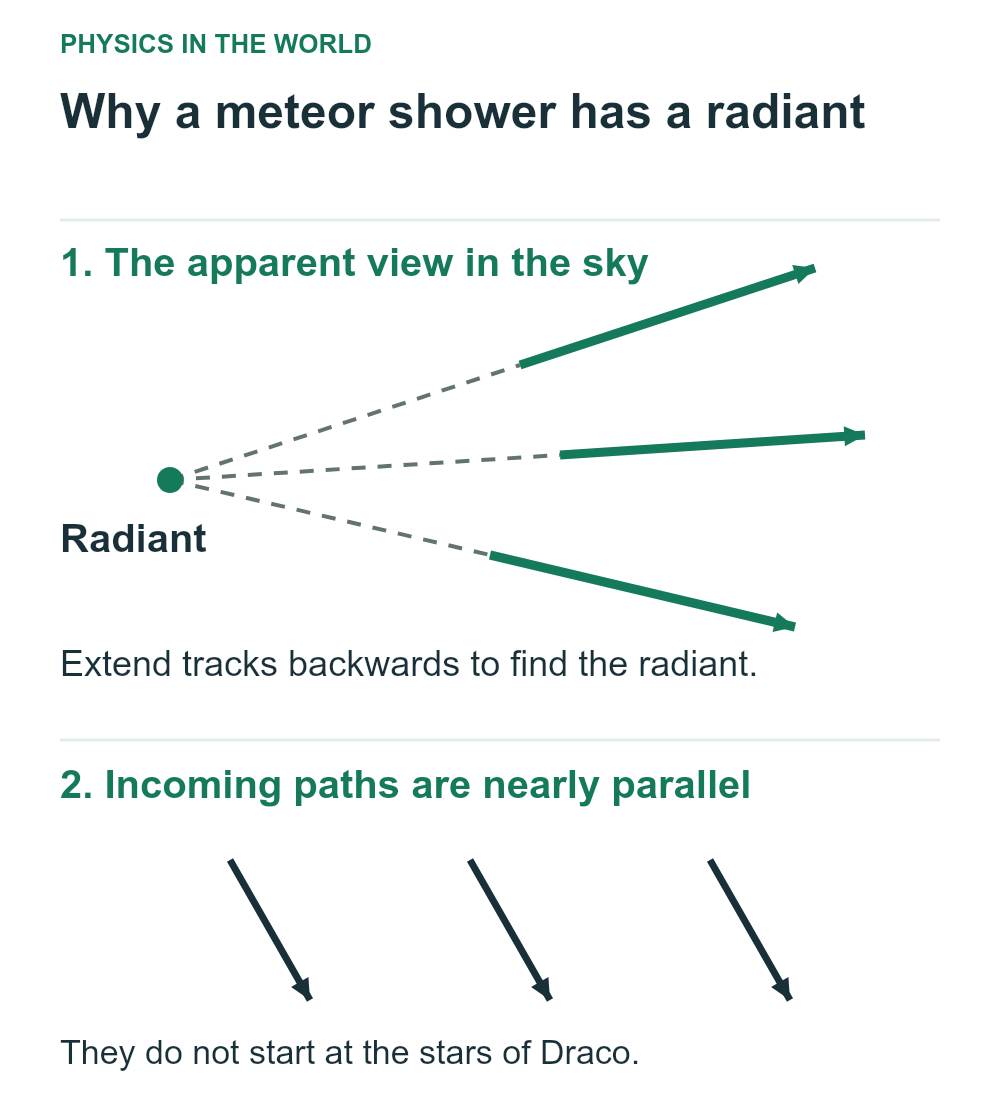
The name comes from Draco, the constellation containing the radiant. The meteors do not start at the stars of Draco. Imagine standing on a straight road: parallel road edges seem to meet in the distance. Meteor paths can create a similar perspective effect when you extend their tracks backwards.
That distinction matters when you watch. You do not have to stare directly at the radiant. A meteor can cross another part of the sky, and a wide view gives you a better chance of noticing it.
Where should you look, and what might you see?
Choose a spot away from direct streetlights, with as much open sky as possible. Let your eyes adjust to the dark and avoid repeatedly checking a bright phone. Looking through binoculars or a telescope narrows your view, which is the opposite of what you want for brief, unpredictable streaks.
The thin waning crescent Moon rises before dawn near the peak, according to the Observatory. That makes moonlight less of an obstacle for evening observers this year. It cannot remove cloud or local light pollution, though, and an unobstructed sky is still essential.
If you want to photograph the shower, support the camera, focus carefully on a distant object or stars, and try repeated exposures rather than expecting to press the shutter after a meteor appears. A wide lens covers more sky. Check a test image for focus and overexposed lights before leaving the camera running.
A single long streak in a photograph is not automatically a Draconid. Aircraft, satellites and unrelated meteors can also leave tracks. Direction, duration and a sequence of images help distinguish them. Photographing one meteor is a bonus; do not judge the whole evening by whether the camera catches it.
From a grain of dust to GCSE physics
Our page on energy stores and changes gives the vocabulary for describing entry into the atmosphere. Energy leaves the kinetic store and increases internal energy elsewhere, with some transferred away by radiation. Saying that all the energy disappears when the grain burns up misses those destinations.
In energy calculations and power, kinetic energy depends on mass and on speed squared. A small mass can carry substantial energy if its speed is high. Brightness alone does not give the mass: speed, composition, how energy is emitted and distance also affect what you see.
The annual shower connects to solar system and orbital motion. Earth repeatedly crosses a particular region of space on its orbit. The display need not be equally strong every year because a debris stream is not a perfectly uniform ring of identical grains.
An astrophysicist might use observations from more than one site to reconstruct a meteor path. A note of time, direction and observing conditions is much more useful than saying only that there were lots of shooting stars.
A Level stretch: what can an observation actually tell us?
Suppose you count three meteors in half an hour. Reporting six per hour is a reasonable conversion of your observed rate, but it is not proof that everyone would see six over a complete hour. Small counts fluctuate, even before you consider changing conditions.
Keep the observing time, patch of sky and method comparable before comparing two counts. Record cloud cover and interruptions. A change in your count could reflect visibility rather than a change in the stream itself.
This is a useful setting for uncertainties in measurements. Repeating an observation can improve an estimate, but it cannot make an obstructed view representative of the whole sky. The important question is not just how precisely you counted, but what your count measures.
Key words
Quick pupil questions
When is the Draconid meteor shower in the UK in 2026?
The Royal Observatory lists 6-10 October as the active period and 9 October as the peak. The Natural History Museum also lists 9 October.
What time should I watch the Draconids?
Watch in the evening after nightfall. This shower favours evening viewing rather than the pre-dawn hours. Cloud and your local horizon still matter.
Where should I look for the Draconid meteor shower?
Use a wide, dark view of the sky. The radiant is in Draco, but meteors can appear away from it. You do not need a telescope or binoculars.
Will there be a Draconid meteor storm in 2026?
The sources checked here give modest typical rates, around ten per hour or fewer. Historical outbursts are not a forecast of a meteor storm in 2026.