

What has Chandra discovered?
A team using NASA's Chandra X-ray Observatory has identified 84 sources with unusually soft X-ray emission in six galaxies. The study, led by Mustafa Muhibullah, was announced on 9 September 2026 with publication in Nature Astronomy.
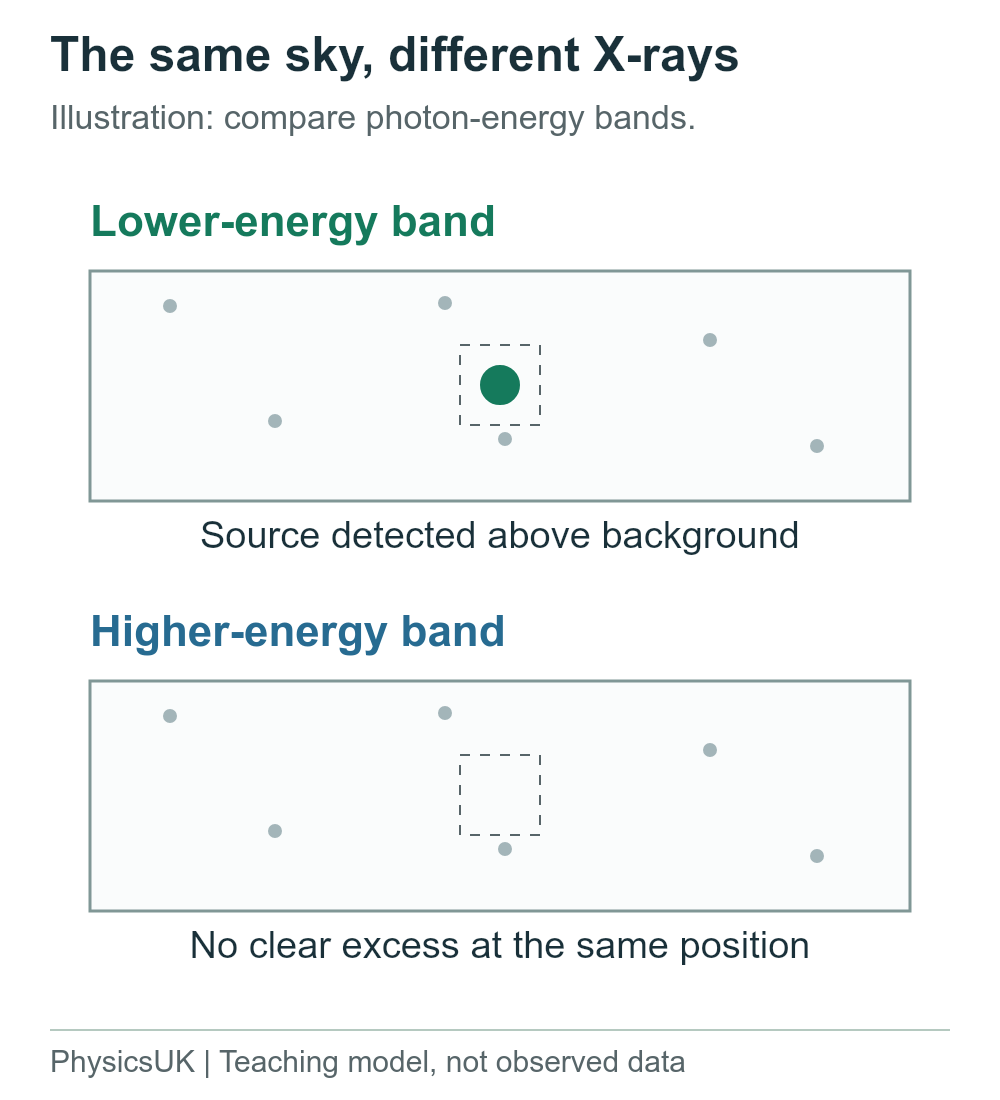
The objects appear in images made from the lowest-energy X-rays accessible to Chandra, but show little or no signal at higher X-ray energies. The researchers found them by searching archived observations rather than waiting for a new telescope launch.
Hypersoft X-ray sources is a name for this unusual observed behaviour. It is not yet a single confirmed identity, like saying that every source is the same type of star.
What does hypersoft X-ray mean?
Visible light is only a small part of the electromagnetic spectrum. Move beyond violet and you reach ultraviolet, then X-rays. Within the X-ray band, astronomers call the lower-energy photons soft and the higher-energy ones hard.
Imagine taking two photographs of the same place using different colour filters. A red object may stand out through one filter and nearly disappear through another. Chandra's comparison uses photon-energy bands instead of visible colours, but the idea of selecting part of the light is similar.
The sources are especially strong at the low-energy end of the X-ray range. Their spectra suggest that much of their output may be in extreme ultraviolet, just below soft X-rays in photon energy. That part is difficult to check directly because hydrogen and helium between the source and us absorb it.
The team thinks many of the sources may involve a compact object receiving material from a companion star. The compact object could be a white dwarf, neutron star or black hole. Material falling into a deep gravitational field can release substantial energy before reaching the surface or the black hole.
That is a possible mechanism, not a final identification for all 84 sources. Observed brightness, changes over time and matching observations at other wavelengths help distinguish the possibilities.
Worked equations
The energy of one photon
E is photon energy, h is Planck's constant, f is frequency, c is the speed of light in a vacuum and lambda is wavelength. Higher frequency means more energy per photon; longer wavelength means less. No numerical calculation is needed to compare soft and hard X-rays.
Two questions these sources could help answer
One question concerns Type Ia supernovae, the stellar explosions used in measurements of cosmic expansion. Some proposed routes involve a white dwarf gaining matter from a companion. Identifying systems before an explosion would help test how that route works.
Some of the weaker hypersoft sources are associated with novae, according to the first author's account. Other sources may involve sustained nuclear burning on a white dwarf. These are clues to investigate, not a forecast that every object will become a supernova.
The second question concerns ionised gas between stars. High-energy photons can remove electrons from atoms, changing the gas's state and how it absorbs and emits radiation. A population bright in extreme ultraviolet could contribute photons missing from existing explanations.
There is also a lesson in how science happens. Old observations can answer new questions when somebody develops a better way to search them. An astrophysicist may spend as much time testing code and comparing models as looking through a telescope.
A photonics engineer works on controlling or detecting light. Choosing which wavelengths an instrument can measure influences which discoveries it can make. The Roman coronagraph article explores a different version of that problem: separating a faint planet from a bright star.
Photons, absorption and the school physics connection
At GCSE, frequency and wavelength let you compare different parts of the spectrum. All electromagnetic waves have the same speed in a vacuum. A lower-energy X-ray photon travels no more slowly through a vacuum than a higher-energy one.
At AS and A Level, the photon model revision notes explain the extra step: frequency determines the energy of an individual photon. Intensity involves how much energy arrives per second per unit area, so it also depends on the number of photons arriving.
Ionisation requires enough energy to remove an electron from an atom. That differs from excitation, where an electron moves to a higher bound energy level. A gas can absorb radiation that produces either process, depending on the photon energy and the available transitions.
Absorption changes the message we receive. A source might emit plenty of radiation in a band that looks weak from Earth because material along the line of sight removes it. A faint detected signal need not mean a faint source.
Earth's atmosphere is another filter. It absorbs astronomical X-rays, so an X-ray observatory needs to operate above it. Looking at the same object in visible light and X-rays can therefore require very different instruments.
Science ideas to understand
Evidence and explanation
The unusual distribution of detected X-ray energies is evidence. The proposed compact-object systems are explanations to test against it.
The illustration is not an observation
Our diagram isolates the comparison between energy bands. The linked research sources contain the actual telescope images and analysis.
A Level stretch: low photon energy does not mean low power
The energy of one photon and the total power of a source are different quantities. A source sending many lower-energy photons each second can emit more power than one sending a few higher-energy photons. Soft is a spectral description, not a statement that the source is weak.
For a thermal emitter, a lower characteristic temperature shifts the spectrum towards longer wavelengths. A larger emitting area can still give a large total luminosity. The first author discusses an expanded white-dwarf photosphere as one possible way to combine a soft spectrum with high luminosity.
The detector has its own wavelength-dependent response. Researchers must account for how efficiently photons in each band are recorded, as well as intervening absorption, before inferring what the source emitted.
Finally, no detected signal in a band gives an upper limit shaped by exposure, sensitivity and background. It does not establish that the object emitted exactly zero photons at those energies. That distinction matters whenever we interpret a blank-looking image.
Key words
Quick pupil questions
What are hypersoft X-ray sources?
They are sources with emission concentrated at very low X-ray energies. The newly reported group may include different compact-object systems; their physical identities are still being investigated.
Has NASA discovered 84 new black holes?
No. Researchers have identified 84 unusual X-ray sources. Black holes are among the possible explanations, alongside systems containing white dwarfs or neutron stars.
Why can Chandra see X-rays but not all the ultraviolet light?
Intervening gas strongly absorbs much of the extreme-ultraviolet radiation. A detectable soft X-ray signal can still provide an indirect clue to the hidden emission.
Do soft X-rays travel more slowly than hard X-rays?
No. Both travel at the speed of light in a vacuum. Their frequencies, wavelengths and photon energies differ.