
What has Roman actually done?
NASA's Nancy Grace Roman Space Telescope has switched on its Coronagraph Instrument. The agency reported that the power-on sequence took place on 1 September, following the telescope's 30 August launch.
That is an important checkpoint, but it is not first science. Engineers still need months to calibrate and test the instrument. There are no newly released planet images associated with this power-on announcement.
Our Roman launch guide covers the wider mission. Here the interesting question is narrower: how do you photograph a planet when the neighbouring star overwhelms the camera?
How does a coronagraph reveal a planet?
A star produces its own light. A cool planet is much fainter in visible light because we mostly see the starlight it reflects. From far away the two objects can also appear very close together.
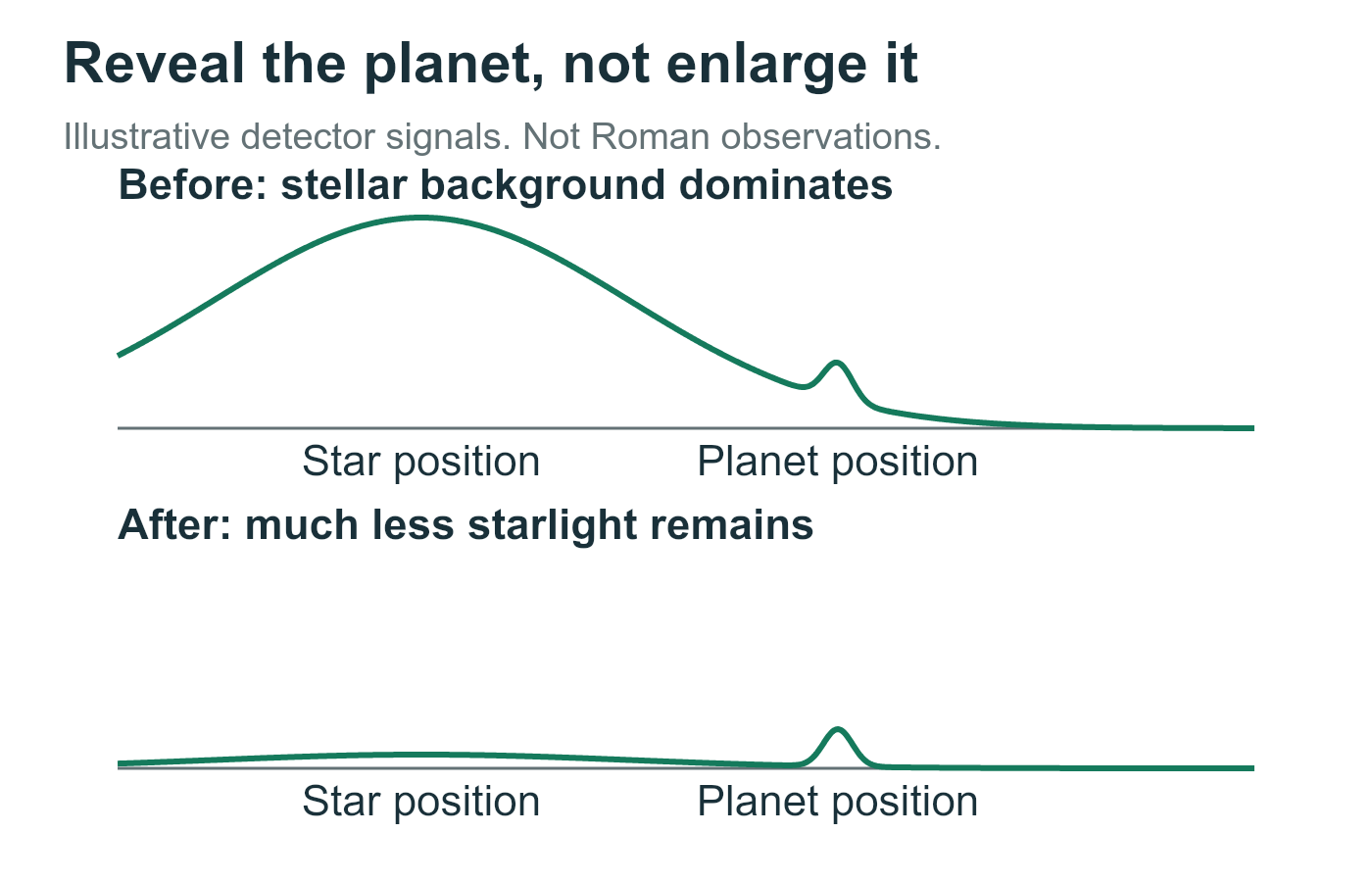
Imagine trying to spot a small reflective marker beside a bright lamp. Zooming in may make both larger, but the glare can still hide the marker. A coronagraph reduces light from the star so some of the planet's light can be distinguished.
An opaque mask alone is not enough. Light behaves as a wave: it diffracts around edges, and a telescope forms a spread-out pattern rather than a perfect point image of a star. Tiny imperfections in the optics scatter more unwanted light into places where a planet might appear.
Roman combines carefully designed masks with sensors and two deformable mirrors. Actuators make tiny changes to the mirror surfaces. Those changes adjust how the light waves overlap, reducing residual starlight in a chosen region of the detector.
The planet lies at a slightly different angle from the star, so its light travels through the optical system differently. Some can reach that darkened region. This is selective suppression, not a pair of sunglasses that dims everything equally.
Why this matters for finding other worlds
Most exoplanets are found indirectly. A transit produces a dip as a planet crosses its star; microlensing reveals the gravitational effect of a foreground system on light from a background star. Neither method is the same as separating out an image of the planet itself.
Direct imaging gives astronomers access to light from the planet. Measurements at different wavelengths can then help test ideas about its atmosphere. They still need models: a colour or a spectral feature is not, on its own, proof of life.
Roman's coronagraph is a technology demonstration aimed at difficult high-contrast observations, including mature giant planets seen in reflected light. Demonstrating the method in space helps prepare future instruments designed to study smaller, Earth-like worlds. It does not make Roman an Earth-twin camera overnight.
This work needs both the astrophysicist asking what the light means and the aerospace engineer helping hardware survive launch and operate reliably. Optical design, electronics, software and careful testing all contribute to whether a faint signal can be trusted.
From GCSE light to A-level interference
At GCSE, start with the distinction between an object emitting light and reflecting it. The Moon is a familiar example of a body that shines mainly by reflected sunlight in the visible part of the spectrum.
GCSE reflection and diffraction introduces why a simple ray sketch has limits. Rays are helpful for following the optical path, but wave behaviour matters when you want to predict the pattern of light at a detector.
At AS and A Level, phase difference and superposition explain how waves reinforce or cancel locally. The interference and coherence revision notes develop these ideas through Young's double-slit experiment. Roman is not a double-slit experiment, but the same wave principles underlie its much more elaborate control system.
The Astrophysics Observatory lets you explore aperture, wavelength and telescope resolution. That is a useful comparison here: resolution is the ability to distinguish close objects, while contrast describes their relative brightness. Improving one does not automatically solve the other.
Science ideas to understand
Bigger is not the same as clearer
Magnification enlarges an image. Resolution separates close features. Starlight suppression improves contrast. These are three different jobs.
Two instruments, different roles
Roman's Wide Field Instrument surveys large areas of sky. The coronagraph concentrates on high-contrast observations over a much smaller field.
A Level stretch: cancelling light without destroying energy
For ideal monochromatic waves, equal amplitudes and a half-cycle phase difference give complete destructive interference at a point. A changing mirror shape changes optical path lengths and therefore phase. Real coronagraph control must deal with many points across an image, finite wavelength bands and imperfect hardware.
The relevant interference is between components of the stellar light that have travelled through the instrument. The device does not rely on making the independently arriving planet light cancel the star.
Destructive interference does not destroy energy. It changes where energy is detected: an interference pattern has darker and brighter regions, while masks and stops also reject light. The goal is a useful dark region, not darkness everywhere.
A tiny bright patch is not automatically a planet. Optical errors can produce speckles, so observations and calibration must establish whether the patch behaves like a real astronomical source. That is why switching on is the beginning of a measurement programme, not its conclusion.
Key words
Quick pupil questions
Has Roman taken its first pictures of planets?
The 1 September 2026 announcement confirms that the coronagraph powered on, not that it has released science images of planets. NASA says months of calibration and testing follow.
How does Roman's coronagraph work?
Masks, sensors and deformable mirrors reduce light from a bright star in selected parts of the image so some fainter light from nearby planets can be detected.
Will Roman photograph another Earth?
Its coronagraph is a technology demonstration, including observations of giant planets. It tests methods that could support future missions studying Earth-like worlds; this milestone is not an image of another Earth.
Does the coronagraph destroy starlight?
No. Masks reject some light and interference redistributes it. Destructive interference reduces intensity in selected regions without violating conservation of energy.