

When is the Roman Space Telescope launch?
NASA and SpaceX are targeting no earlier than 12:26pm BST on Sunday 30 August 2026 for the launch of the Nancy Grace Roman Space Telescope. A Falcon Heavy rocket will lift off from Launch Complex 39A at Kennedy Space Center in Florida. NASA's live coverage is scheduled to begin at 11:20am BST.
No-earlier-than matters. A launch time is a target, not a promise. Weather, the rocket, the spacecraft and the launch range all have to be ready, so the countdown can pause or move to another opportunity. Check NASA's launch page on Sunday before planning around the stated time.
After separation from the rocket, Roman will travel towards the second Sun-Earth Lagrange region, L2, about 1.5 million kilometres from Earth in the direction away from the Sun. Its primary mission is planned to last five years, with a goal of reaching ten years.
The launch is the start of the engineering story, not the start of normal science observations. Controllers must establish communications, check the spacecraft, complete the journey to L2, cool and calibrate the instruments, and show that the telescope can point and focus accurately before large surveys begin.
Roman Space Telescope launch schedule in UK time
These British Summer Time conversions come from NASA's published mission schedule. All events remain subject to real-time operational changes.
| Event | Date | UK time |
|---|---|---|
| Mission science briefing | Saturday 29 August | 2:00pm BST |
| Prelaunch news conference | Saturday 29 August | 3:30pm BST |
| NASA launch coverage begins | Sunday 30 August | 11:20am BST |
| Target liftoff | Sunday 30 August | 12:26pm BST |
| Postlaunch news conference | Sunday 30 August | 2:30pm BST |
The launch is targeted for no earlier than 12:26pm BST. Use NASA Live for the current countdown and any delay announcement.
What is the Roman Space Telescope?
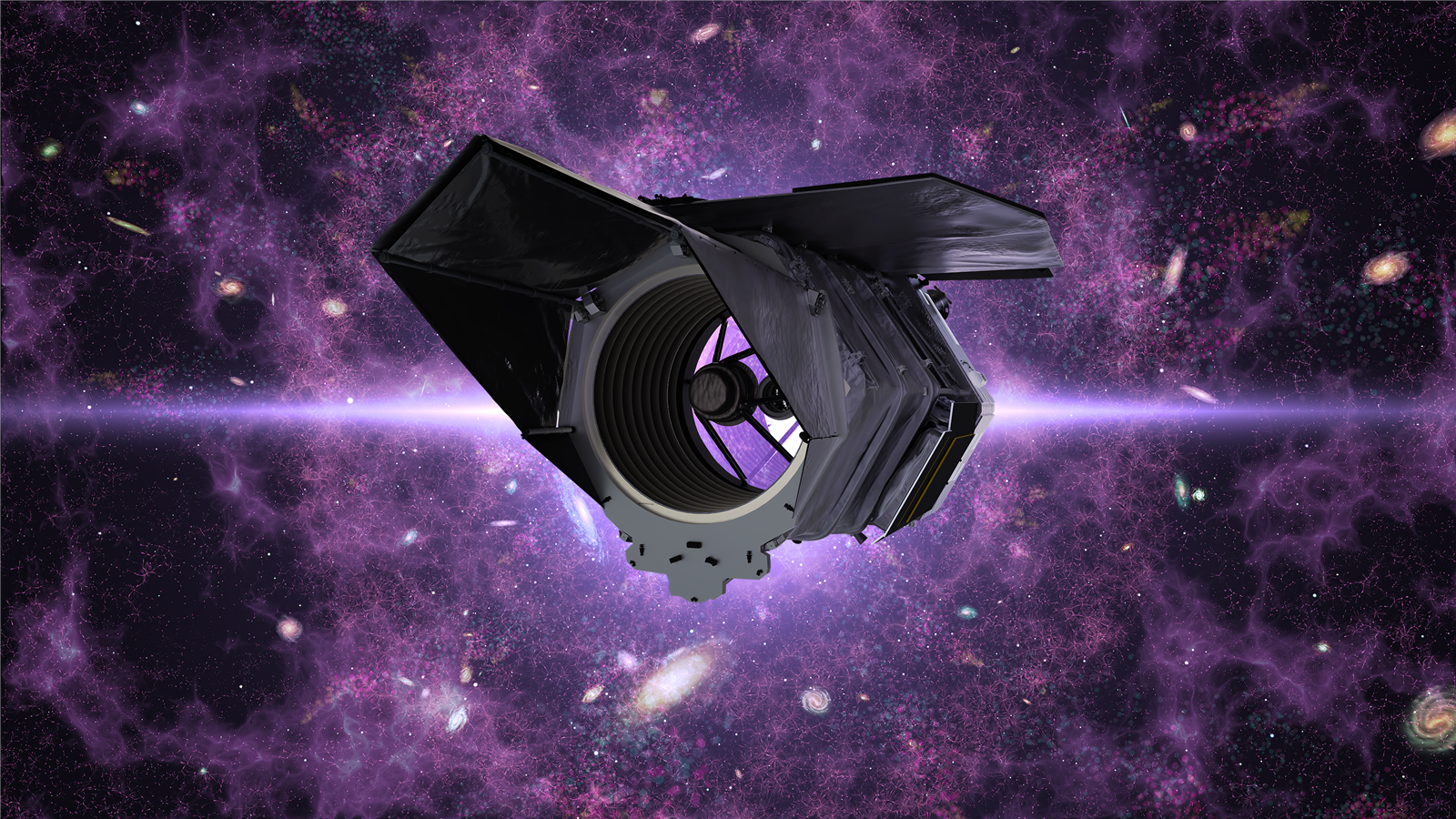
Roman is a survey telescope. Hubble and Webb are often used to study a smaller target in great detail; Roman is designed to collect sharp information across a much wider patch of sky in each observation. It can therefore find patterns, rare objects and short-lived changes that a narrow view could miss.
Its primary mirror is 2.4 metres across, the same diameter as Hubble's. The big difference is behind the mirror. Roman's Wide Field Instrument uses 18 detectors to make an approximately 300-megapixel near-infrared camera. NASA says its field of view is at least 100 times larger than Hubble's while keeping comparable infrared sensitivity and resolution.
Infrared light has a longer wavelength than visible red light. It is useful in astronomy because cooler objects can be bright in infrared, dust can be less obstructive at some infrared wavelengths, and cosmic expansion can stretch light from distant galaxies into the infrared by the time it reaches us. Being above Earth's atmosphere removes much of the infrared absorption and glow that makes faint observations difficult from the ground.
Roman also carries a Coronagraph Instrument technology demonstration. Masks and actively controlled mirrors will suppress a star's glare so that much fainter planets and dusty discs nearby can be measured. It is not the same method as microlensing: the coronagraph tries to isolate light from a planet, while microlensing detects the way mass changes light from a different background star.
Roman is not replacing Hubble or the James Webb Space Telescope. The missions have overlapping abilities but different strengths. Roman can find large samples and unusual targets across wide surveys; Hubble and Webb can provide other wavelengths or detailed follow-up observations.
Worked equations
Why aperture and wavelength affect telescope resolution
For a diffraction-limited circular aperture, a smaller minimum angle means two close objects can be distinguished more clearly. A larger aperture improves resolution, while a longer wavelength makes the diffraction limit larger.
- For a 2.4 m aperture at an example wavelength of 1.0 micrometre: theta_min approx (1.0 x 10^-6 m) / (2.4 m) = 4.2 x 10^-7 rad
How to watch the Roman launch from the UK
NASA will stream the launch online. Open NASA Live before coverage begins and keep the official mission page available in case the countdown changes.
Start watching by 11:20am BST
NASA's scheduled coverage begins just over an hour before the target launch, giving time for mission explanations and the final countdown.
Target liftoff is 12:26pm BST
The launch window is operational, so treat 12:26pm as the current target rather than a guaranteed second.
Use the official NASA stream
The Sources checked section links directly to NASA Live and the current launch advisory.
Expect holds or a delay
A pause protects the mission when weather, range safety or a technical reading is outside its permitted limits. It is evidence that the launch process is being controlled, not that the mission has failed.
What will Roman Space Telescope discover?
Roman's wide surveys are designed to answer questions that need large samples rather than one striking picture. If astronomers want to know how common a type of planet is, how matter is distributed across the Universe or how cosmic expansion changed over time, they need consistent measurements of many objects.
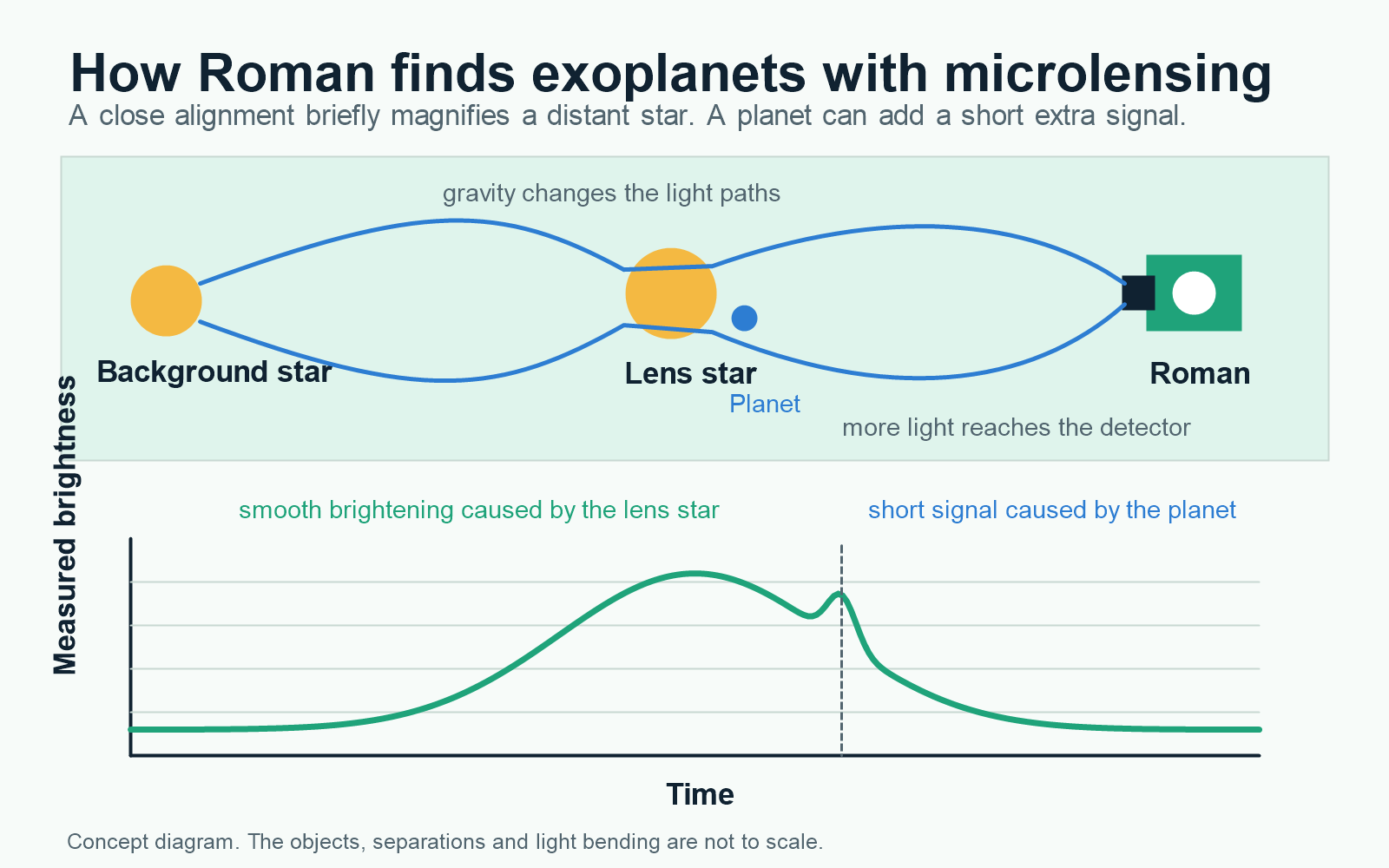
One exoplanet method will be gravitational microlensing. When a foreground star passes very close to the line of sight to a more distant star, the foreground mass bends the path of the background light. The background star briefly appears brighter. A planet around the lens star can add a smaller, shorter feature to that brightness curve.
Microlensing is useful because it responds to mass, not just the light a planet reflects or the regular dip made during a transit. That makes it sensitive to planets on wider orbits and even some objects travelling without a host star. The alignment usually does not repeat, so careful timing, uncertainty and independent checks matter.
Roman will also investigate dark matter by mapping gravitational effects and dark energy by measuring how the large-scale Universe has expanded and how structure has grown. Neither substance will appear as a coloured patch in an ordinary photograph. Physicists infer them by comparing precise observations with models of gravity, matter and cosmic expansion.
The scale of the data changes the work too. Roman's detectors convert incoming photons into electrical signals, and the mission is expected to produce a very large public archive. Instrument scientists, software engineers and data analysts will be as important as the people who choose the astronomical targets.
The school physics inside Roman
At GCSE, Roman connects directly to the electromagnetic spectrum. All electromagnetic waves travel at the same speed in a vacuum, but infrared has a longer wavelength and lower frequency than visible light. Detectors are needed because human eyes cannot see it.
At A Level, telescope resolution depends on diffraction. The approximate Rayleigh relationship links the smallest resolvable angle to wavelength and aperture diameter. Roman's 2.4-metre mirror helps it keep sharp detail, while the detector layout gives it a much wider field of view. Resolution and field of view are different properties.
Gravitational microlensing is an application of gravitational fields and general relativity. School ray diagrams usually show light travelling in straight lines through a uniform region. Near a mass, spacetime is curved and the path followed by the light is changed. Astronomers observe the resulting change in brightness rather than watching a visible ray bend.
The telescope resolution section of the PhysicsUK Astrophysics Observatory lets you change aperture and wavelength and see how the diffraction limit responds. It is a useful way to separate magnification, angular resolution and collecting power before attempting the article challenge.
The work behind the mission also shows what an astrophysicist and space scientist actually does: design observations, model physical systems, build and calibrate detectors, write analysis software and decide whether a weak signal is real.
Science ideas to understand
The launch time can change
NASA says no earlier than 12:26pm BST on Sunday. Weather or technical checks can delay liftoff, so use the live NASA countdown rather than an old social-media post.
Roman is wide, Webb is deep
That shorthand is useful but incomplete. Roman is optimised for large, sharp surveys; Webb has a larger mirror and reaches farther into the infrared for very sensitive observations. They can investigate some of the same targets in different ways.
Field of view is not magnification
A wide field records more sky at once. It does not automatically make an individual galaxy appear larger, and it should not be confused with angular resolution.
Microlensing does not mean extra light is created
Gravity redirects light from the background source. More of that existing light reaches the observer during a close alignment, so the unresolved source appears brighter.
The first images will not arrive at liftoff
The spacecraft must travel, cool, commission and calibrate before normal science surveys begin. Launch success is the first milestone in a longer process.
A Level stretch: what the headline leaves out
L2 is often described as a place where gravity balances, but Roman will not sit motionless at one mathematical point. In the rotating Sun-Earth frame, the combined gravitational effects and the spacecraft's motion allow it to stay near the Earth-Sun line while following a large orbit around the L2 region. Small station-keeping manoeuvres are still needed.
A field of view 100 times larger does not mean the mirror is 100 times wider or that every object looks 100 times bigger. Field of view describes the area of sky recorded in one pointing. Angular resolution describes the smallest separation the telescope can distinguish. Roman's instrument design gives it a wide view without throwing away the sharpness expected from its aperture.
Microlensing surveys need repeated measurements because the useful information lies in how brightness changes with time. The duration and shape of the main event constrain the lens system, while a short planetary deviation can constrain the planet-to-star mass ratio and projected separation. Crowded star fields, detector systematics and incomplete sampling all have to be modelled.
A coronagraph has a different measurement problem. Blocking the centre of a star's image is not enough because diffraction and tiny optical errors spread starlight across the detector. Roman uses masks, sensors and deformable mirrors to control the wavefront and reduce that unwanted light.
Dark energy is a name for the unknown cause represented in models of accelerating cosmic expansion; it is not an ordinary fuel spread through space. Roman will test the history of expansion and the growth of structure using several kinds of survey evidence, which is stronger than depending on one measurement method.
Key words
Quick pupil questions
What time is the Roman Space Telescope launch in the UK?
NASA and SpaceX are targeting no earlier than 12:26pm BST on Sunday 30 August 2026. NASA launch coverage is scheduled to begin at 11:20am BST, and the time remains subject to change.
How can I watch the Roman Space Telescope launch live?
NASA will stream coverage through NASA Live. Use the official mission page on launch day for the current countdown, because weather or technical checks can move the target time.
What will the Roman Space Telescope do?
Roman will carry out wide-field infrared surveys to study exoplanets, dark matter, dark energy, galaxies, stars and changing objects. It will also test coronagraph technology for directly imaging some exoplanets and dusty discs.
Is Roman better than Hubble or the James Webb Space Telescope?
It is designed for a different job. Roman combines a Hubble-sized mirror with a much wider field of view, while Webb has a larger mirror and reaches farther into the infrared. The missions can discover and follow up different kinds of targets together.
How will Roman find exoplanets?
Roman will use gravitational microlensing, transits and a coronagraph technology demonstration. Microlensing detects temporary brightening caused when a foreground star and planet bend light from a more distant star.
Why does Roman observe infrared light?
Infrared observations reveal cooler objects, can see through some dust and capture light that cosmic expansion has stretched to longer wavelengths. A space telescope also avoids much of the infrared absorption and glow from Earth's atmosphere.
Where will the Roman Space Telescope orbit?
Roman will operate near the second Sun-Earth Lagrange region, L2, about 1.5 million kilometres from Earth away from the Sun. It will follow an orbit around the L2 region rather than remaining motionless at one point.
Who was Nancy Grace Roman?
Nancy Grace Roman was NASA's first chief of astronomy and played a major role in establishing space-based astronomy, including the early planning that led to the Hubble Space Telescope.