

When will BepiColombo arrive at Mercury?
BepiColombo is preparing to enter orbit around Mercury on 21 November 2026. On 3 September, ESA confirmed that the Mercury Transfer Module had separated, completing its job of carrying and propelling the science spacecraft through the long cruise.
ESA's Mercury Planetary Orbiter, or MPO, and JAXA's Mercury Magnetospheric Orbiter, called Mio, remain together for now. Their separation is planned for 9-10 December, with the science phase scheduled to start in April 2027.
These dates describe different milestones. Transfer-module separation is not orbit entry, and orbit entry is not the start of the full science programme. This guide uses the mission plan checked on 13 September 2026.
BepiColombo arrival timeline
Current ESA milestones. Later dates remain planned operational events.
| Date | Milestone | Status |
|---|---|---|
| 3 September 2026 | Mercury Transfer Module separates | Confirmed |
| 21 November 2026 | Entry into Mercury orbit | Planned |
| 9-10 December 2026 | MPO and Mio separate | Planned |
| April 2027 | Science phase begins | Planned |
This is a mission timeline, not a UK skywatching timetable. ESA's arrival updates are the source for operational changes and coverage.
Why is Mercury so difficult to reach?
A spacecraft leaving Earth already shares Earth's motion around the Sun. It does not begin stationary in space. Reaching Mercury means changing that solar orbit and arriving with a suitable velocity relative to a planet that is itself moving.
Falling towards the Sun can increase a spacecraft's speed as gravitational potential energy becomes kinetic energy. So getting closer is not the whole problem: an uncontrolled approach may send the craft rapidly past Mercury instead of keeping it there.
BepiColombo has used carefully timed planetary flybys and long periods of electric propulsion to reshape its trajectory. A gravity assist can increase or decrease a spacecraft's energy relative to the Sun, depending on how it passes the moving planet.
For the cruise, solar panels supplied electricity to ion thrusters. Electric fields accelerate charged propellant out of the thruster. The reaction changes the spacecraft's motion. Each push is small, but a small force acting for a long time can produce a large change in velocity.
At the destination, the aim is a bound orbit around Mercury: a path that brings the spacecraft back around the planet. The craft must have the right position and velocity. Simply switching off an engine beside a planet does not guarantee capture.
What will the two spacecraft study?
The two orbiters have different jobs. MPO will study Mercury's surface, composition and interior. Mio will investigate the magnetic environment and its interaction with particles from the Sun. Simultaneous measurements can help connect what happens near the planet to changes around it.
Mercury is a rocky planet with a large metallic core and a global magnetic field. Understanding its interior and history helps test how rocky planets form and evolve. Scientists can compare it with Earth without assuming the two developed in the same way.
Infrared measurements offer another kind of evidence. MPO's MERTIS instrument will study thermal radiation from the surface to investigate minerals and thermal properties. Different materials interact with radiation differently, so a spectrum can reveal more than the colour in a photograph.
The engineering is just as demanding as the navigation. The spacecraft receives intense sunlight and radiation from Mercury's hot surface. Heat pipes carry energy towards a radiator designed to lose energy to space while limiting what it absorbs from the planet.
A spacecraft engineer has to make that thermal system, the power supply and the instruments work together. An astrophysicist or planetary researcher then uses the measurements to test explanations of what is happening. Reliable science begins with hardware that measures what we think it measures.
Orbits, forces and thermal physics you already know
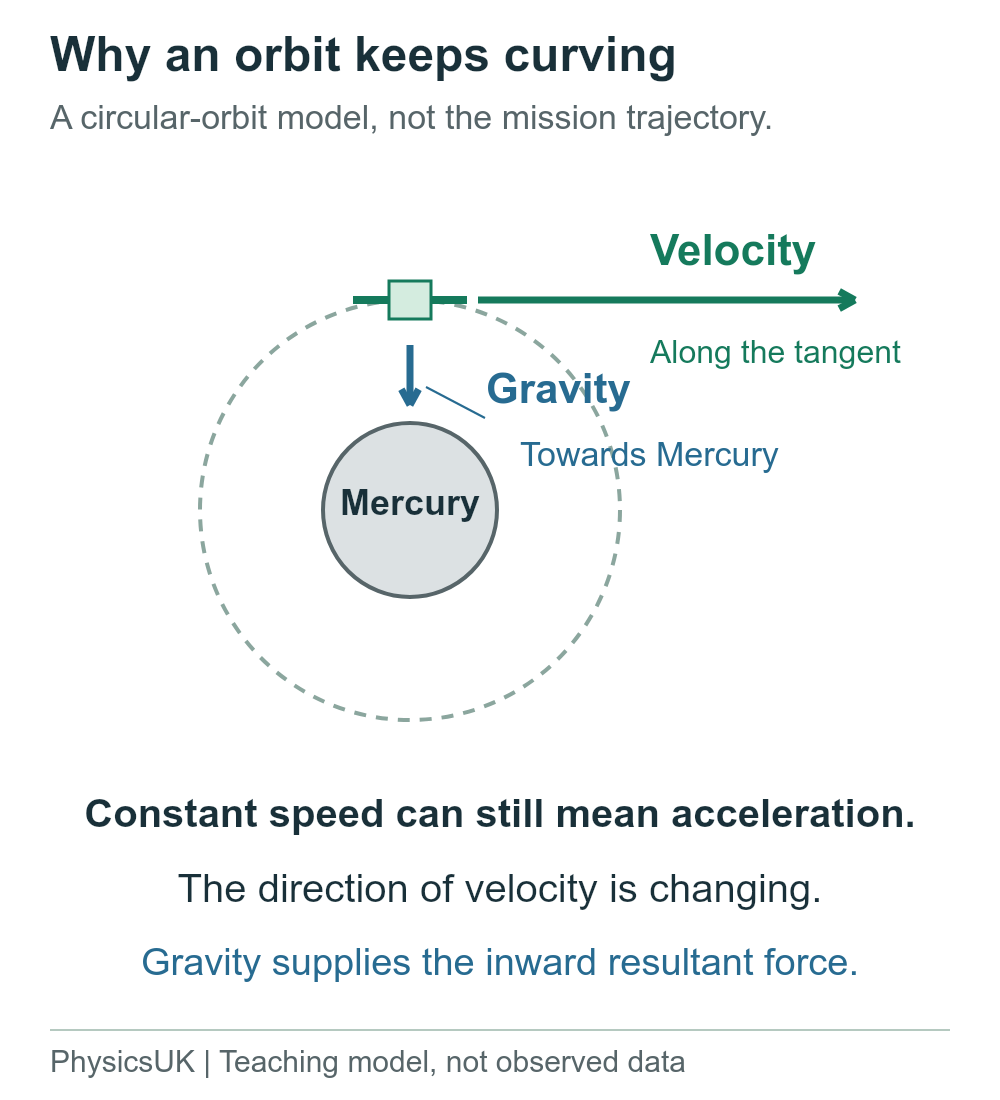
The GCSE resource on satellites and orbital motion explains why gravity is needed even when orbital speed is constant. Velocity includes direction. As the spacecraft turns, its velocity changes, so it is accelerating towards the centre of the orbit.
Our guide to Newton's laws and acceleration also explains propulsion. The spacecraft pushes on its expelled propellant, and the propellant exerts an equal and opposite force on the spacecraft. A rocket does not need air to push against.
The A-level resource on gravitational fields, orbits and potential develops the energy picture. You need to distinguish motion relative to Mercury from motion relative to the Sun. A change described as braking in one frame can be misleading if you silently switch to another.
The infrared absorption and emission practical connects directly to spacecraft cooling. A radiator loses energy by electromagnetic radiation, which can travel through a vacuum. There is no surrounding air in space to carry heat away by convection.
A bright reflective finish and a radiator do different jobs. Reflection can reduce incoming solar energy; emission removes energy already in the spacecraft. Good thermal design controls both pathways.
Science ideas to understand
Orbiting is continuous falling
Gravity turns the velocity towards the planet while the spacecraft moves sideways. A stable orbit does not require a continuous forward engine push in an ideal model.
Can I watch from the UK?
You will not see the spacecraft entering orbit in the UK sky. Check ESA for any live mission coverage and its time zone closer to arrival.
A Level stretch: losing orbital energy without simply slowing down
There is a useful apparent puzzle: planets in smaller circular orbits around the Sun move faster, yet engineers talk about removing orbital energy to reach an inner planet. Both statements can be true.
Orbital mechanical energy includes kinetic and gravitational potential energy. On moving into a lower bound orbit, the potential-energy term becomes more negative. The total can decrease even though the final circular-orbit speed is greater.
During a gravity assist, the spacecraft's direction changes in the planet's frame. Because the planet is moving around the Sun, that deflection can change the spacecraft's heliocentric speed and energy. The exchange conserves energy and momentum for the combined system; the massive planet's change is tiny.
This is why a useful diagram must say what it represents. Our circular-orbit sketch explains the direction of force and velocity. It cannot stand in for the mission's full trajectory, which involves several moving bodies, propulsion and elliptical orbits.
Key words
Quick pupil questions
When will BepiColombo arrive at Mercury?
ESA currently plans Mercury orbit entry for 21 November 2026, followed by spacecraft separation in December and the science phase in April 2027.
Why has BepiColombo taken so long to reach Mercury?
It must reshape its orbit around the Sun and arrive at a suitable speed relative to Mercury. Repeated gravity assists and long periods of low-thrust propulsion make that possible with the available spacecraft.
Will BepiColombo land on Mercury?
No. It carries two science orbiters, MPO and Mio. They will study Mercury from orbit rather than land on the surface.
What is the difference between MPO and Mio?
MPO focuses on the surface, composition and interior of Mercury. Mio focuses on its magnetic and charged-particle environment.
What time can I watch BepiColombo arrive from the UK?
The checked ESA plan gives the orbit-entry date, 21 November 2026. Consult ESA's arrival updates for a confirmed broadcast and UK time closer to the event.