
When is the Beaver supermoon in the UK?
November's full Moon falls on Tuesday 24 November 2026. It is commonly called the Beaver Moon, a seasonal name rather than a different kind of astronomical object. NASA also lists it as a supermoon.
The exact full-phase instant is in the afternoon here. That is not an instruction to go outside at that minute and expect the Moon to rise. Moonrise depends on where you are. The useful plan for most readers is to check their local horizon and look during the evening.
NASA lists full phase at 14:54 UTC, which is GMT in the UK in November. Greenwich's calendar gives 14:53. That one-minute difference between calendars makes no practical difference to the evening view.
Why does a supermoon look bigger?
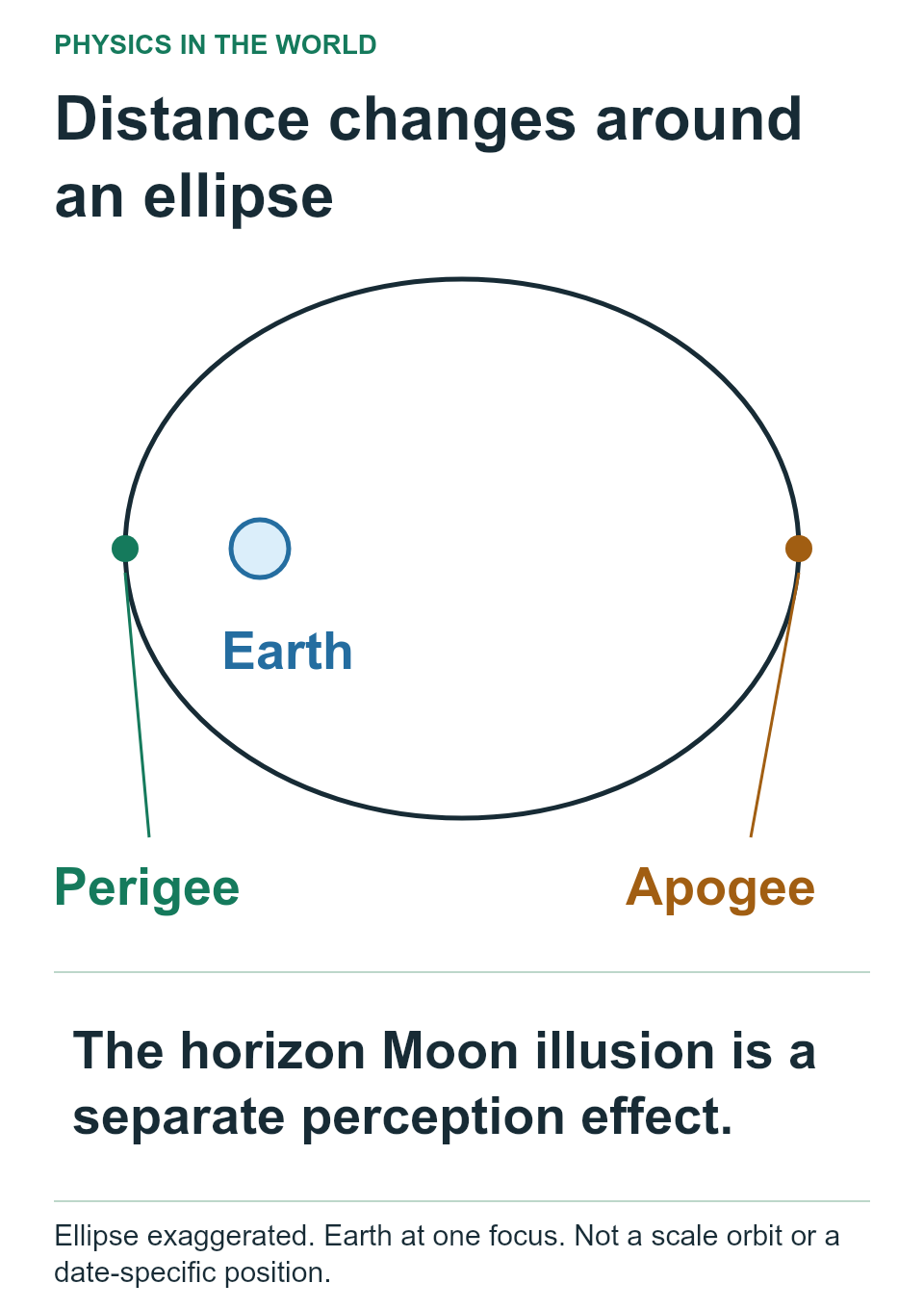
The Moon's distance from Earth changes because its orbit is an ellipse, not a perfect circle. The nearest part is called perigee; the farthest part is apogee. A full Moon near the nearer part is often called a supermoon.
Supermoon is an informal label with different cut-offs, not a new lunar phase. There is no switch that makes the Moon ordinary on one side of a precise distance and spectacular on the other. Its apparent size changes gradually.
Hold a coin at arm's length, then move it closer. It takes up more of your view even though the coin itself is unchanged. The same geometry explains the Moon's real change in apparent size. Astronomers describe this as a change in angular diameter.
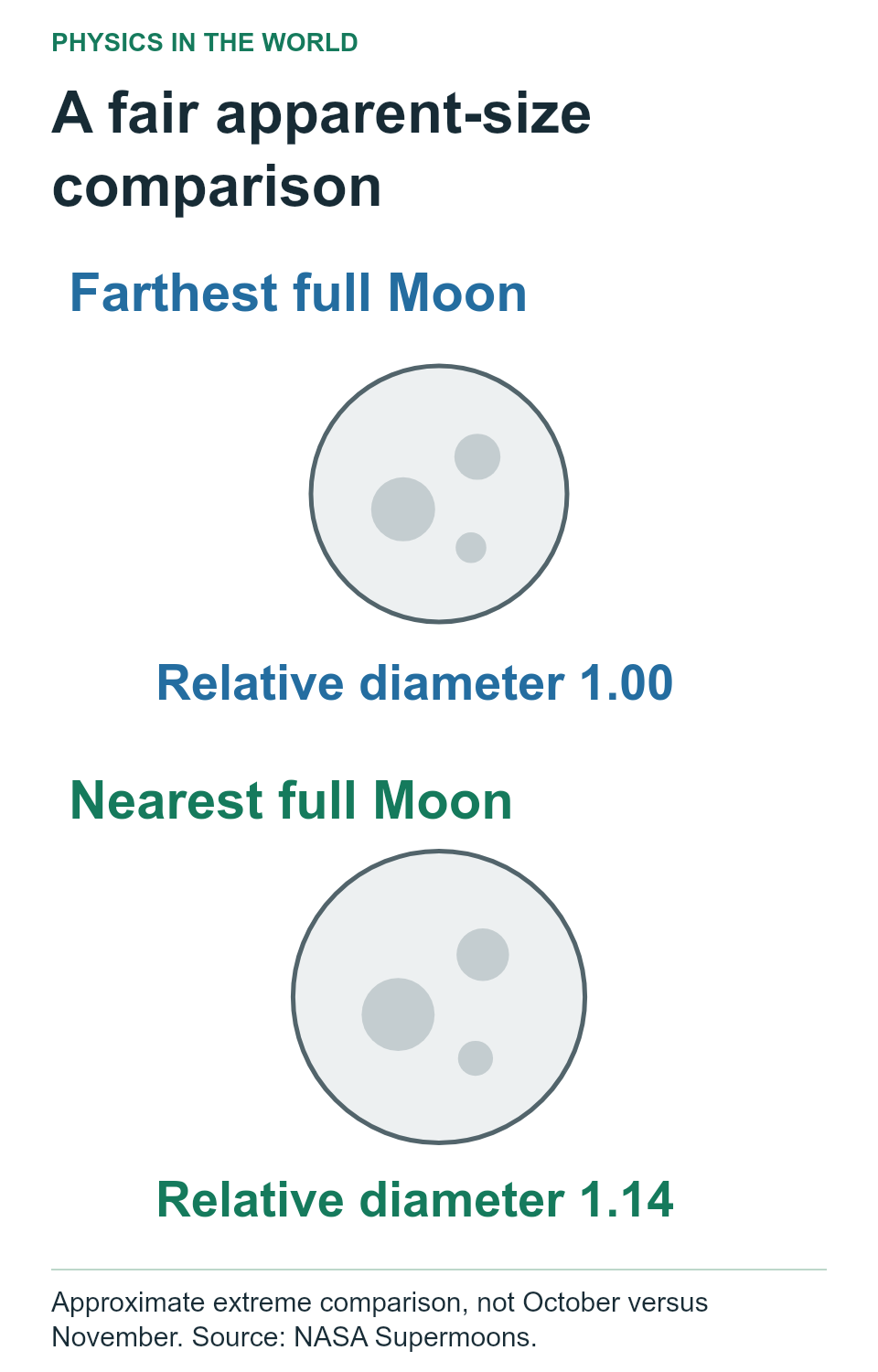
NASA's maximum comparison is about 14% larger in apparent diameter and 30% brighter than a farthest, faintest full Moon. These are comparisons between extremes. They do not say that every supermoon is 14% larger than an average full Moon, or that November's will look dramatically different from October's.
That distinction matters in photographs. Changing the lens or enlarging an image changes how big the Moon looks on a screen. A fair comparison uses the same image scale, as the paired discs below do.
A better Moon photograph, without misleading the viewer
Steady the camera and focus on the Moon rather than the foreground. If your camera lets you adjust exposure, reducing it can reveal lunar detail instead of recording a plain white patch. A longer lens changes the framing, not the real Moon.
Keep the comparison fair
Use the same focal length and image scale for a before-and-after size comparison. Say if an image is cropped, enlarged or combined from several exposures.
Plan a safe viewpoint
Check access and weather, stay away from traffic and unstable ground, and take an adult if you are a younger pupil. Do not aim binoculars or a telescope near the Sun while setting up in daylight.
Where should I look on 24 November?
Start with a clear view towards the eastern part of the horizon around local moonrise, then follow the Moon as it climbs. Buildings, hills and trees can delay your first view even after a published moonrise time. There is no single clock time that works for every UK garden.
You do not need a telescope to enjoy a full Moon. Binoculars can show more surface detail, although the shadows around the boundary between lunar day and night are more striking at other phases. A completely full disc is not always the best time for seeing crater relief.
If it looks enormous while low down, you are also noticing the Moon illusion. The Moon can seem much bigger against the horizon than high in the sky without a comparable change in its photographed angular diameter. That perception effect is not evidence that it suddenly moved much closer during the evening.
The Moon can look orange or yellow low down because its light travels through more atmosphere, with shorter wavelengths scattered more strongly out of the direct beam. Beaver Moon does not mean a red Moon or a lunar eclipse. Haze and cloud can change the view too.
For a different sight earlier in the month, our Leonid meteor shower guide explains when to watch for meteors. The best observing conditions are not identical: bright moonlight is attractive for a Moon photograph but makes faint meteors harder to spot.
The school physics: orbits, light and apparent size
The Moon is a natural satellite. Gravity continually changes its motion and keeps it in orbit around Earth. The solar system, satellites and orbital motion notes explain why moving sideways and falling under gravity can produce an orbit rather than a straight drop.
For an ideal circular orbit, the speed can stay constant while the velocity changes. Velocity includes direction. The inward gravitational force changes that direction and produces acceleration. Saying an orbiting object has no acceleration because its speed is steady misses half the definition.
Moonlight is reflected sunlight, not light made by the Moon itself. At full Moon, we see almost all of its sunlit hemisphere. A lunar eclipse needs a closer alignment in which Earth's shadow falls across the Moon; most full Moons miss the shadow because the lunar orbit is tilted.
The reflection and refraction revision page separates two useful ideas here: reflection at the lunar surface and changes to light travelling through Earth's atmosphere. Do not use Earth's shadow to explain normal lunar phases.
An astrophysicist or space scientist needs to distinguish a real measurement from an impression. An image with a fixed scale, a stated observing time and a clear comparison is much more useful than simply saying the Moon looked huge.
A Level stretch: why the Moon is not in a perfect circle
The circular-orbit model is useful, but it is not the whole story. In an elliptical orbit, the Earth-Moon separation and orbital speed both vary. Nearer Earth, the Moon moves faster; farther away, it moves more slowly. Do not transfer the constant-speed result for a circle to the whole ellipse.
The gravitational fields and orbits resource develops force, potential and orbital energy. A nearer Moon experiences a stronger gravitational attraction, but the motion also depends on its existing velocity. Stronger gravity alone is not a complete explanation of an orbit.
For a small apparent angle, angular diameter is approximately physical diameter divided by distance. Keep the physical diameter fixed and reducing the distance increases the angle. This is geometry, not evidence that the Moon's material expands.
A fair size comparison also distinguishes diameter from area. Making a circular disc 14% wider increases its displayed area by about 30%. The two percentages describe different quantities, so they should not be swapped in a caption.
Key words
Quick pupil questions
When is the Beaver supermoon in the UK in 2026?
It falls on 24 November. Full phase is around 14:54 GMT in NASA's calendar, but practical viewing is after local moonrise that evening, subject to the weather and your horizon.
Is a supermoon really 14% bigger?
The quoted maximum is a comparison of apparent diameter between a nearest and a farthest full Moon. The Moon does not physically grow, and the difference from a typical or previous full Moon is smaller.
Why does the Moon look huge near the horizon?
Much of that impression is the Moon illusion, a perception effect. It is separate from the genuine change in angular size caused by the Moon's changing distance through its orbit.
Do I need eclipse glasses to look at the Beaver Moon?
No. Ordinary viewing of the Moon is different from looking at the Sun. Never point binoculars or a telescope at or near the Sun when setting up.