

When is the Leonid meteor shower in the UK?
The Leonids are an annual meteor shower associated with comet 55P/Tempel-Tuttle. In 2026, the main UK viewing night is 17 November into the early hours of 18 November. The shower remains active on surrounding nights, but its rate changes.
The International Meteor Organization gives a nominal peak of 23:45 UT on 17 November. UK clocks are on GMT then, so the clock reading is also 23:45 here. That does not mean the sky switches on at that minute. A prediction of maximum activity and the best conditions for your view are different things.
The Royal Observatory recommends the overnight period, with darker skies after the Moon sets. After midnight, the radiant rises higher and more of the incoming activity is accessible above the horizon. Clouds and nearby lighting can still spoil the view; no calendar can promise a clear night.
What is a shooting star, and where does it come from?
A meteoroid is a piece of material moving through space. When it enters our atmosphere at high speed, the luminous event is called a meteor. If some material survives to reach the ground, that material is a meteorite. The bright streak is not a star dropping out of its constellation.
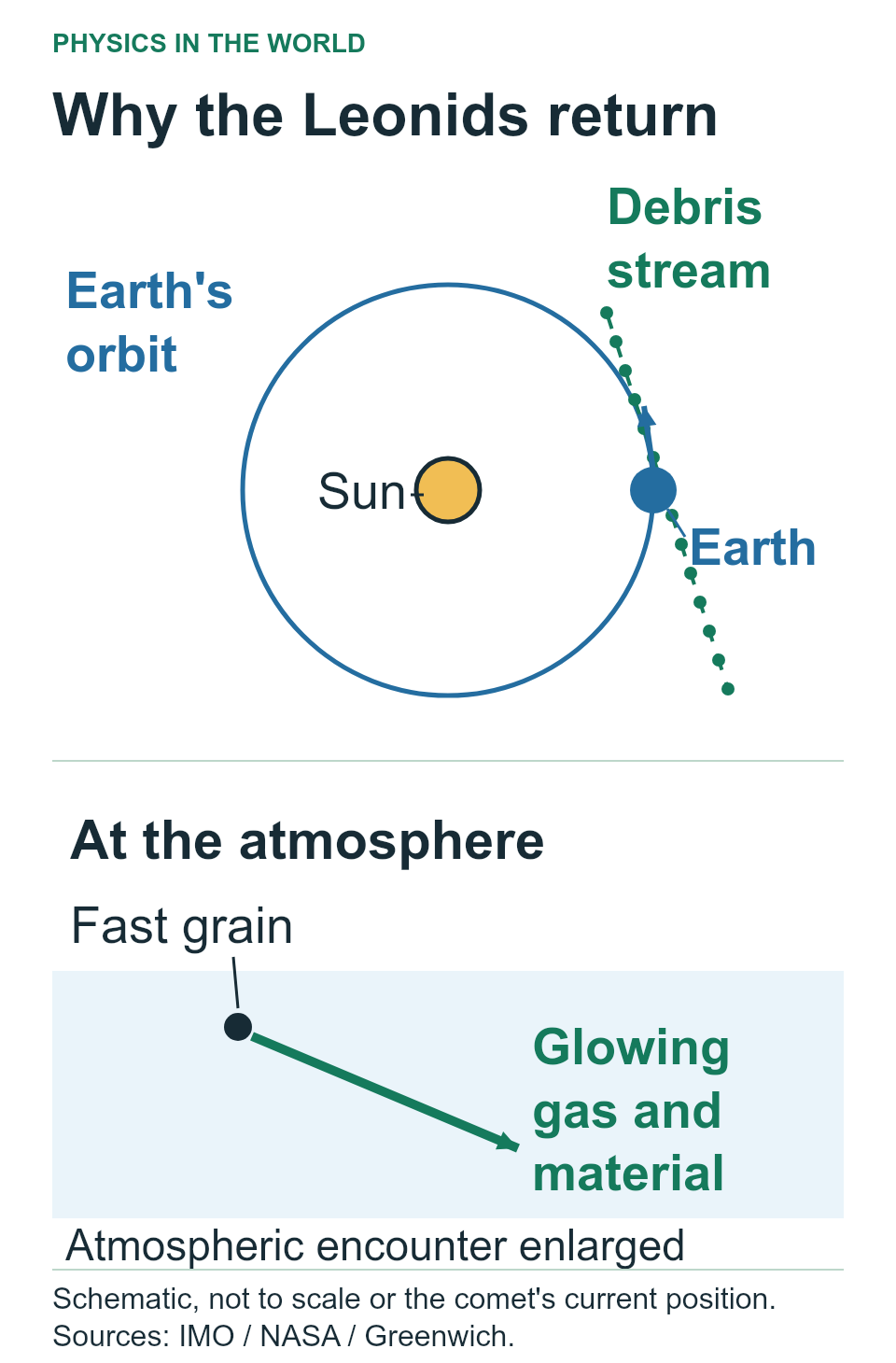
Comets shed material as they travel around the Sun. Over time, that debris spreads along a stream. Earth encounters the Leonid stream around the same part of its yearly orbit, which is why the shower returns at a similar time each November.
The parent comet does not have to be passing close to Earth now. We are encountering material left along its path, not necessarily watching dust being released beside us that evening. The solar system and orbital motion resource helps separate an orbit from the current position of the object following it.
Leonid meteoroids enter the atmosphere at around seventy kilometres per second. Even a small grain can carry considerable kinetic energy at that speed. Most visible meteors are atmospheric events far above the observer, not rocks landing nearby.
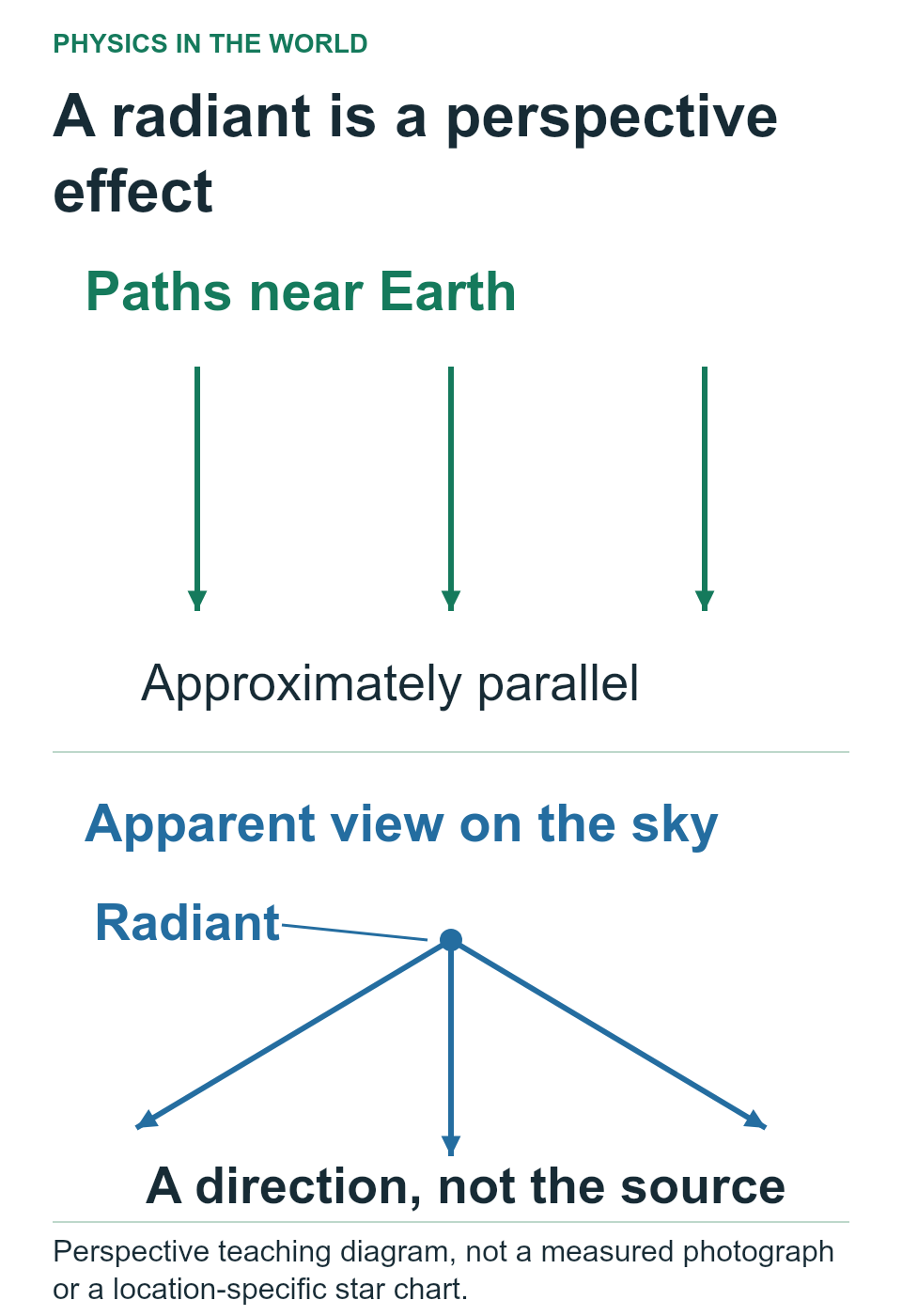
Leo gives the shower its name because the paths appear to lead back towards a point in that constellation. The stars of Leo are not throwing material towards us. The constellation identifies a direction on our sky.
Can I photograph the Leonids?
You can try, but watching is often more rewarding than checking whether a camera captured anything. A tripod or stable support helps, and a wide view gives a better chance than tightly framing one star. Do not expect a phone to record every meteor your eyes detect.
Keep the camera still
Use a timer or remote shutter if available. If you use manual focus, check that stars are sharp rather than assuming an autofocus setting will work in darkness.
Know what a trail shows
A meteor makes a brief trail. Long star trails record Earth's rotation during an exposure and are a different effect. Aircraft and satellites can also leave tracks in images.
Keep the scene honest
If combining several exposures, say so. A composite showing a whole night's meteors is not what someone would see in one instant.
Where should I look, and how much will I see?
A broad view is better than a narrow one. You do not need to recognise every star in Leo, and staring directly at the radiant is not the best way to catch long trails elsewhere in the sky. Binoculars and telescopes show too small a patch for general meteor watching.
Find the darkest safe view available, let your eyes adapt and be patient. A few quiet minutes do not mean the prediction has failed. Meteors arrive irregularly rather than at evenly spaced intervals.
The roughly fifteen-per-hour peak figure is an idealised reference rate. It assumes excellent conditions and a radiant overhead. A lower radiant, haze, cloud or artificial light reduces the number one observer can see. It is not a guarantee of fifteen visible meteors from every UK garden.
The Leonids have produced spectacular storms in some years, but that history is not a forecast of a storm in 2026. The IMO describes modest expected activity and weak additional trail encounters. A practical guide should help you enjoy a possible sighting, not promise a sky full of fireballs.
Why does a tiny grain make a bright meteor?
The incoming grain has a kinetic energy store. During its high-speed interaction with air, energy is transferred into the internal energy of the grain and surrounding gas. Material can be heated and removed from the grain, while nearby gas becomes excited and ionised.
Excited particles can emit light as they lose excitation energy. There are several processes in a meteor's luminous region, so saying the rock simply burns like wood is not an adequate explanation. Ordinary combustion is not needed for a meteor to shine.
The energy-transfer revision page gives useful language: name the store that decreases, the stores that increase and the transfer. Energy is not created when the streak becomes visible. The thermal physics notes then separate temperature from the total internal energy of a collection of particles.
The radiant is a separate idea. Meteoroids in a stream can have approximately parallel paths near Earth, but perspective makes their apparent paths on the sky seem to spread from a common direction. Railway lines appearing to meet in the distance are a useful geometrical comparison, not a claim that the physical paths intersect at Leo.
An astrophysicist or space scientist might compare many observations to work out a stream's orbit and structure. A time, direction and observing condition make a sighting more useful than a description saying only that the meteor looked bright.
A Level stretch: speed, perspective and meteor counts
At a fixed mass, kinetic energy depends on the square of speed. Doubling the speed gives four times the kinetic energy in the ordinary low-speed model, which is appropriate for these meteoroids. That helps explain why a tiny amount of material can make a noticeable event.
An observer's count is not a direct measurement of the total number of grains in space. It is affected by how much sky was watched, the observing time, the visibility of faint meteors and the radiant's height. Comparing raw counts without these conditions can give a misleading result.
The predicted maximum is also a model, not an appointment. Different parts of the debris stream have different densities, and model calculations carry uncertainty. Nearby nights can still be worthwhile, especially if the weather on the nominal peak is poor.
Key words
Quick pupil questions
When is the Leonid meteor shower in the UK in 2026?
The main peak night is 17 into 18 November. The IMO gives a nominal maximum at 23:45 UT on 17 November, the same clock reading as GMT. Practical viewing can be better after midnight, depending on sky conditions.
Do I need a telescope to see the Leonids?
No. Naked-eye watching with a broad view of a dark sky is better for catching trails across different parts of the sky.
How many Leonid meteors will I see?
The idealised peak reference rate is about fifteen per hour, but a real observer may see fewer because of the radiant's height, light pollution, weather and other conditions. It is not a guaranteed local count.
Are shooting stars actually stars?
No. A shooting star is the light from a meteoroid's high-speed interaction with the atmosphere. The material is usually small and comes from within the Solar System.
Will the Leonids produce a meteor storm in 2026?
A major storm is not promised by the current predictions. The shower's famous past storms should not be used as a forecast for this year.