

What is a superconductor?
A very good conductor still has some electrical resistance. A superconductor is different: under suitable conditions, its steady current can flow without DC electrical resistance. That change is a property of the material's state, not simply an exceptionally thick piece of ordinary copper.
Superconductivity also has a characteristic magnetic response. In the simplest description, weak applied magnetic fields are expelled from the interior: the Meissner effect. Real type-II superconductors can admit magnetic flux in vortices under suitable conditions, so magnetic behaviour is more subtle than a blanket statement that no field can ever enter.
A useful new research update was announced by HKU on 4 November. Before reaching it, get the basic distinction clear: understanding a model of superconductivity is not the same as manufacturing a new material that works in an everyday cable.
How is zero resistance different from low resistance?
In an ordinary metal wire, moving charge carriers interact with the material. Electrical work can increase its internal energy. We notice this as heating, whether useful in a heater or unwanted in a cable. The resistance and resistivity notes connect those observations to measurements.
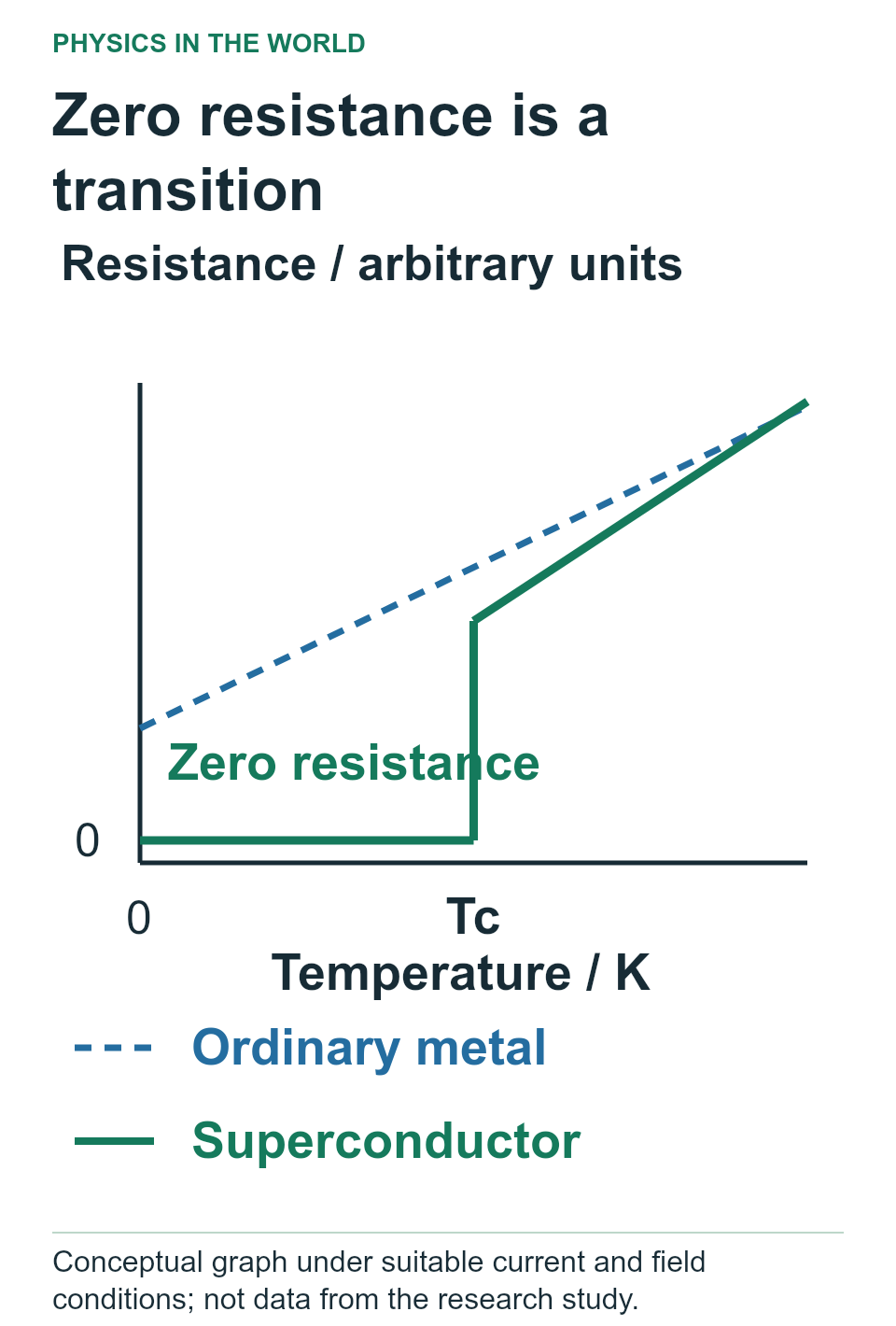
Lowering a metal's temperature often reduces its resistance, but a superconducting transition is not just more of the same gradual reduction. Below a critical temperature, the material can enter a distinct state with zero DC resistance.
Temperature is only one condition. Too large a current or magnetic field can also destroy superconductivity. A real device has to remain within its operating limits; cooled below the critical temperature is not permission to ignore every other condition.
In conventional superconductors, electrons form correlated pairs and a collective quantum state allows current without ordinary resistive dissipation. Do not imagine individual electrons simply finding a route that avoids every atom. Explaining the collective state needs quantum physics beyond the simple school picture of collisions in a metal.
The phrase high-temperature superconductor is relative to conventional superconducting temperatures. A material can earn that description and still need cooling far below everyday room temperature. It is not a promise that cooling has become unnecessary.
Worked equations
Compare electrical heating at the same current
For the same controlled current, reducing resistance reduces this heating term. An ideal superconducting coil in steady DC operation has zero resistive heating; this equation does not say the refrigerator or the complete machine needs no power.
Why use superconductors in magnets?
A current in a coil produces a magnetic field. Strong magnets often need large currents, which would cause substantial heating in an ordinary resistive coil. A superconducting coil reduces that particular problem, provided it remains superconducting.
Accelerator magnets use strong fields to guide charged particles. The magnetic fields and charged particles resource develops that application. The field bends the particle path; it does not supply the beam's energy gain.
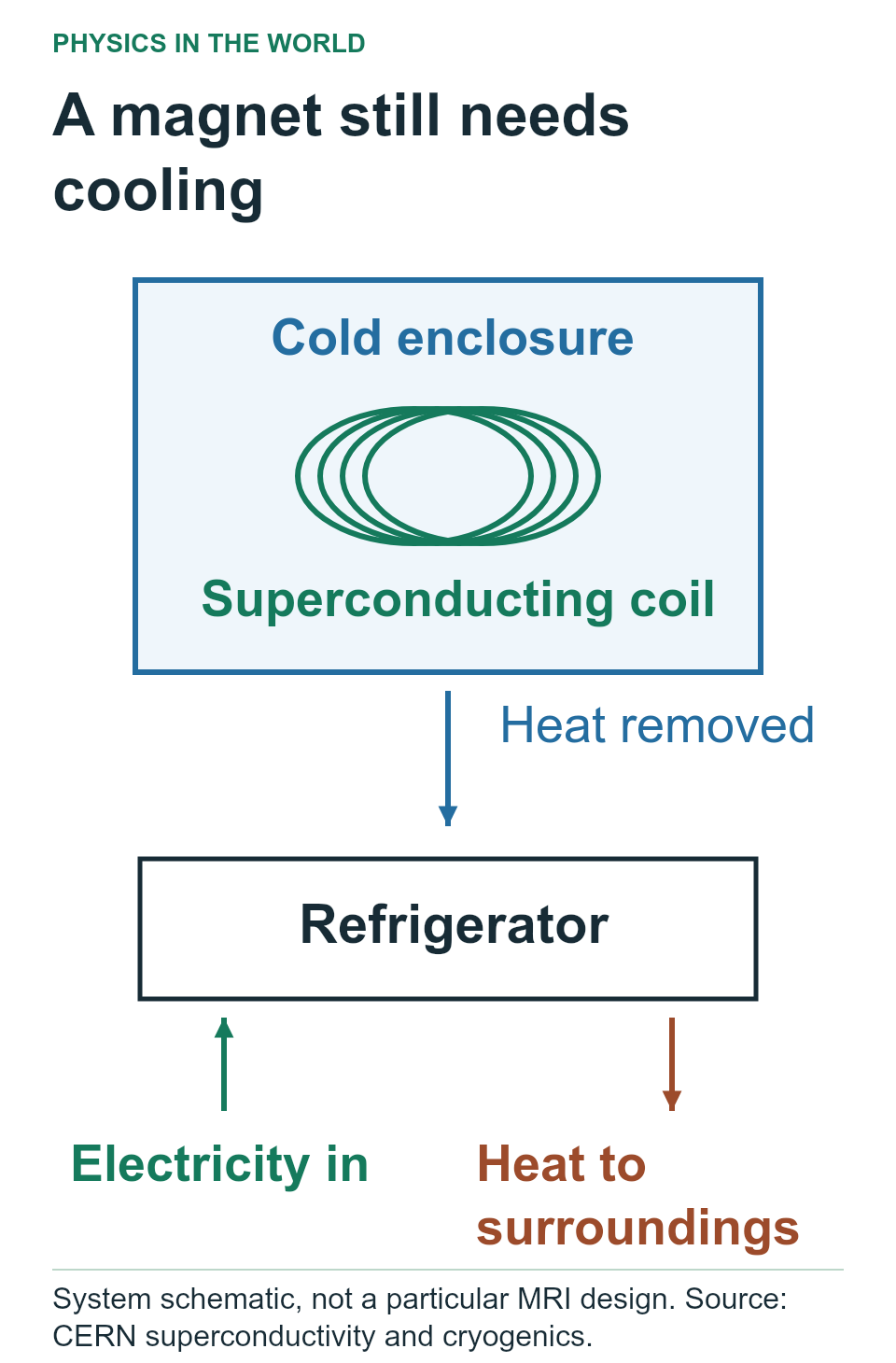
Many MRI systems also use superconducting magnets to produce a strong, stable magnetic field. A medical physicist works with the measurement, performance and safe use of imaging systems, not just a drawing of a magnet. MRI has other electrical and engineering systems as well.
The refrigerator is part of the energy story. It uses work to remove energy entering the cold region and reject heat to warmer surroundings. Zero resistance in the coil does not remove heat leaks, refrigeration demand, power electronics or the need to establish the magnet's stored energy.
That is why a materials scientist asks several questions together: what conditions produce the desired state, what currents and fields can it tolerate, how can it be manufactured, and what would an entire useful device require?
Resistance, heating and the physics you already know
Current measures the rate of charge flow. It is not a substance used up by the wire. The current and electrical energy notes help separate charge circulating in a circuit from energy transferred to the material and its surroundings.
The power relationship below explains one attraction of reducing resistance. Compare wires at the same controlled current: a smaller resistance means less resistive heating. The energy, power and resistance resource gives practice in choosing the appropriate electrical-power equation.
The condition about current matters. If instead the voltage across a component is fixed, changing its resistance also changes its current. Do not silently change what is held constant in the middle of a comparison.
A graph of resistance against temperature can locate a transition. Check the axes first: a temperature axis in kelvin is not a temperature difference, and a critical-temperature marker is not a measured result unless a particular material and measurement are identified.
Below the transition, an ideal zero-resistance line does not mean an unlimited current is possible. Superconducting devices have critical currents and fields. Contacts, changing fields and other practical processes can also introduce energy losses outside the simple DC model.
A Level stretch: what the new study actually tests
The HKU and Harvard study concerns a simplified model motivated by copper-based high-temperature superconductors, called cuprates. It investigates a transition between an antiferromagnetic insulator and a d-wave superconducting state. Antiferromagnetic means neighbouring magnetic moments tend to alternate; d-wave describes the symmetry of the pairing state.
The team used quantum Monte Carlo simulations to study that transition. Their model describes spin and electrical charge through different emergent excitations, called spinons and chargons. Spin is a quantum property, not a tiny ball physically turning. Emergent means the description belongs to the collective system.
This is not an experiment breaking one isolated electron into two smaller particles. It is a way of representing and calculating the behaviour of an interacting material model. The simulations provide evidence for a continuous quantum transition within that setting.
The work focuses on a simplified half-filled model. Connecting its results more fully to real cuprate materials with added mobile carriers remains a research question. It does not establish a room-temperature device or solve every high-temperature-superconductivity problem.
The dates deserve care too. The preprint first appeared in July, with later revisions and a PNAS journal reference. The 4 November date belongs to HKU's public announcement, not to all stages of the research. Our conceptual resistance graph explains the background; it is not a graph extracted from their simulation.
Key words
Quick pupil questions
What is a superconductor?
It is a material that can enter a state with zero DC electrical resistance and a distinctive magnetic response, within suitable temperature, current and magnetic-field conditions.
Does zero resistance mean zero energy use?
No. It removes resistive heating in the ideal steady-current model of the superconducting material. Cooling, controls and other equipment can still consume electricity.
Does high-temperature superconductivity mean room temperature?
Not automatically. High temperature is relative to conventional superconductors, and many such materials still require cooling well below room temperature.
Did the new study split an electron into pieces?
No. Spinons and chargons are emergent descriptions in an interacting quantum model. The work is not an experiment breaking an isolated elementary electron into smaller particles.
Where are superconductors used?
Applications include strong accelerator magnets and many MRI magnets. A usable system also needs appropriate cooling, controls and protection.