
AQA 7408 · Section 3.5.1
Resistance, resistivity and current–voltage characteristics
Read I–V graphs in either orientation, investigate a wire as in Required Practical 5, and explore the AQA-specific physics of thermistors and superconductors.
Active revision
Predict, test, explain
Predict
Commit to a direction or value before moving a control.
Test
Change one variable and compare the evidence with your prediction.
Explain
Use an equation and a physical reason, then attempt the exam questions.
Interactive graph
Current–voltage characteristics
Resistance and Ohm’s law
Resistance is the ratio of p.d. to current at an operating point. Ohm’s law says I is proportional to V while physical conditions, especially temperature, remain constant.
Ideal ammeters have zero resistance; ideal voltmeters have infinite resistance unless the question says otherwise.
Compare component behaviour
Required Practical 5
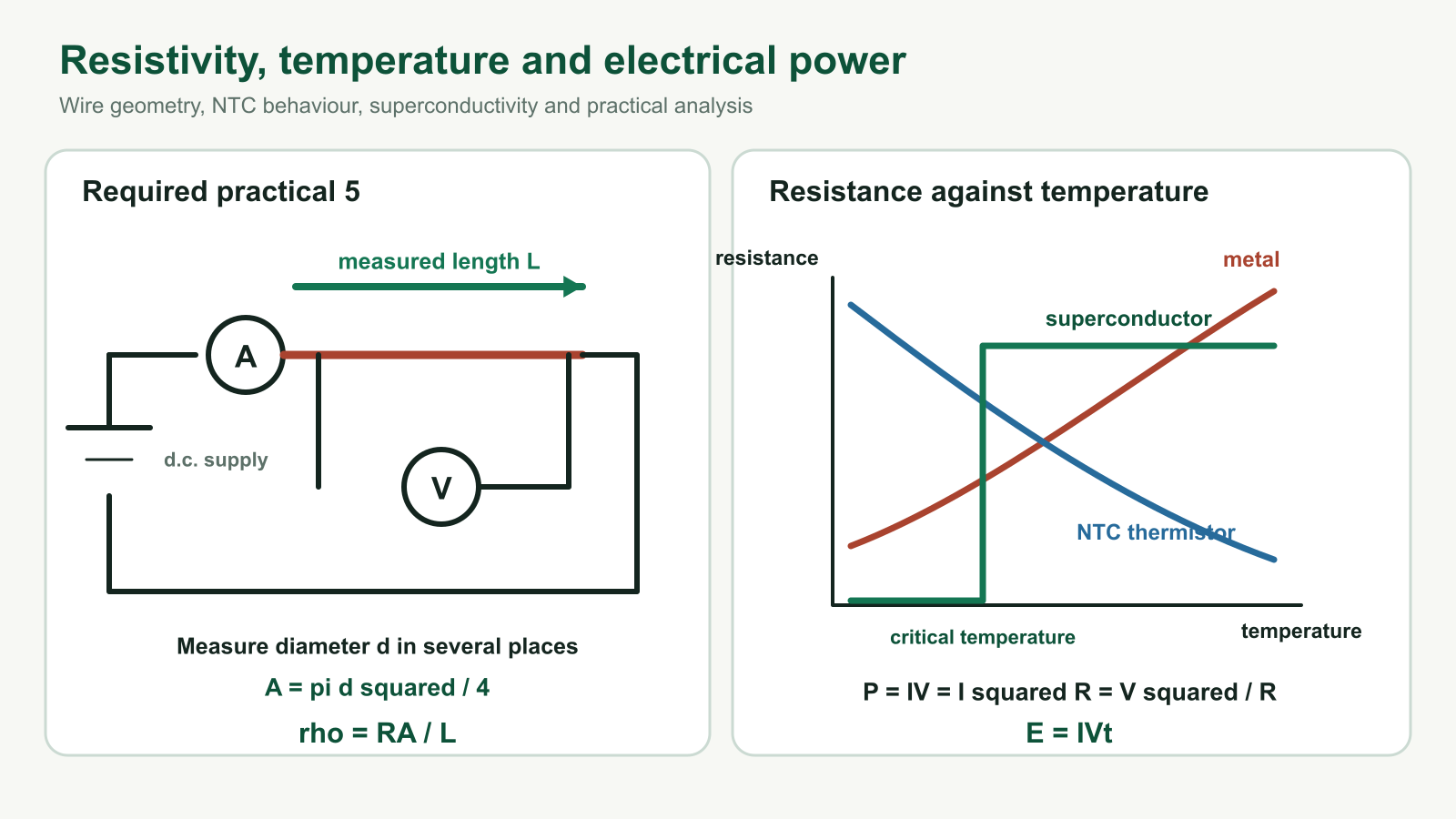
Determine the resistivity of a wire
Method
- Fix a test wire beside a metre ruler and measure several lengths.
- Measure diameter at several positions and in perpendicular directions with a micrometer.
- Use a low current, record V and I, and calculate R = V/I for each length.
- Plot R against L. The gradient is ρ/A, so ρ = gradient × A.
Control and evaluate
Keep temperature constant: switch off between readings or use low current. Check and correct any zero error. Repeat diameter measurements because area depends on diameter squared.
Wire model
Predict how doubling diameter affects resistance, then test it.
Temperature effects
Metals and NTC thermistors
Metal conductor
Higher temperature increases lattice vibrations and electron scattering, so resistance rises.
NTC thermistor
Higher temperature releases more charge carriers, so resistance falls.
Sensor use
A thermistor in a potential divider converts temperature changes into measurable voltage changes.
AQA-only emphasis
Superconductivity
A superconductor has zero resistivity at and below its critical temperature. Applications include producing strong magnetic fields and reducing energy losses in power transmission. AQA states that critical field will not be assessed.
Original exam-style practice
Questions and answers
1. Why does a filament lamp’s I–V graph become less steep when V is on the horizontal axis? [3 marks]
Current heats the filament; increased lattice vibration causes more electron scattering; resistance rises, so each further increase in V produces a smaller current increase.
2. A wire is 1.20 m long, diameter 0.42 mm and resistance 9.6 Ω. Calculate its resistivity. [4 marks]
A = π(0.21 × 10⁻³)² = 1.39 × 10⁻⁷ m². ρ = RA/L = 9.6 × 1.39 × 10⁻⁷ / 1.20 = 1.11 × 10⁻⁶ Ω m.
3. Explain two improvements to a school resistivity experiment. [4 marks]
Use low current/switch off between readings to limit temperature change. Measure diameter repeatedly in perpendicular directions because small diameter uncertainty is doubled in percentage terms when calculating area.
4. State what happens at the critical temperature of a superconductor and give one use. [2 marks]
Its resistivity becomes zero at or below the critical temperature. One use is a high-field electromagnet or low-loss power transmission.
Specification checklist
AQA 7408 coverage
Letter suffixes in this checklist are PhysicsUK subdivisions for navigation. The official AQA references are the numbered sections above.
- 3.5.1.1(c) Define resistance as R = V/I.
- 3.5.1.2(a) Describe current-voltage characteristics for an ohmic conductor, semiconductor diode and filament lamp.
- 3.5.1.2(b) State Ohm's law as I proportional to V under constant physical conditions.
- 3.5.1.2(c) Treat ammeters and voltmeters as ideal unless a question states otherwise.
- 3.5.1.2(d) Interpret I-V characteristic graphs regardless of whether current or voltage is on the horizontal axis.
- 3.5.1.3(a) Define resistivity using ρ = RA/L.
- 3.5.1.3(b) Describe qualitatively how temperature affects resistance of metal conductors.
- 3.5.1.3(c) Describe qualitatively how temperature affects resistance of negative-temperature-coefficient thermistors.
- 3.5.1.3(d) Use thermistor applications including temperature sensors and resistance-temperature graphs.
- 3.5.1.3(e) Define superconductivity as zero resistivity at and below a critical temperature.
- 3.5.1.3(f) Describe applications of superconductors in strong magnetic fields and reducing transmission energy losses.
- 3.5.1.3(g) Recognise that critical field will not be assessed.
Continue AQA Electricity
Current, charge and electrical energy · Circuits, potential dividers, e.m.f. and internal resistance · AQA 3.5 Electricity hub · Mechanics and materials · Waves · AQA Paper 1 revision · Physics calculation practice.
Written against AQA Physics 7408 section 3.5.1 and Required Practical 5. All questions are original.