
AQA 7408 · Section 3.6.1 · A-level only
Simple harmonic motion, damping and resonance
Connect the defining equation to motion graphs, energy, oscillators and resonance. Make a prediction, test it in the SHM Explorer, then answer the exam questions without relying on pattern matching.
Active revision
Predict, test, explain
Predict
State the sign, direction or graph shape before touching a control.
Test
Change one quantity in the model and compare the result with your prediction.
Explain
Use a defining equation and physical reasoning, then attempt the exam question.
Core model
What makes motion simple harmonic?
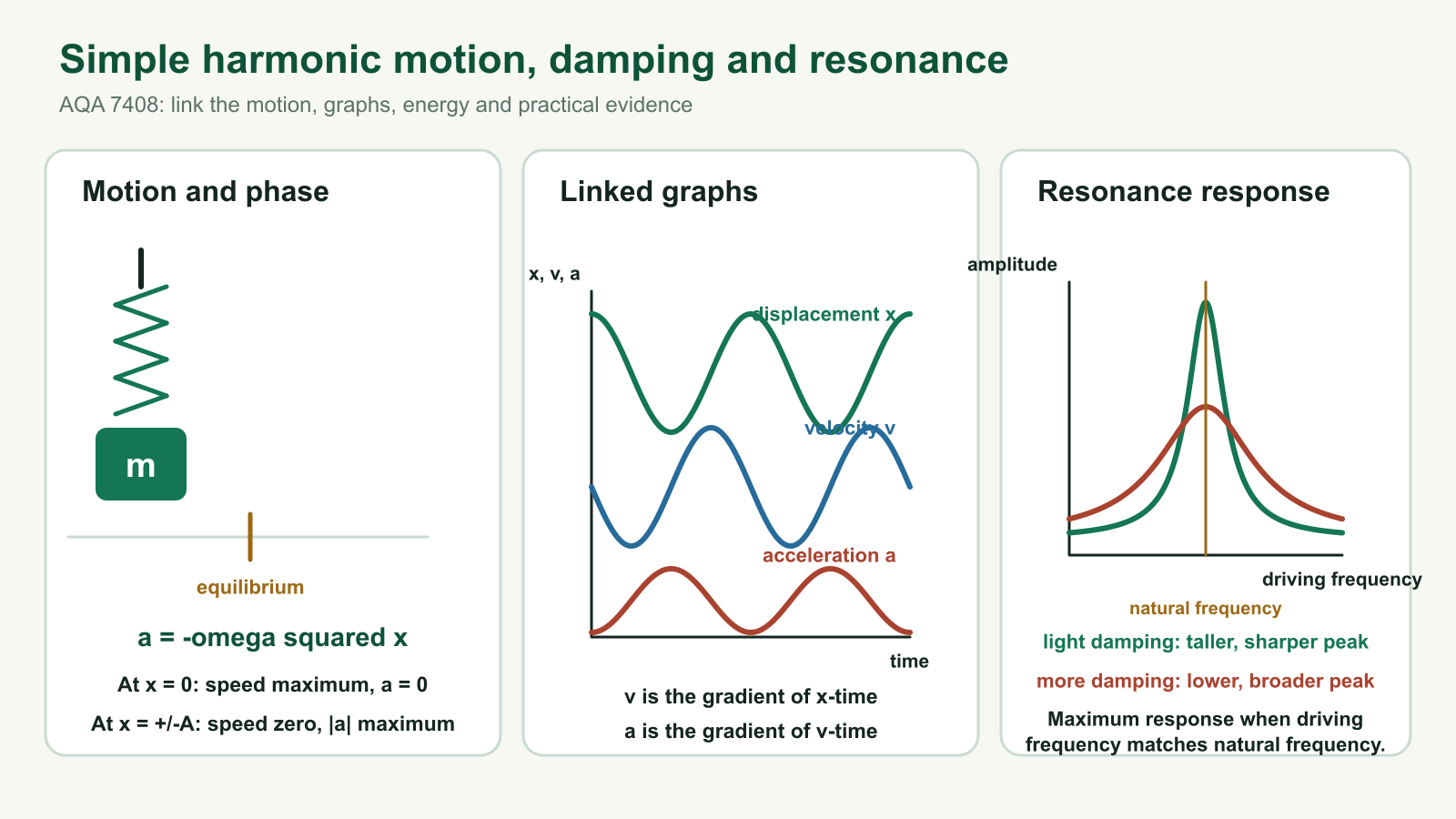
Simple harmonic motion is oscillation in which acceleration is proportional to displacement from equilibrium and always directed back towards equilibrium.
The minus sign describes direction. At positive displacement, acceleration is negative; at negative displacement, acceleration is positive. At equilibrium, acceleration is zero but speed is greatest.
The ± sign in the velocity equation matters because the oscillator can pass the same displacement in either direction. Speed is a magnitude; velocity has a direction.
| Position | Velocity | Acceleration | Energy |
|---|---|---|---|
| x = +A | 0 | −ω²A | Maximum potential; zero kinetic |
| x = 0 | Maximum magnitude | 0 | Maximum kinetic; minimum potential |
| x = −A | 0 | +ω²A | Maximum potential; zero kinetic |
Phase and sign checkpoint
A mass is at x = +0.60A and moving towards equilibrium. Select the only correct statement.
Interactive model
Use the PhysicsUK SHM Explorer
Choose Mass–spring and set Damping to zero with Driving force off. Use Mass, Spring constant and Amplitude; the natural frequency follows from these physical settings. Pause and compare the signed x, v and a readouts with the motion graphs.
Sign and phase
Play, then Pause while x is positive and v is negative. Check that a is negative: the mass is moving towards equilibrium and the restoring acceleration points the same way. Find an equilibrium crossing where |v| is greatest and a is zero.
Change the natural frequency
At fixed mass and amplitude, change Spring constant from 10 to 40 N m⁻¹. Frequency doubles because ω = √(k/m), while maximum acceleration quadruples. Read T and ω while paused; changing a parameter applies immediately. Reset and Play to collect a fresh set of graphs.
Compare a pendulum
Choose Pendulum, use a small initial angle, and vary Length. Quadrupling length doubles the small-angle period. Compare the formula period with the simulated period only after enough complete cycles; a large angle lies outside exact SHM.
Oscillators and energy
Springs, pendulums and energy transfer
Mass–spring system
Increasing mass increases the period. Increasing spring constant makes the system stiffer and decreases the period. The period does not depend on amplitude while the system remains within the SHM model.
Simple pendulum
This relation is approximate because the derivation uses the small-angle approximation. Measure length from the pivot to the centre of the bob, not to its top or bottom.
Energy in ideal SHM
With no damping, kinetic and potential energy exchange while total energy stays constant. Energy graphs against displacement are parabolic. Against time, kinetic and potential energy repeat twice in every oscillation.
Forced motion
Damping, forced vibrations and resonance
Free vibration
After one displacement, the system oscillates at its natural frequency. Damping removes energy and reduces amplitude.
Forced vibration
A periodic driving force makes the system vibrate at the driving frequency after transients have faded.
Resonance
Amplitude is greatest when driving frequency is close to natural frequency because energy transfer is most effective.
Resonance curve investigation
Predict how the peak changes, then adjust damping. Keep natural frequency and driving-force amplitude fixed when comparing damping. The vertical axis is the dimensionless amplitude ratio A/(F₀/k), using one fixed 0–7 scale for every setting.
Required Practical 7
Investigate SHM with a spring and a pendulum
Mass–spring method
- Clamp the spring securely and measure the mass, including the mass hanger.
- Displace the mass vertically by a small amount and release without pushing.
- Time at least 10 complete oscillations, repeat, average, then divide by the number of cycles.
- Change mass while keeping the same spring and a small amplitude.
- Plot T² against m. From T² = (4π²/k)m, gradient = 4π²/k.
Pendulum method
- Measure l from the pivot to the centre of the bob.
- Use a small angle and release without a push.
- Time repeated oscillations as the bob passes a fiducial marker in the same direction.
- Repeat for a range of lengths.
- Plot T² against l. From T² = (4π²/g)l, gradient = 4π²/g.
Required Practical graph analysis
Use the gradient of a T² graph to recover k or g. Enter a best-fit gradient, not two neighbouring data points.
Original exam-style practice
Questions and worked answers
1. An oscillator has amplitude 0.080 m and frequency 1.5 Hz. Calculate its maximum speed and maximum acceleration. [4 marks]
ω = 2πf = 9.42 rad s⁻¹. vmax = ωA = 0.754 m s⁻¹. amax = ω²A = 7.11 m s⁻².
2. A particle is at x = 0.030 m in SHM with ω = 8.0 rad s⁻¹. State the acceleration and explain its sign. [3 marks]
a = −ω²x = −8.0² × 0.030 = −1.92 m s⁻². The negative sign means acceleration is towards equilibrium from a positive displacement.
3. A 0.40 kg mass oscillates on a spring of constant 63 N m⁻¹. Find the period. [2 marks]
T = 2π√(m/k) = 2π√(0.40/63) = 0.50 s.
4. Explain the energy changes from maximum positive displacement to equilibrium. [3 marks]
Potential energy decreases while kinetic energy increases. Speed rises from zero to its maximum. In ideal SHM total mechanical energy remains constant.
5. Explain why the pendulum equation becomes less accurate at large amplitude. [2 marks]
The derivation assumes a small angle so sin θ ≈ θ when θ is measured in radians. At larger angles this approximation fails, so the restoring acceleration is not exactly proportional to displacement.
6. A T²–l graph has gradient 4.05 s² m⁻¹. Determine g. [3 marks]
Gradient = 4π²/g, so g = 4π²/4.05 = 9.75 m s⁻².
7. Describe how greater damping changes a resonance curve. [3 marks]
The maximum amplitude is lower, the peak is broader and resonance is less sharp. The frequency at maximum amplitude may also shift slightly lower for appreciable damping.
8. A bridge is driven periodically by wind. Explain one design approach that reduces dangerous resonance. [3 marks]
Add damping so energy is dissipated, lowering and broadening the resonance response, or change stiffness/mass to move the natural frequency away from likely driving frequencies. The explanation must link the design change to reduced oscillation amplitude.
Specification checklist
AQA 7408 coverage
Letter suffixes in this checklist are PhysicsUK subdivisions for navigation. The official AQA references are the numbered sections above.
- 3.6.1.2(a) Analyse the characteristics of simple harmonic motion.
- 3.6.1.2(b) Use the condition for SHM that acceleration is proportional to negative displacement.
- 3.6.1.2(c) Use the defining equation a = −ω²x.
- 3.6.1.2(d) Use x = A cosωt for displacement in SHM.
- 3.6.1.2(e) Use v = ±ω√(A² − x²) for speed in SHM.
- 3.6.1.2(f) Link graphical variations of displacement, velocity and acceleration with time.
- 3.6.1.2(g) Use gradients to connect x-t, v-t and a-t graphs for SHM.
- 3.6.1.2(h) Use maximum speed = ωA.
- 3.6.1.2(i) Use maximum acceleration = ω²A.
- 3.6.1.3(a) Use T = 2π√(m/k) for a mass-spring system.
- 3.6.1.3(b) Use T = 2π√(l/g) for a simple pendulum.
- 3.6.1.3(c) Apply provided information to other harmonic oscillators where required.
- 3.6.1.3(d) Describe variation of kinetic energy, potential energy and total energy with displacement and time in SHM.
- 3.6.1.3(e) Describe effects of damping on oscillations.
- 3.6.1.3(f) Recognise the small-angle approximation in derivations of time period for approximate SHM.
- 3.6.1.4(a) Describe free vibrations and forced vibrations qualitatively.
- 3.6.1.4(b) Explain resonance.
- 3.6.1.4(c) Explain how damping affects the sharpness of resonance.
- 3.6.1.4(d) Apply resonance and damping to mechanical systems and stationary-wave situations.
- 8.2.RP7 Investigate simple harmonic motion using a mass-spring system and a simple pendulum.
Build the connected AQA physics picture
Revisit mechanics and materials for forces, energy and springs, or waves for phase, stationary waves and resonance. Strengthen circuit work with current and electrical energy, resistance and resistivity, and circuits and potential dividers. Return to the AQA 3.6 hub, prepare with the AQA Paper 1 revision hub, or attempt A-level Physics problem-solving questions.
Written against AQA Physics 7408 sections 3.6.1.2–3.6.1.4 and Required Practical 7. Questions are original and examiner-report misconceptions are paraphrased for teaching.