
Mechanics and materials
A revision guide for the AQA mechanics and materials topic: vectors, motion, forces, momentum, energy and the behaviour of materials. Use it to build the story first, then practise the calculations with the diagrams and short simulations.

Build confidence in three passes
Get the picture
Read the key ideas and make a one-page formula list. Mechanics is much easier when every symbol has a physical meaning.
Change one thing
Use the short models to see how a slope, launch angle or wire diameter changes the result before you calculate it.
Write exam answers
Do the worked examples, then cover the answers to the self-check questions and show every line of working.
- Resolve forces, use moments and decide whether an object is in equilibrium.
- Read motion graphs, select a SUVAT equation and describe projectile and terminal-speed motion.
- Apply Newton's laws, conservation of momentum, impulse, work done, power and energy conservation.
- Use density, Hooke's law, stress, strain, elastic strain energy and Young modulus correctly.
- Plan and evaluate the free-fall and Young-modulus required practicals.
Know what belongs where
| Part of the topic | What you need to be able to do | Useful equation |
|---|---|---|
| Vectors, moments and motion | Resolve forces, use equilibrium conditions, interpret gradients and areas on motion graphs, and select SUVAT equations. | v² = u² + 2as |
| Forces and momentum | Draw a free-body diagram, apply F = ma, conserve momentum in one dimension and explain impulse. | FΔt = Δp |
| Work, energy and power | Calculate work done at an angle, use areas under F–x graphs and explain efficiency and energy transfers. | W = Fs cos θ; P = Fv |
| Materials | Use stress, strain, elastic energy and Young modulus; interpret a stress–strain graph and describe failure. | E = FL / AΔL |
Write the equation, convert values into SI units, substitute with units, give a sensible number of significant figures and state the final unit. For a vector answer, include a direction or a sign convention.
For uncertainty, significant figures and practical-data language, revisit Measurements and their errors before the required practical sections.
Start with a force diagram, not an equation
A scalar has magnitude only; a vector has magnitude and direction. Distance, speed, mass, time and energy are scalars. Displacement, velocity, acceleration, force, weight and momentum are vectors. This distinction is what makes a negative velocity meaningful but a negative distance meaningless.
Resolving a force
Choose axes that simplify the question. If a force F makes an angle θ with the horizontal, its horizontal component is F cos θ and vertical component is F sin θ. Draw the triangle rather than trusting memory.
Equilibrium and moments
For an object at rest or moving at constant velocity, the resultant force is zero. For a rigid body that is not turning, clockwise and anticlockwise moments balance about any chosen pivot.
To add two vectors at right angles, use Pythagoras for the magnitude and trigonometry for the direction. At other angles, use a head-to-tail scale drawing or resolve both vectors into perpendicular components. When two or three forces act at a point in equilibrium, their vector diagram closes to make a triangle or polygon.
The distance in a moment is the shortest distance from the pivot to the force's line of action, not simply the length drawn along a beam. A couple is two parallel forces, equal in magnitude and opposite in direction, separated by a perpendicular distance. Its resultant force is zero but it produces rotation. The centre of mass is the point through which weight acts; for a uniform regular solid it is at its geometric centre.
Worked example — a balanced beam
A 15 N load is 0.20 m to the left of a pivot. A force acts at right angles to the beam 0.50 m to the right. Find the force needed for equilibrium.
Take moments about the pivot. The two moments must have equal magnitudes and opposite senses.
Mini model: forces on an incline
Change the mass and slope. The model resolves the weight into components parallel and perpendicular to a frictionless slope. A normal contact force balances the perpendicular component.
On a rough slope, friction acts along the surface and opposes the tendency to move. Add it to the parallel-force equation with the correct sign.
Motion: translate the graph before you calculate
Displacement is distance in a stated direction; velocity is rate of change of displacement; speed is a scalar rate of change of distance; and acceleration is rate of change of velocity. In symbols, v = Δs/Δt and a = Δv/Δt. An instantaneous value is the value at one moment; an average is the total change divided by the total time.
Displacement–time
Gradient = velocity. A straight sloping line means constant velocity; a horizontal line means the object is stationary.
Velocity–time and acceleration–time
Velocity–time gradient = acceleration and area = displacement. An acceleration–time graph has area equal to change in velocity. A changing gradient represents non-uniform acceleration.
For constant acceleration, define your symbols first: u initial velocity, v final velocity, a acceleration, s displacement and t time. Do not invent a value for a quantity that the question has not told you.
Worked example — free fall
A stone is dropped from rest and falls for 1.80 s. Ignore air resistance and take g = 9.81 m s−2. Find its speed and displacement.
Near Earth, acceleration due to gravity is approximately 9.81 m s-2 downwards. A projectile has independent horizontal and vertical motion: horizontal velocity is constant if air resistance is ignored; vertical acceleration is g. In real air, drag grows as speed rises, so the path is not the ideal parabola.
Mini model: launch a projectile
This model is deliberately ideal: no air resistance, level launch and landing. It helps you see why the vertical and horizontal motions can be treated separately.
With the same speed and no air resistance, complementary angles such as 30° and 60° have the same range. In an exam question about air resistance, do not use that idealised conclusion without qualification.
Drag, friction and terminal speed
Friction is a contact force that opposes relative motion or its tendency. Drag and lift are fluid forces. Drag acts opposite motion and usually increases with speed. At terminal speed, drag equals weight, resultant force is zero and acceleration is zero. A vehicle's maximum speed occurs when its driving force equals the total resistive force.
Newton's laws
1: a body remains at rest or constant velocity unless a resultant force acts. 2: F = ma for constant mass. 3: forces come in equal-and-opposite pairs on different objects. Use a separate free-body diagram for each object.
Account for the interaction
Momentum is a vector, so choose a positive direction before writing any numbers. For an isolated system, total momentum is conserved. This applies to a collision, recoil or explosion even when kinetic energy is not conserved.
Momentum and impulse
The area under a force–time graph is impulse and therefore change in momentum; this works for a changing force as well as a constant one. Increasing contact time reduces the average force for the same change in momentum: this is the physics behind crumple zones, airbags and packaging.
Elastic and inelastic collisions
Momentum is conserved in both. In an elastic collision, kinetic energy is also conserved. In an inelastic collision, kinetic energy is transferred to internal energy, sound or deformation. A perfectly inelastic collision means objects stick together.
Worked example — collision in one dimension
A 0.40 kg trolley travels at +3.0 m s-1 and sticks to a 0.60 kg trolley initially at rest. Find their final velocity.
Use conservation of momentum. The combined mass is 1.00 kg.
Work done, power and efficiency
Work done is energy transferred. When force and displacement are at an angle, only the component of force parallel to the displacement does work. On a force–displacement graph, area under the graph is the work done; that applies even when the force changes.
Mechanical energy
For a closed system, energy is conserved. Gravitational potential energy change is ΔEp = mgΔh and kinetic energy is Ek = ½mv². If resistive forces act, mechanical energy decreases because energy is transferred to thermal stores.
Explain the chain
A stronger answer names the stores and the pathway: “the object's gravitational potential energy decreases; energy is transferred mechanically to its kinetic energy and thermally to the surroundings by air resistance.” Avoid saying energy is “lost”. For percentage efficiency, multiply the ratio by 100.
Transport design is a useful context for both momentum and energy: lower mass and regenerative braking can reduce energy demand, while crumple zones must absorb energy over a longer time. Good design balances safety, material use, repairability and emissions rather than treating one quantity in isolation.
The upward normal contact force on a book and the downward weight of the book are not a Newton's third-law pair: both act on the book. The third-law partner of the book's weight is the gravitational force exerted by the book on Earth.
Link the microscopic idea to the graph
Density tells you how much mass is packed into a volume. In a solid under tension, stress describes the applied force per unit cross-sectional area and strain describes the fractional extension. They are not forces or lengths, so their units matter.
| Quantity | Meaning | Equation and unit |
|---|---|---|
| Density, ρ | Mass per unit volume | ρ = m / V in kg m-3 |
| Stress, σ | Tensile force per cross-sectional area | σ = F / A in Pa |
| Strain, ε | Extension divided by original length | ε = ΔL / L no unit |
| Young modulus, E | Stress / strain in the linear region | E = FL / AΔL in Pa |
Hooke's law says extension is proportional to force up to the limit of proportionality. In this region, F = kΔL. The spring constant k measures stiffness: a large k means more force is needed for the same extension. The elastic limit is the greatest stress for which a material returns to its original length when unloaded. On a stress–strain curve, the gradient in the straight elastic section is Young modulus; a steeper gradient means a stiffer material.
Energy and the area
Elastic strain energy is the area under a force–extension graph. For a Hookean material, the graph is a triangle.
Failure language
Beyond the elastic limit, unloading leaves a permanent extension: plastic deformation. A brittle material fractures with little plastic deformation. A ductile material has a substantial plastic region before fracture. In a spring launcher or bungee, elastic strain energy can transfer into kinetic and gravitational potential energy; resistive forces transfer some energy thermally.
Mini model: wire extension and Young modulus
Set the wire and load, then compare the stress, strain and extension. The calculation assumes the material stays in its linear elastic region; a real wire can yield or fracture if overloaded.
Reducing the diameter has a large effect because area depends on diameter squared. That is why measuring diameter carefully, at several positions and in perpendicular directions, matters in the required practical.
Explain the method, then evaluate it
Required Practical 3: determine g by free fall
- Fix a short opaque interrupt card to a falling object. Measure its length l in the direction of motion. Align two horizontal light-gate beams vertically and secure the supports.
- Release above both gates without pushing. Record interruption durations τ₁ and τ₂ and the time Δt between the centres of those interruption intervals. The centre time is the leading-edge timestamp plus half its interruption duration.
- Estimate speeds at the interval centres using v₁ ≈ l/τ₁ and v₂ ≈ l/τ₂. For a short card and nearly constant acceleration, calculate g ≈ (v₂ − v₁)/Δt. Gate separation and one travel time alone are insufficient unless the initial velocity is known.
- Repeat and vary gate separation or release height. Plot (v₂ − v₁) vertically against Δt horizontally; the best-fit gradient is g. Alternatively, measure vertical separation Δy between gate beams and plot (v₂² − v₁²) against Δy; gradient ≈ 2g, with the short-card approximation stated.
Example check: l = 0.0200 m, τ₁ = 0.0100 s and τ₂ = 0.00800 s give v₁ = 2.00 m s⁻¹ and v₂ = 2.50 m s⁻¹. With Δt = 0.0510 s between interval centres, g = 0.50/0.0510 = 9.80 m s⁻². Check logger resolution, use the same card length, minimise drag and avoid a long card for which speed changes appreciably while the beam is blocked.
A strong evaluation separates random uncertainty (for example variation in release) from systematic error (for example a distance scale zero error). Repeats can reduce the impact of random uncertainty; they do not fix a systematic offset.
Use a secure clamp, keep the drop zone clear and use electronic timing rather than a handheld stopwatch where possible. Quote the gradient and its uncertainty if a graph is used.
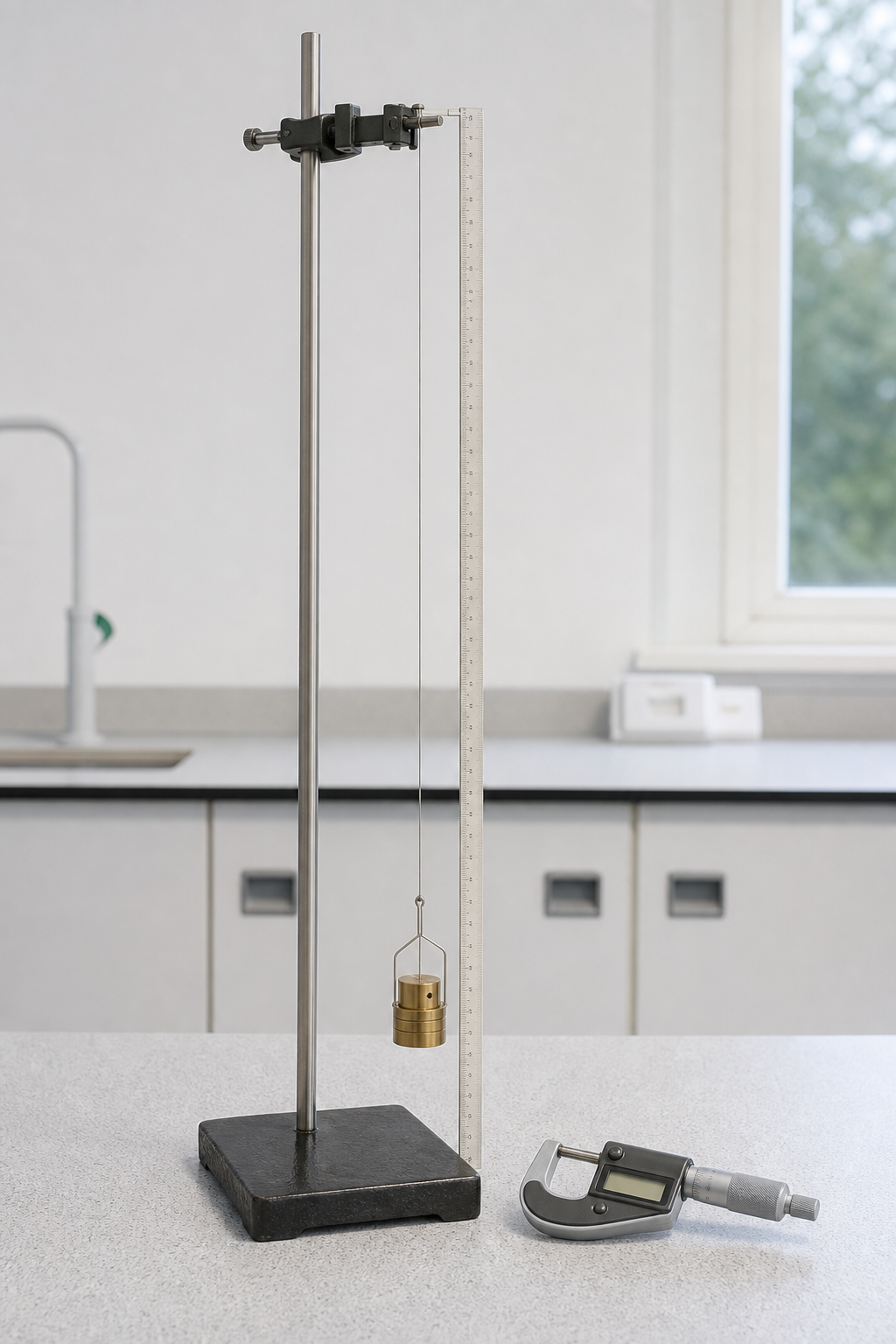
Required Practical 4: Young modulus
Measure the original wire length L. Use a micrometer to measure diameter at several points and orientations, then calculate area using A = πd²/4. Add loads in steps, measure extension ΔL while remaining in the elastic region, then calculate E = FL/AΔL or use the gradient of a stress–strain graph.
Practical improvements
Use a longer, thinner wire to give a larger extension, but stay below the elastic limit. Remove slack before taking readings. Keep the ruler parallel to the wire, avoid parallax and use a pointer. Repeated diameter measurements matter because A = πd²/4 gives approximately %ΔA = 2%Δd. For E = FL/(AΔL), add the percentage uncertainties in F, L, A and ΔL; small extension can dominate. Load and unload to check reversibility, measure extension from the preloaded reference, and use a large best-fit gradient triangle rather than one load reading. Secure clamps, wear eye protection and place a tray beneath suspended masses.
When planning either practical, identify the independent variable, dependent variable and controls, then explain how your chosen apparatus improves resolution or reduces a stated uncertainty. The measurements revision guide has the uncertainty vocabulary to use here.
Short questions with the answer hidden
1. A 12 N force acts at 30° above the horizontal. Find its horizontal and vertical components.
Horizontal component = 12 cos 30° = 10.4 N. Vertical component = 12 sin 30° = 6.0 N upwards.
2. A velocity–time graph is a straight line with gradient −2.5 m s-2. What does the gradient mean?
The object has a constant acceleration of −2.5 m s-2; with the chosen convention it accelerates in the negative direction, or slows down if it is initially moving positively.
3. Explain why a skydiver reaches terminal speed.
As speed increases, air resistance increases. Eventually drag equals weight, so the resultant force is zero. Therefore acceleration is zero and the skydiver continues at constant speed.
4. A 0.20 kg ball changes velocity from +8.0 m s-1 to −6.0 m s-1 in 0.070 s. Find the average force on it.
Δp = m(v − u) = 0.20[−6.0 − 8.0] = −2.8 kg m s-1. F = Δp/Δt = −2.8/0.070 = −40 N. The force is 40 N opposite to the initial direction.
5. State the difference between an elastic and an inelastic collision.
In both, momentum is conserved for an isolated system. In an elastic collision kinetic energy is conserved; in an inelastic collision some kinetic energy is transferred to other stores.
6. A 60 kg climber rises vertically by 4.0 m in 12 s. Calculate the useful power output, taking g = 9.81 m s-2.
Useful energy transferred = mgh = 60 × 9.81 × 4.0 = 2354 J. P = W/t = 2354/12 = 196 W (3 s.f.).
7. A wire of original length 2.0 m extends by 1.2 mm. Calculate its strain.
Convert extension: 1.2 mm = 1.2 × 10⁻³ m. Strain = ΔL/L = (1.2 × 10⁻³)/2.0 = 6.0 × 10⁻⁴. Strain has no unit.
8. Why is the area below a force–extension graph equal to elastic strain energy?
A small strip of area represents force × a small extension, which is a small amount of work done. Adding all of the strips gives the total work done in stretching the material, stored as elastic strain energy if it is still elastic.
Before you move on
- I can distinguish a vector from a scalar and use signs and directions consistently.
- I can resolve a force, take moments about a pivot and draw a free-body diagram.
- I can explain velocity–time and displacement–time gradients and areas.
- I can choose a SUVAT equation and state the assumptions behind an ideal projectile model.
- I can conserve momentum, calculate impulse and explain why increased stopping time reduces force.
- I can move confidently between work done, power, efficiency and energy-store explanations.
- I can calculate stress, strain, elastic energy and Young modulus using SI units.
- I can describe, improve and evaluate both AQA 3.4 required practicals.
Keep building your AQA revision map
Return to the AQA A-level Physics resource hub, practise the core measurement skills in Measurements and their errors, revisit Particles and radiation, or continue with Waves. For mixed calculation practice, use the A-level Physics problem-solving questions.