

When will Voyager 1 be one light-day from Earth?
NASA announced this week that Voyager 1 is approaching a new distance milestone. On 18 November it will be about one light-day from Earth. It launched in 1977, long before the pupils now reading about it were born.
There is no new destination or finish line at that distance. Voyager will keep moving. What changes is our description of the gap: even the fastest signal we can send needs a whole day to cross it.
What is a light-day?
A light-day is the distance light travels in one day in a vacuum. The name contains a time, but the unit describes a length. A light-year works in the same way, using a year instead of a day.
Think of saying a village is a twenty-minute walk away. That description connects a journey time to a distance, provided you know the walking speed. A light-day uses a precisely defined speed rather than somebody's walking pace.
The useful school calculation is distance equals speed multiplied by time. First turn one day into 86,400 seconds. Multiplying by the vacuum speed of light gives about 25.9 billion kilometres. That is the gap the radio signal crosses, not the distance Voyager travels in a day.
A radio message is not sound travelling across space. Sound needs a material medium, such as air. Radio is electromagnetic radiation and can cross a vacuum. The electromagnetic spectrum revision page puts radio and visible light in the same family.
This is also why the milestone does not mean Voyager is travelling at light speed. The spacecraft took decades to build up that separation. A newly transmitted radio wave covers a comparable distance in a day.
Worked equations
How long is one light-day?
Use a rounded vacuum light speed, then multiply by the number of seconds in a day. This calculates a distance, not Voyager's speed.
- Light speed, in metres per second: c = 3.00 x 10^8
- One day, in seconds: t = 86400
- Multiplying gives a distance in metres: d is approximately 2.59 x 10^13
- In kilometres, that is about: 25.9 billion km
Why does a reply take about two days?
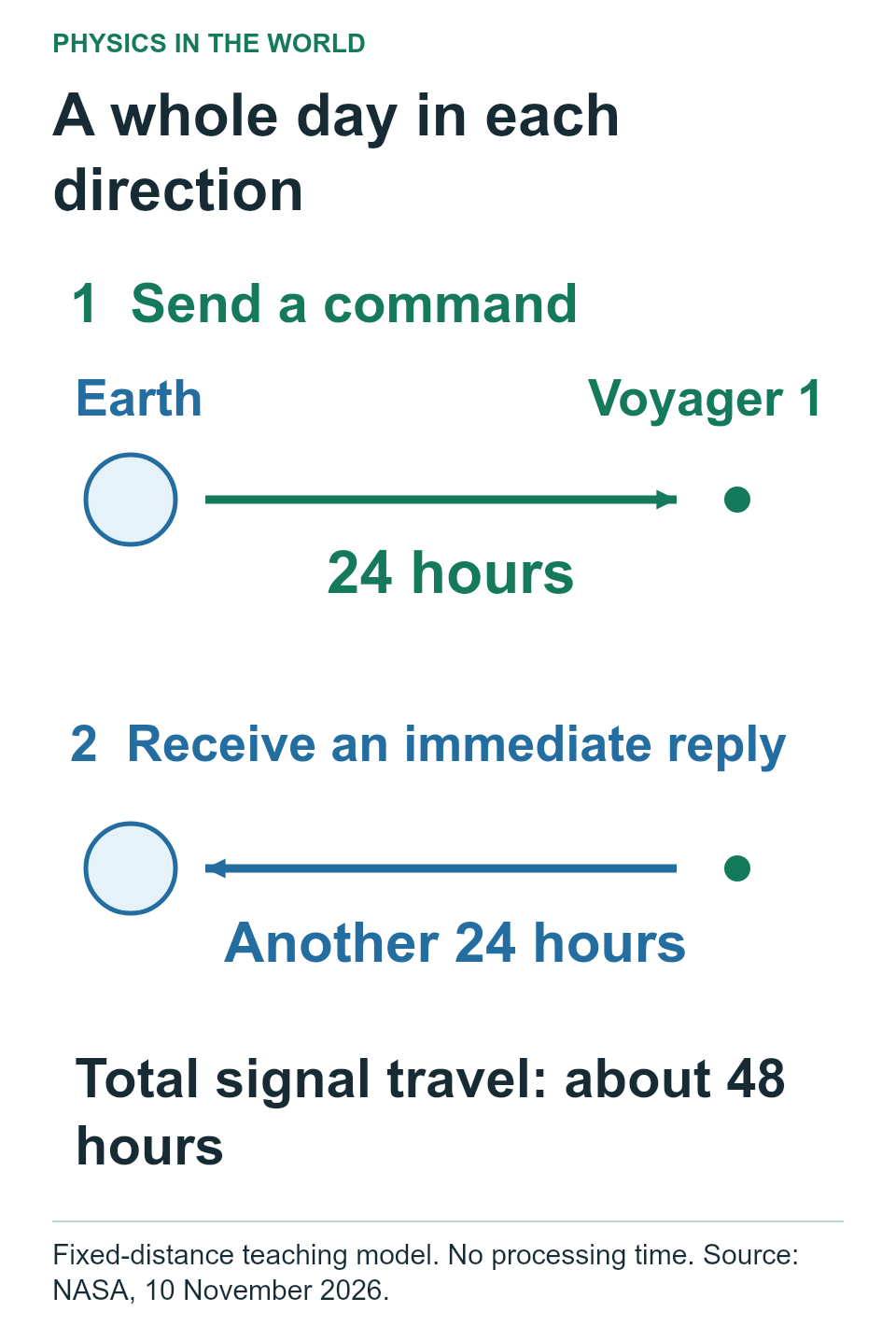
Suppose controllers send a command at noon on a Monday when the one-way delay is 24 hours. In a simple fixed-distance model, it arrives at noon on Tuesday. Even if Voyager replies immediately, Earth does not receive that reply until noon on Wednesday.
The silence during those two days does not itself mean something has gone wrong. Controllers must allow for the travel time before judging the result. Real operations also include time to execute instructions, prepare data and use the ground antennas.
You cannot steer this spacecraft as if it were a remote-control car in the next room. Commands need careful checking, and onboard routines must handle some situations before a human reply can arrive. That is a very practical consequence of a wave-speed limit.
Nor would a more powerful transmitter make the message arrive earlier. More power can help a receiver identify a weak signal. It does not increase the signal's propagation speed in a vacuum.
Radio waves, distance and a very weak signal
Radio waves have frequency and wavelength, just as visible light does. At a fixed vacuum speed, increasing the frequency reduces the wavelength. It does not make the information race ahead. The wave speed, frequency and wavelength resource gives worked examples of that relationship.
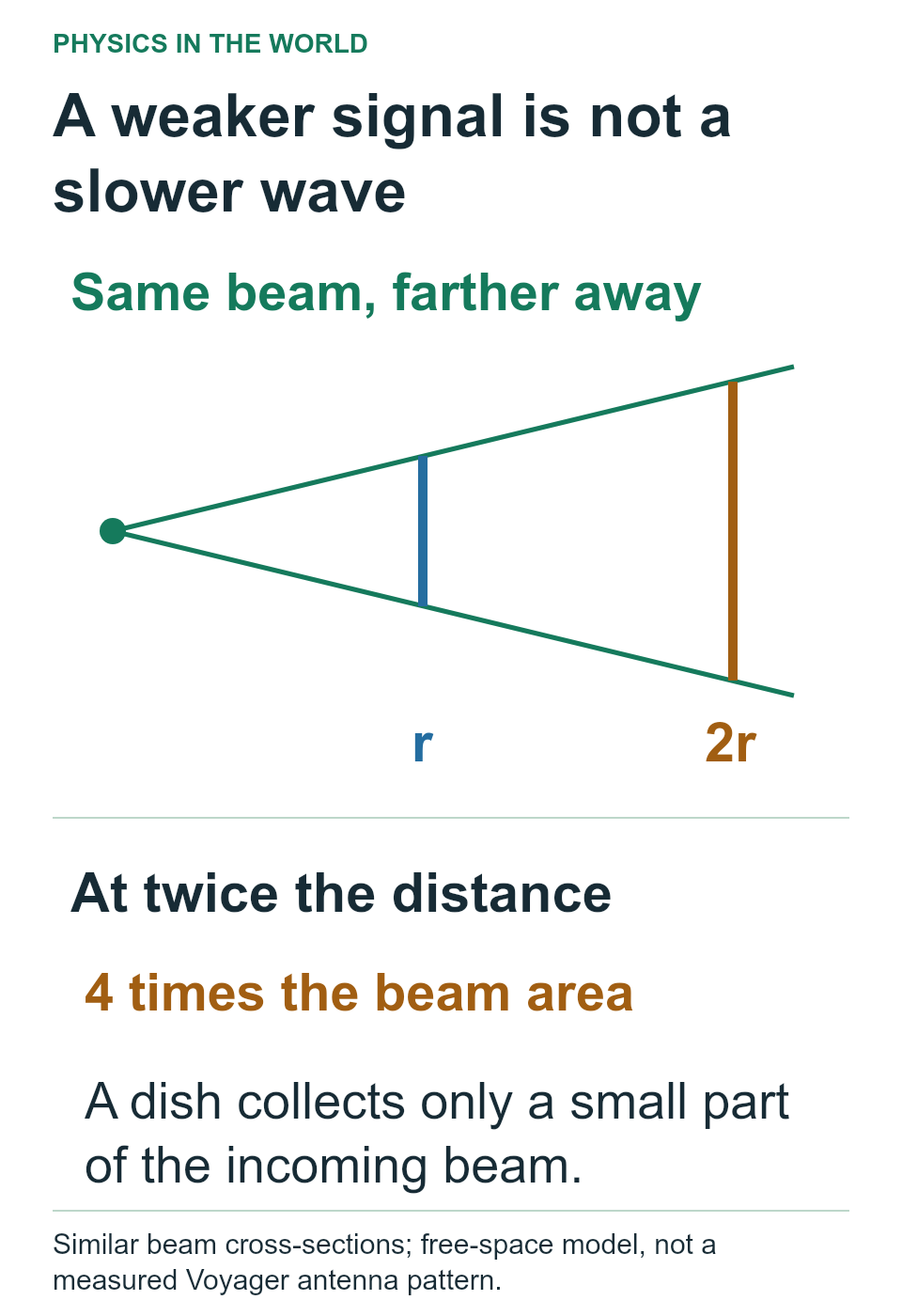
The other problem is collecting enough of the transmitted signal. As a beam spreads, its power is distributed across a larger area. Only a small share reaches the receiving antenna, so the electronics must distinguish it from background noise.
NASA uses the Deep Space Network: large radio antennas at sites around the world. A larger collecting dish intercepts more of a weak incoming signal. This is a receiving problem as well as a transmitting problem; turning up a loudspeaker on Earth is not an explanation of how it works.
A spacecraft engineer has to consider the whole chain: power available on the probe, pointing accuracy, radio equipment, ground antennas and the time allowed for each exchange. The best design is one that still works under those constraints, not simply the one with the largest headline data rate.
Voyager is in interstellar space, beyond the heliosphere, the region dominated by the Sun's outward-flowing solar wind. That does not put it beyond every object belonging to the Solar System. The much more distant Oort Cloud is a different boundary.
A Level stretch: spreading a signal without slowing it
For a fixed beam shape in empty space, doubling the distance makes its cross-sectional area about four times larger. The power per unit area therefore falls to about a quarter. This inverse-square model describes spreading; it does not say the total transmitted energy disappears.
An actual antenna is directional rather than a source radiating equally in every direction. Its beam pattern, pointing errors and receiver noise all matter. The AQA waves notes are a useful next step for keeping intensity, amplitude and speed distinct.
The exact communications delay also changes as Earth and Voyager move. A distance measured from Earth is not identical to one measured from the Sun. Treat 24 and 48 hours as the rounded milestone picture, not permanent timetable entries.
For a different use of the same careful planning, look at ESCAPADE's powered Earth flybys. One mission makes us think about signal travel time; the other makes us think about how a moving spacecraft changes direction and energy.
Key words
Quick pupil questions
When does Voyager 1 reach one light-day from Earth?
NASA gives 18 November 2026 for the distance milestone. Its symbolic public light-up activity takes place a day earlier, on 17 November.
How far is a light-day in kilometres?
One light-day is about 25.9 billion kilometres: the distance light or a radio signal travels in a vacuum in 24 hours.
Why does it take about two days to get a reply from Voyager 1?
At a one-way light time of 24 hours, the command needs one day to arrive and the reply needs another day to return. Processing and communications scheduling can add further time.
Would a higher radio frequency make the signal reach Voyager faster?
No. All electromagnetic waves travel at the same speed in a vacuum. A different frequency changes wavelength, not that vacuum propagation speed.