
What happened during ESCAPADE's Earth flybys?
NASA's twin ESCAPADE spacecraft have each completed a powered close pass of Earth: one on 7 November and the other on 9 November. The manoeuvres put them on course for Mars, with orbit insertion planned for September 2027.
They launched in November 2025 and spent the intervening period on a deliberately chosen loitering path rather than heading straight to Mars. The return to Earth was part of the route, not a wrong turn. Each close pass included an engine burn lasting roughly nine minutes.
How can flying past Earth help a spacecraft reach Mars?
A spacecraft already has a velocity before it reaches a planet. Gravity pulls towards the planet, changing that velocity and bending the path. If the approach is carefully chosen, the spacecraft leaves on a useful new route instead of hitting the planet or remaining in orbit around it.
The word slingshot can help you picture a curved departure, but there is no giant elastic band. The force is gravitational attraction. A planet does not have to repel the spacecraft to send it away on a different path.
It is also not enough to say that a probe falls towards Earth and therefore keeps all the speed it gains. While it travels away again, Earth's gravity continues pulling it back. For an ideal unpowered flyby, you need to consider the whole encounter, not only the incoming half.
The moving planet is important. A spacecraft can exchange energy and momentum with a planet that is itself orbiting the Sun. Its speed relative to the Sun can change even in an ideal flyby whose far-incoming and far-outgoing speeds relative to the planet are equal.
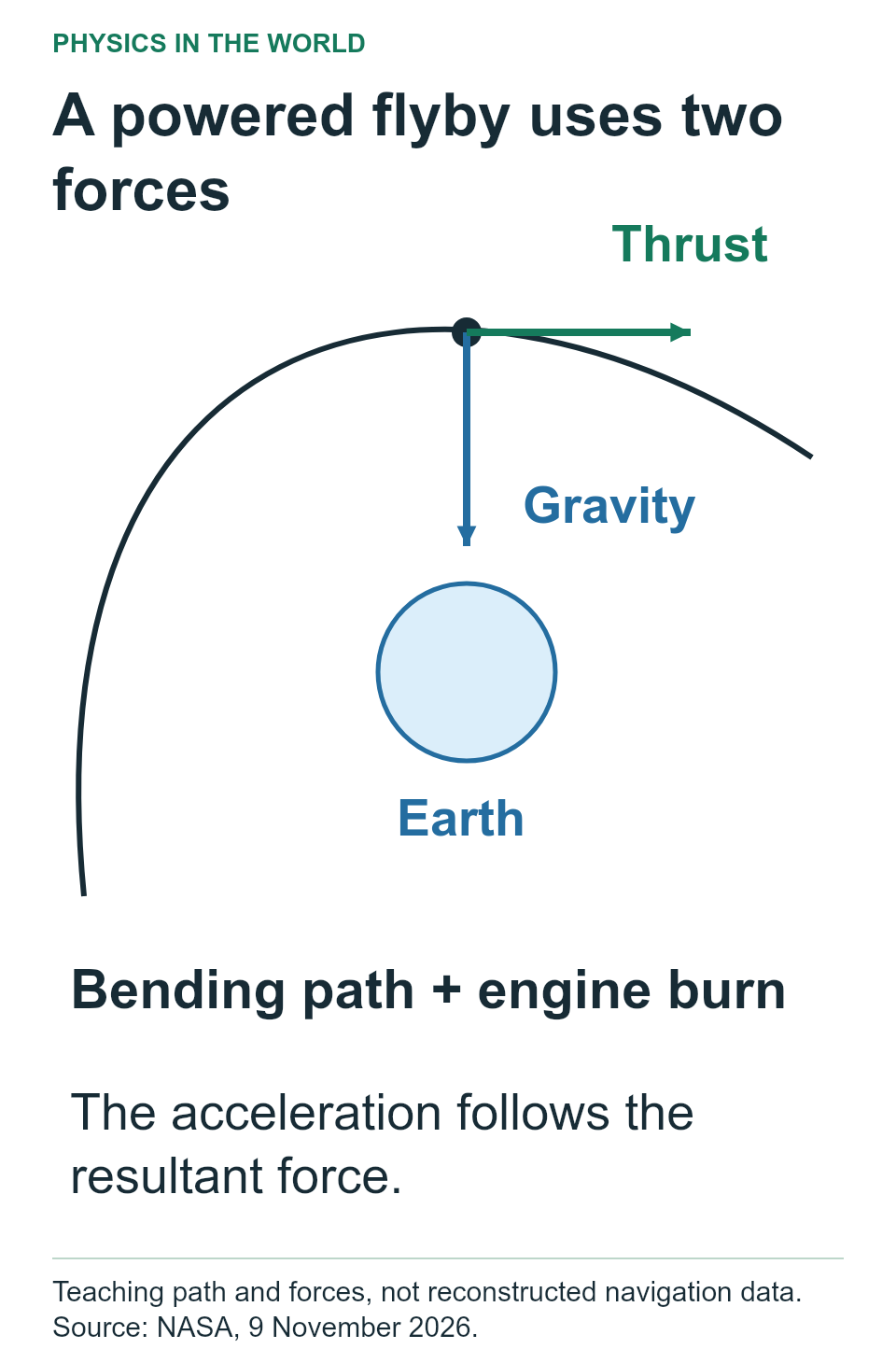
ESCAPADE adds another ingredient: thrust from its own engines. The burn was timed as part of the close encounter. Calling the manoeuvre a powered flyby matters because it stops us treating this particular mission as a demonstration of an engine-free trajectory.
What will the twin probes measure at Mars?
The route gets a pair of measuring stations to Mars. The solar wind is a stream of charged particles flowing from the Sun, and it interacts with a planet's magnetic and atmospheric environment. It is not a breeze travelling through air between planets.
Mars does not have an Earth-like global magnetic field, although magnetised regions of its crust and its interaction with the solar wind still create a complicated magnetic environment. Charged particles and electromagnetic fields help transfer energy through that environment.
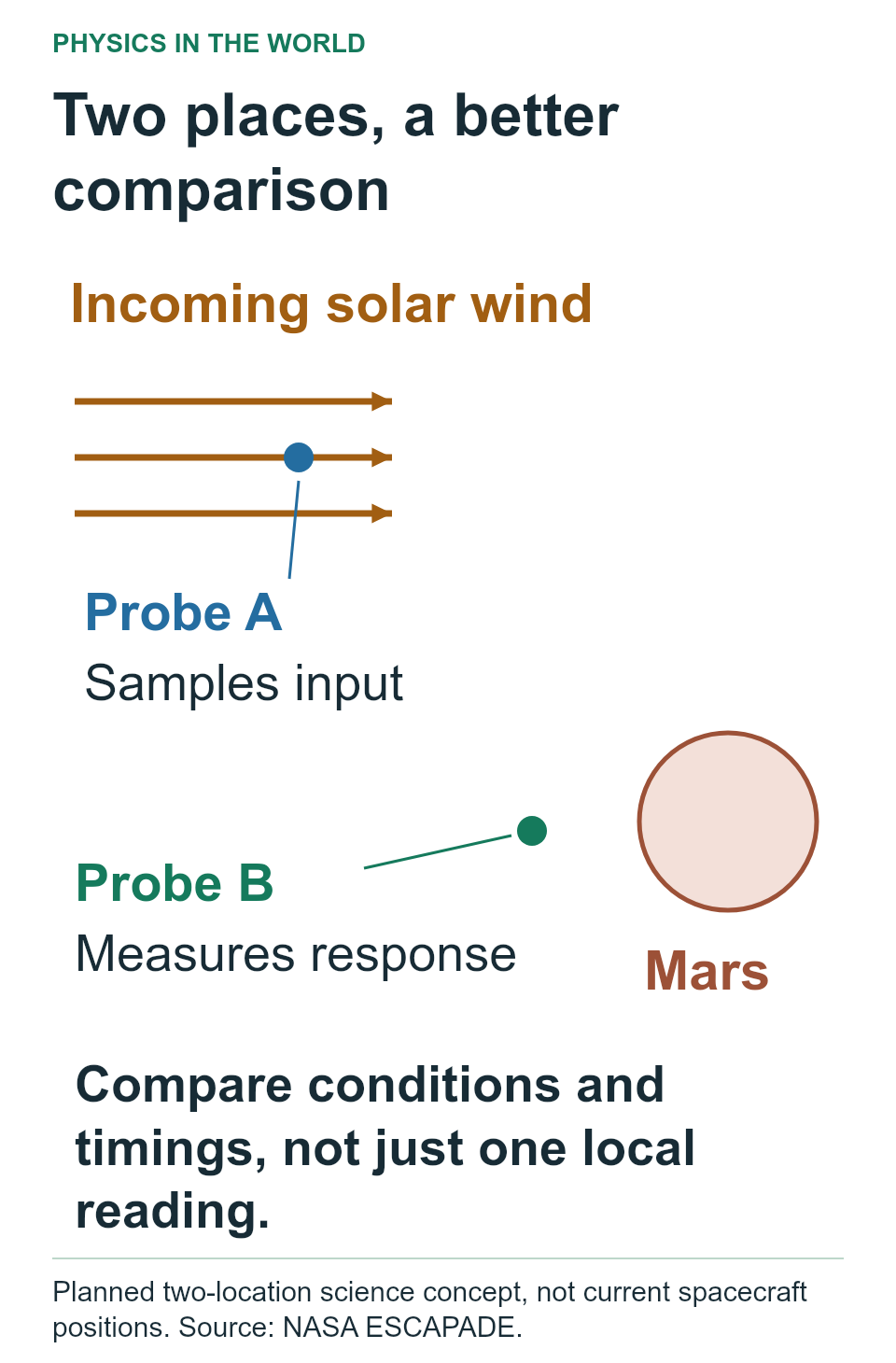
One reading at one place leaves an awkward question: did the measured conditions change because the incoming solar wind changed, or because the spacecraft moved into a different region? Two coordinated spacecraft can help separate those explanations.
In a planned campaign, one probe will measure the incoming solar wind while the other measures the response closer to Mars. Comparing the timings and conditions is more informative than assuming one local measurement represents the whole planet.
The main science operations are expected in June 2028. Arrival is not the same as being ready for every experiment: the team must establish suitable orbits and configurations first. That distinction is worth keeping when reading a launch or flyby headline.
Forces change velocity: the school physics
Velocity includes direction as well as speed. A spacecraft can therefore accelerate when its path bends even if, at some instant, its speed is not changing. The speed, velocity and acceleration revision page is the right place to practise that distinction.
For a freely flying spacecraft near Earth, gravity points approximately towards Earth's centre. It does not point along a curved track just because the spacecraft is following that track. During an engine burn, thrust adds a separate force, and the acceleration depends on the resultant.
There is no need to invent an outward centrifugal force to push the spacecraft away in a straightforward inertial-frame explanation. Its existing velocity and the changing gravitational pull determine the unpowered part of the trajectory.
The gravitational fields and orbits notes connect that force picture to potential energy. A probe falling closer can gain kinetic energy while gravitational potential energy decreases. Moving away reverses that exchange unless other parts of the system or an engine also transfer energy.
A spacecraft engineer must plan more than a closest approach. Small navigation errors can change the later path, and the vehicle also needs propellant, power and communications. Voyager's one-light-day milestone shows how a completely different mission makes those communications constraints especially obvious.
A Level stretch: where does the extra energy come from?
Always state the reference frame. In the ideal planet-centred description of an unpowered flyby, far before and far after the encounter at the same separation, the speeds are equal but the velocity directions differ. Adding the planet's orbital velocity changes the picture in the Sun-centred frame.
The planet experiences an equal and opposite gravitational force. Its enormous mass makes its change in motion tiny, but the energy and momentum exchange is still real. A spacecraft gaining orbital energy is not getting something from nothing.
For the powered case, add the work done by thrust and account for expelled propellant. You cannot use a conservation-of-mechanical-energy argument for the spacecraft alone while quietly leaving its firing engine out. The OCR gravitational fields resource helps establish the unpowered model before adding that complication.
Finally, reaching Mars is not the same as being captured by Mars. The spacecraft need further engine burns to reduce their speed relative to the planet and enter the intended orbits. Flying past a destination and remaining there are different navigation problems.
Key words
Quick pupil questions
When did ESCAPADE fly past Earth?
The two powered Earth flybys were completed on 7 and 9 November 2026. Both used gravity together with an engine burn.
When will ESCAPADE arrive at Mars?
Mars orbit insertion is planned for September 2027. Main science operations are expected to begin in June 2028 after further orbit adjustments.
Does a gravity assist break conservation of energy?
No. An unpowered spacecraft exchanges energy and momentum with the moving planet. For ESCAPADE's powered flyby, the engine and its propellant must also be included.
Why does ESCAPADE need two spacecraft?
Coordinated measurements at two locations help distinguish changes in the incoming solar wind from changes across the Martian space environment.