

When do the Orionids peak in 2026?
The 2026 Orionids peak on the night of Wednesday 21 October into Thursday 22 October. NASA lists activity from 2 October to 7 November, so the peak is the middle of an observing season rather than the only night anything happens.
For UK viewers, after midnight towards dawn is a useful window. Royal Observatory Greenwich warns that the waxing gibbous Moon will affect the 2026 display. Its light brightens the background sky, making faint meteors harder to notice.
Check cloud, the Moon and your local horizon before choosing a time. There is no reason to travel a long way to a dark site under solid cloud. A clear view on a nearby night can be better than a poor view on the nominal peak.
NASA gives a typical dark-sky rate of about 10 to 20 meteors an hour. Treat that as context, not a forecast for your garden. Streetlights, moonlight, cloud and the amount of sky you can see all reduce the number you might count.
What does Halley's comet have to do with it?
The Orionids are linked to Halley's comet. As a comet approaches the Sun, warming releases gas and small particles from its icy material. Some of that debris spreads along the comet's route. Earth crosses a stream of these particles each year.
We are not waiting for Halley's comet itself to fly overhead in October. The comet is far away; the shower comes from debris left on earlier journeys. This is a useful distinction between an object and the trail it leaves behind.
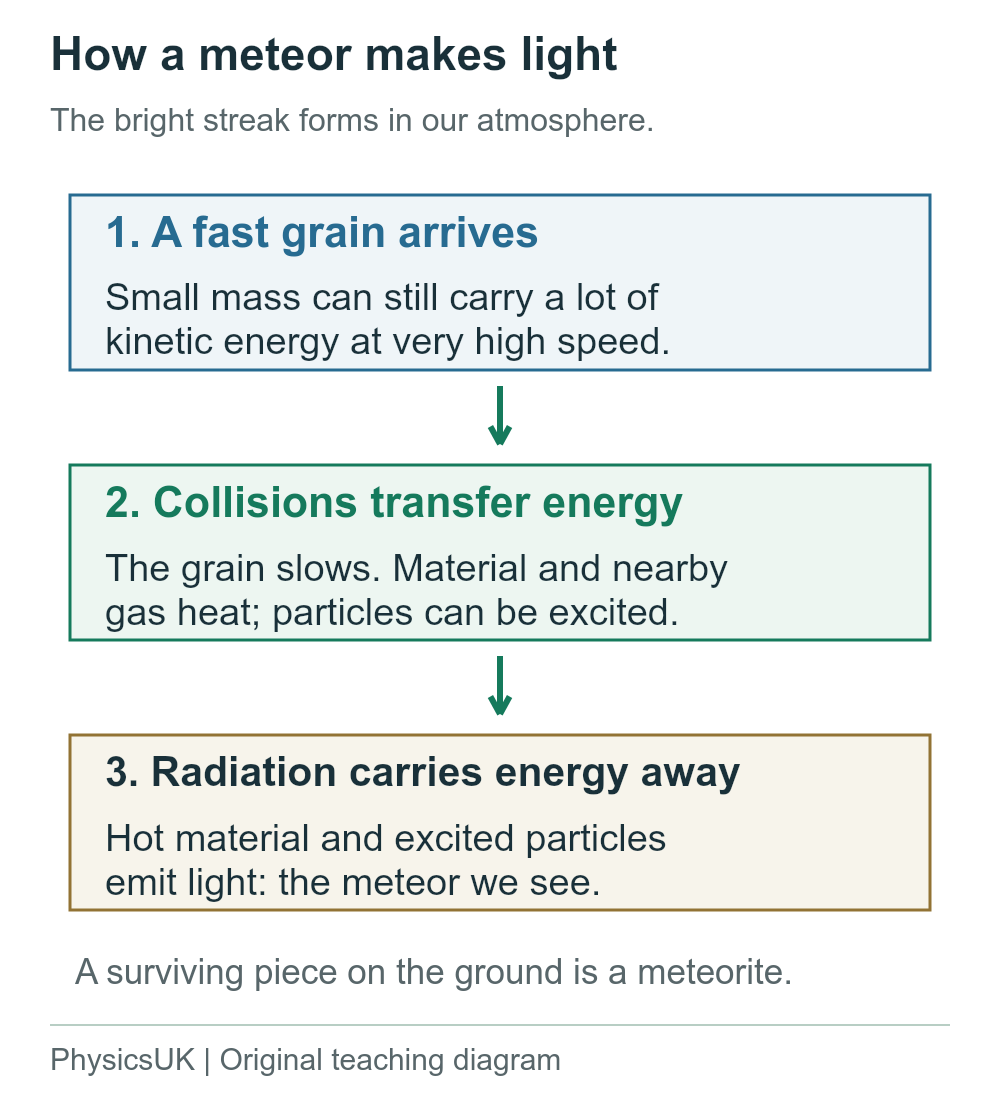
A small piece travelling through space is a meteoroid. The brief luminous event as it enters the atmosphere is a meteor. If some material survives to reach the ground, that surviving piece is a meteorite. Seeing a streak does not mean you should expect to find a rock nearby.
The name Orionids describes where the paths appear to lead back to in the sky: a point called the radiant, in the direction of Orion. It does not mean the particles came from the stars in that constellation. Nearly parallel paths can appear to converge through perspective, just as railway tracks seem to meet in the distance.
How to watch the Orionids from the UK
Find a safe place with a wide, unobstructed view. Dress warmly and allow your eyes time to adjust to darkness. A reclining chair makes it easier to watch a broad area without spending the whole time craning your neck.
Leave the telescope indoors. Its narrow field of view is excellent for a planet but a poor match for short streaks appearing in different parts of the sky. You do not need to stare directly at Orion either; meteors can be seen well away from the radiant.
Try to keep bright lamps and the Moon out of your direct view. Shielding your eyes helps, although it cannot remove the moonlight scattered across the sky. Avoid repeatedly checking a bright phone screen. Go with a responsible adult if you are a pupil heading out late.
For a first record, paper and a pencil are enough. Note when you began and ended, how much cloud there was and the meteors you saw. There will be quiet intervals. A satellite moving steadily across the sky is not the same as a meteor flashing past in a fraction of that time.
Why does a tiny grain make a bright meteor?
Orionid particles enter the atmosphere at roughly 66 kilometres per second, according to NASA. That speed is why a small mass can matter. Kinetic energy depends on mass, but it also depends on the square of speed: doubling speed gives four times the kinetic energy for the same mass.
As the particle meets the atmosphere, collisions transfer energy from its motion to the particle and surrounding gas. Material heats and can be lost from its surface. Excited particles emit light as they return to lower-energy states; hot material can also radiate. The luminous trail is more than a solid pebble glowing on its own.
Calling this simply "rubbing against the air" misses much of the story. A better GCSE explanation follows the energy: a decrease in kinetic energy is accompanied by energy transferred to material in the atmosphere and by radiation. Energy has not appeared from nowhere.
The energy calculations and power revision page helps with the speed-squared relationship. The explanation links directly to energy stores and changes, while solar system and orbital motion explains how Earth can encounter a debris stream at a similar time each year.
A Level stretch: what would make a fair meteor count?
Suppose two pupils report five and ten meteors. Before deciding the second saw a stronger shower, ask how long each watched, whether their skies were equally dark and whether one had trees blocking half the view. A count needs a defined observing interval and conditions.
Even under the same conditions, short counts fluctuate. Watching twice as long improves your evidence, but it does not guarantee exactly twice as many meteors. These are individual arrivals, not a clock ticking at a fixed rate.
For a simple comparison, use equal time intervals, record cloud cover and keep the same observing direction. Do not quietly count a cloudy ten-minute gap as though you had a clear view throughout. Our work on uncertainties in measurements explains why a result needs more context than one number.
These habits also matter to a data scientist: define what is being measured, keep track of missing observations and resist turning a small sample into a confident trend. Your meteor log can be the beginning of that kind of investigation.
Key words
Quick pupil questions
When is the Orionid meteor shower in the UK in 2026?
The peak night is 21-22 October. Activity runs from 2 October to 7 November, so meteors can also appear on surrounding nights.
What is the best time to watch the Orionids?
After midnight towards dawn is a useful window. In 2026, check local Moon conditions as well as cloud: moonlight can hide faint meteors.
Do I need binoculars or a telescope for a meteor shower?
No. Your eyes give a much wider field of view, which is useful for meteors appearing across the sky. Choose a safe place away from bright lights.
Will Halley's comet be visible during the Orionids?
The shower is caused by debris from earlier passages of Halley's comet, not the comet itself passing close to Earth in October.