

Can you see the northern lights in the UK?
The northern lights can be visible from the UK, but a social-media photograph from last night does not tell you what will happen tonight. The display depends on changing space weather as well as ordinary weather, darkness and your location.
For an advance view, read the Met Office space-weather forecast. Check its issue time and the period it covers. Look for the expected level of geomagnetic activity and any description of where aurora might be visible. A forecast for northern Scotland is not a forecast for the whole UK.
AuroraWatch UK provides a different kind of information. Its alerts use ground-based measurements of geomagnetic activity to indicate possible visibility. They are not advance predictions of a display hours or days away. A rising alert can be useful, but conditions can change while you travel.
This is an evergreen guide, not a live forecast embedded in an article. Follow the checked Met Office and Lancaster University links in Sources checked for the current position, and use a local cloud forecast as well. No alert can make an aurora visible through thick cloud.
What causes the northern lights?
The Sun continually sends out a flow of charged particles called the solar wind. Changes in that flow, including fast streams and some solar eruptions, can disturb the magnetic environment around Earth. It is more complicated than every solar flare immediately producing a display over Britain.
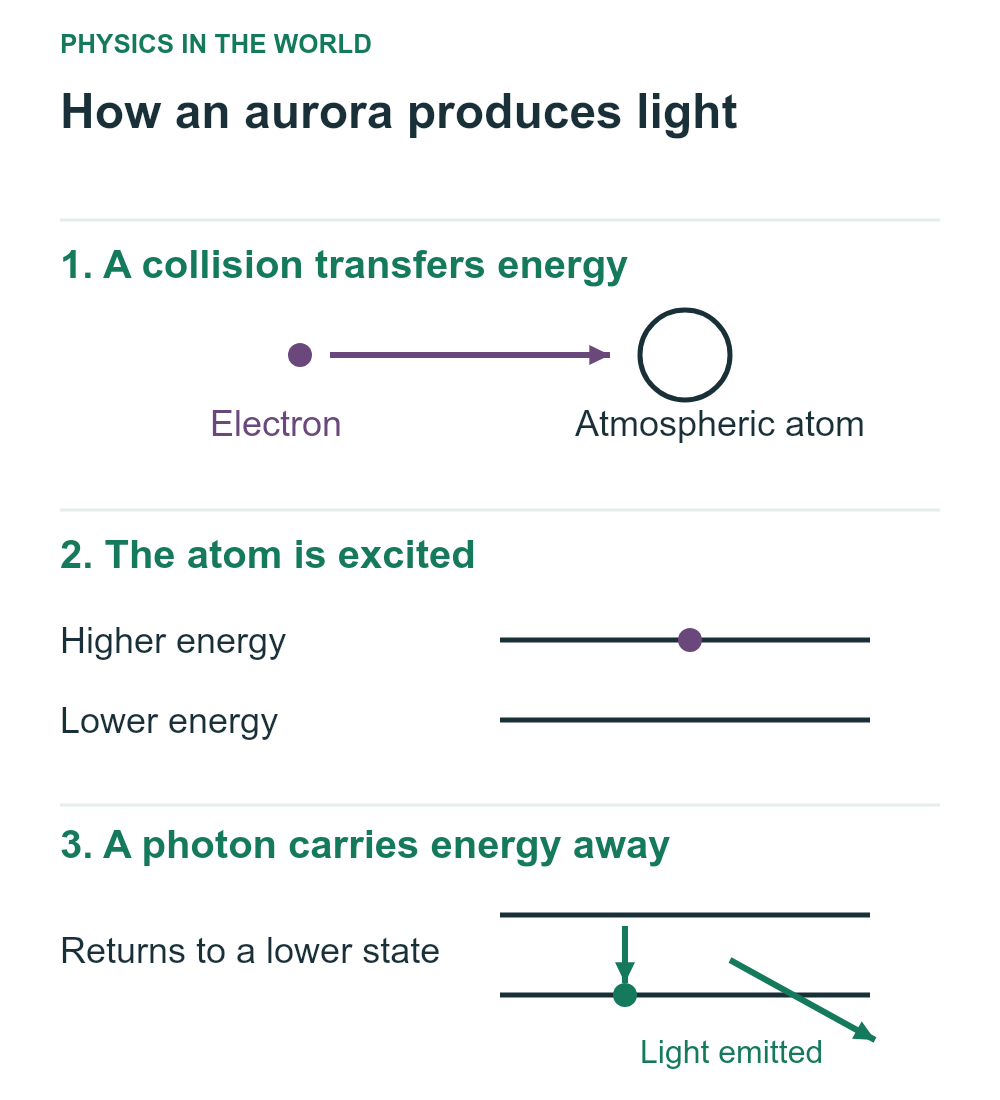
Earth has a magnetic field extending into space. During auroral activity, electrons can gain energy within this magnetic environment and travel along magnetic field lines towards the polar upper atmosphere. There they collide with atoms and molecules in the air.
In a collision, some energy can be transferred to an atom or molecule, leaving it in an excited state. When it returns to a lower energy state, it can emit a photon: a small packet of electromagnetic radiation. Large numbers of these events make the light visible.
NASA identifies oxygen as a source of green and red auroral light, and nitrogen as a source of blue and purple. Colour depends on which gas and which transition produce the light. It is not simply a rule that hotter air looks greener.
NOAA places aurora roughly 80-500 kilometres above the ground. This is far above ordinary weather clouds. A low cloud can still block our view, just as a nearby wall can hide a distant mountain.
How to check the forecast and take a photograph
Read AuroraWatch alert colours as guidance, not a ticket to a guaranteed show. Yellow indicates a more limited opportunity, particularly in Scotland and for cameras farther north. Amber and red indicate greater activity and wider potential visibility. Lancaster explicitly warns that local conditions must still be right.
Once it is dark, look from somewhere safe with a clear northern horizon and little direct artificial light. If activity becomes strong, the display can extend higher or across more of the sky, so keep an eye on a broad area. Do not walk onto unsafe ground or stop a car dangerously to chase a photograph.
At low light levels our eyes are less effective at seeing colour. A supported camera can collect light over an exposure and make a faint coloured glow easier to record. That is why a phone image can look greener than the scene does to you. Automatic processing can change the appearance further.
Try a stable support, a timer and a modest night-mode exposure. Compare several images, keep a note of time and direction, and check whether the glow has structure or changes. Light pollution and thin cloud can also create coloured patches, so one bright phone image is not conclusive evidence.
The useful question is whether the observation matches the direction, conditions and recorded activity, not whether it is colourful enough to share. Expect anything from no visible display to a faint glow or moving structure; do not assume every UK event resembles a long-exposure photograph from the Arctic.
The school physics inside an aurora
The electromagnetic spectrum includes the visible light reaching your eyes. Red and green light are the same kind of radiation, but their wavelengths and frequencies differ. Neither colour is a different speed of light when travelling through a vacuum.
For A Level, the photon model of electromagnetic radiation explains how a colour relates to energy per photon. A shorter wavelength corresponds to a higher frequency and greater photon energy. A brighter patch does not necessarily mean that its individual photons have more energy.
Our GCSE page on lenses and the eye explains how an image forms. Forming a sharp image and detecting faint light are different tasks: good focus cannot replace enough collected light. This helps explain why a camera support is often more useful than digital zoom.
A space scientist combines measurements from the Sun, spacecraft and ground instruments. The basic habit is familiar from school: compare evidence, record the conditions and distinguish a prediction from an observation. An alert and your own photograph measure different parts of the same event.
A Level stretch: why different colours mean different energies
Atomic and molecular systems have particular allowed energy states. An emitted photon carries the energy difference for a transition between states. Different transitions give different frequencies, which is why an emission spectrum can identify gases.
The familiar green oxygen emission is not evidence that oxygen emits only green light. The same element can have several allowed transitions. Atmospheric density and collision rates help determine which excited states survive long enough to emit, so altitude can affect the colours we see.
Think about uncertainties in measurements when interpreting an alert. A magnetometer records a local magnetic signal; it does not directly count the photons entering your eye. Turning that measurement into visibility guidance involves assumptions, and your cloud cover and light pollution add another layer.
Key words
Quick pupil questions
Can I see the northern lights in the UK tonight?
Check the current Met Office space-weather forecast, AuroraWatch UK alerts and your local cloud forecast. Visibility changes, and an alert does not guarantee a display at your location.
What causes the northern lights?
Energetic particles collide with gases in the upper atmosphere. Excited atoms and molecules can emit light as they return to lower energy states.
Why are the northern lights green?
Oxygen can emit green light in a particular transition. Oxygen can also produce red light, while nitrogen contributes other colours, including blue and purple.
Why do northern lights look brighter on a phone?
A camera can collect faint light over an exposure and process the result, while our eyes have reduced colour sensitivity in dim conditions. A photograph can therefore show colour you barely see by eye.