

What has NASA actually announced about PRIMA?
NASA announced on 23 September 2026 that PRIMA will move into Phase B, its preliminary design and technology development stage. The name stands for PRobe far-Infrared Mission for Astrophysics. NASA gives 2033 as the target launch year and describes a planned five-year mission.
That wording matters. PRIMA has not launched, collected its first image or discovered a new planet. It still has to pass the reviews needed to proceed through the rest of development. This week's news is the decision to develop a particular kind of observatory.
The planned telescope has a 1.8-metre aperture. Its instruments would measure far-infrared radiation, including wavelengths beyond those covered by the James Webb Space Telescope. Rather than asking which telescope is "best", it is more useful to ask what each is able to measure.
NASA lists the UK Space Agency among the international partners. The scientific interest for a pupil is straightforward: choosing the wavelength of light you collect changes which parts of the Universe you can investigate.
PRIMA vs James Webb: a different part of the spectrum
Visible light is only a small part of the electromagnetic spectrum. Infrared has longer wavelengths than visible light. The radiation is still electromagnetic: it travels at the speed of light in a vacuum, even though our eyes cannot detect it.
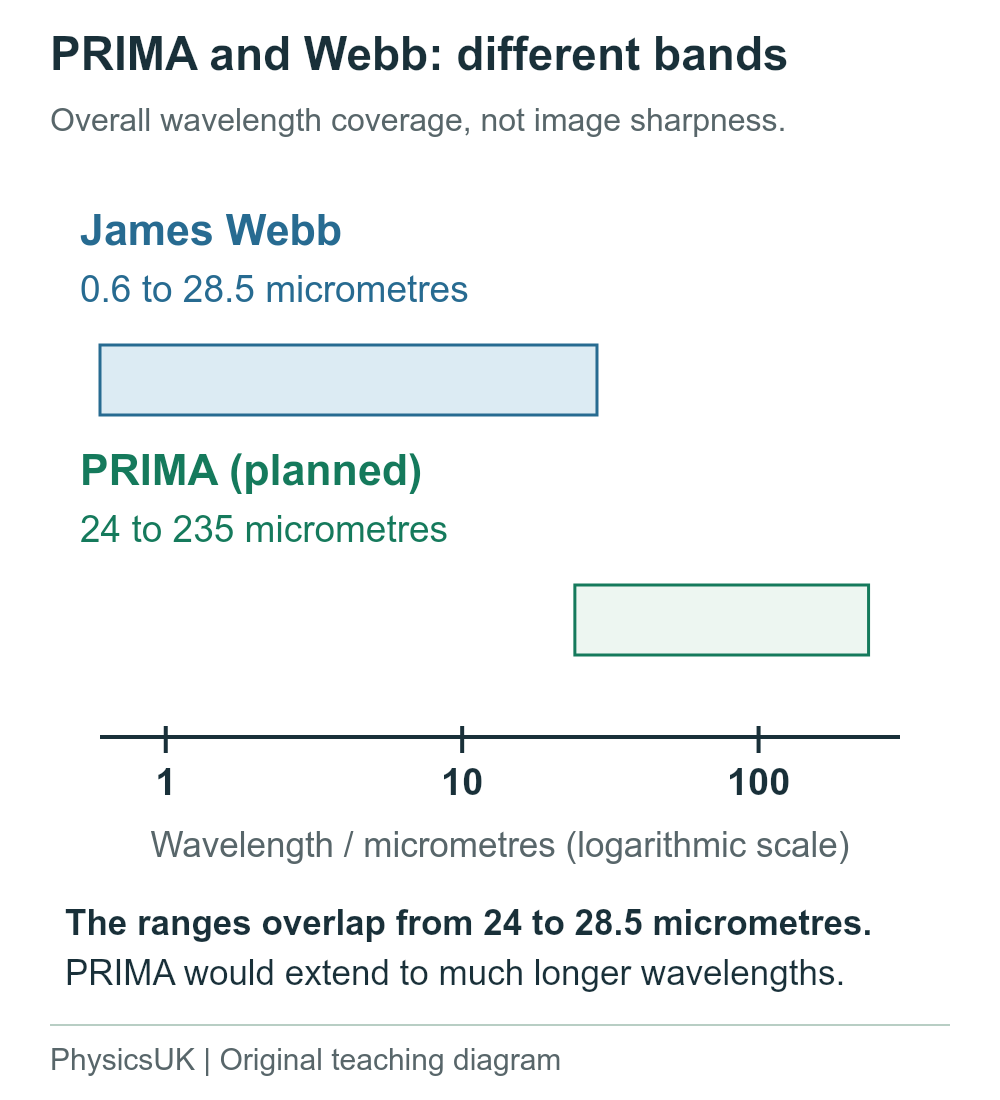
NASA lists Webb's overall coverage as about 0.6 to 28.5 micrometres. Caltech describes PRIMA's planned range as 24 to 235 micrometres. The ranges overlap a little, but PRIMA would extend much farther towards long wavelengths. A micrometre is one millionth of a metre.
Think of the comparison as listening to different parts of a musical range, not turning the volume up on the same sound. A telescope sensitive to one band cannot simply recover every signal in another band by taking a longer exposure.
The diagram uses a logarithmic scale. Equal distances along that axis represent equal multiplying factors, not equal additions. That lets the short and long wavelength ranges share one readable figure. It does not mean that either telescope is equally sensitive at every point along its bar.
What can cold dust tell us about stars and planets?
Space contains dust as well as stars. Dust can absorb shorter-wavelength radiation and emit energy at infrared wavelengths. Cooler material tends to have its strongest thermal emission at longer wavelengths than hotter material. An object can therefore be interesting even if it makes a poor visible-light photograph.
Studying that radiation helps astronomers investigate material involved in forming stars and planetary systems. It also helps them trace energy in galaxies, including environments where visible light alone gives an incomplete picture. These are measurement goals, not a claim that every dusty region contains a hidden planet.
PRIMA is planned to carry an imaging and polarimetry instrument, PRIMAger, and a spectrometer, FIRESS. An image maps where radiation arrives from. A spectrum separates it by wavelength, allowing scientists to look for features associated with particular materials and physical conditions.
Those approaches answer different questions. A brighter patch could reflect temperature, the amount of emitting material or other properties. Combining images and spectra helps test interpretations rather than assuming that brighter always means hotter. This is why a new wavelength range can be valuable without producing a sharper version of every familiar Webb picture.
Why must an infrared telescope be cold?
A warm telescope emits infrared radiation too. If that radiation reaches the detector, it contributes to the background against which a faint astronomical signal must be measured. Cooling the telescope and instruments reduces this thermal contribution.
Imagine trying to hear a quiet sound while equipment beside you hums loudly. Removing some of the equipment noise helps, but it does not make the distant sound louder. Cooling an observatory similarly improves the conditions for a measurement; it does not increase the energy of the incoming photons.
The classroom starting point is infrared absorption and emission. In that required practical, the radiation emitted or absorbed by a surface is part of what you investigate. In an observatory, unwanted radiation from the instrument itself becomes an engineering problem.
A spacecraft engineer has to consider temperature control alongside power, structure and communications. An astrophysicist then has to distinguish a real source from backgrounds and detector effects. Building the measurement and interpreting it are connected jobs, not separate stories.
A Level stretch: photon energy is not image brightness
In the photon model of electromagnetic radiation, photon energy is proportional to frequency and inversely proportional to wavelength. A longer-wavelength infrared photon has less energy than a shorter-wavelength photon. Both travel at the same speed in a vacuum.
Brightness is a different issue. A detector can receive many low-energy photons or fewer higher-energy photons. To compare total received power, you need the energy per photon and how many arrive each second. Wavelength alone is not enough.
Angular resolution is another separate property. For comparable optics at the same wavelength, a larger aperture can separate finer angular detail. PRIMA is smaller than Webb and is designed for longer wavelengths, so it should not be presented as a universal upgrade in sharpness.
The useful comparison is the question each instrument can answer. Which wavelength carries the evidence? How faint is it? What background competes with it? Those are the same kinds of decisions you make when choosing a sensor and controls for a school experiment.
Key words
Quick pupil questions
When will the PRIMA space telescope launch?
NASA gives 2033 as the target launch year. As of the September 2026 announcement, PRIMA is entering Phase B development and still has reviews ahead; it has not launched.
Is PRIMA replacing the James Webb Space Telescope?
No. PRIMA is designed to study a different, partly overlapping wavelength range. Its planned coverage is 24-235 micrometres, compared with about 0.6-28.5 micrometres for Webb.
Why are infrared telescopes cooled?
Their own warm components emit infrared radiation. Cooling reduces that thermal background, helping the instruments measure faint astronomical signals.