

Can solar panels generate through a UK winter?
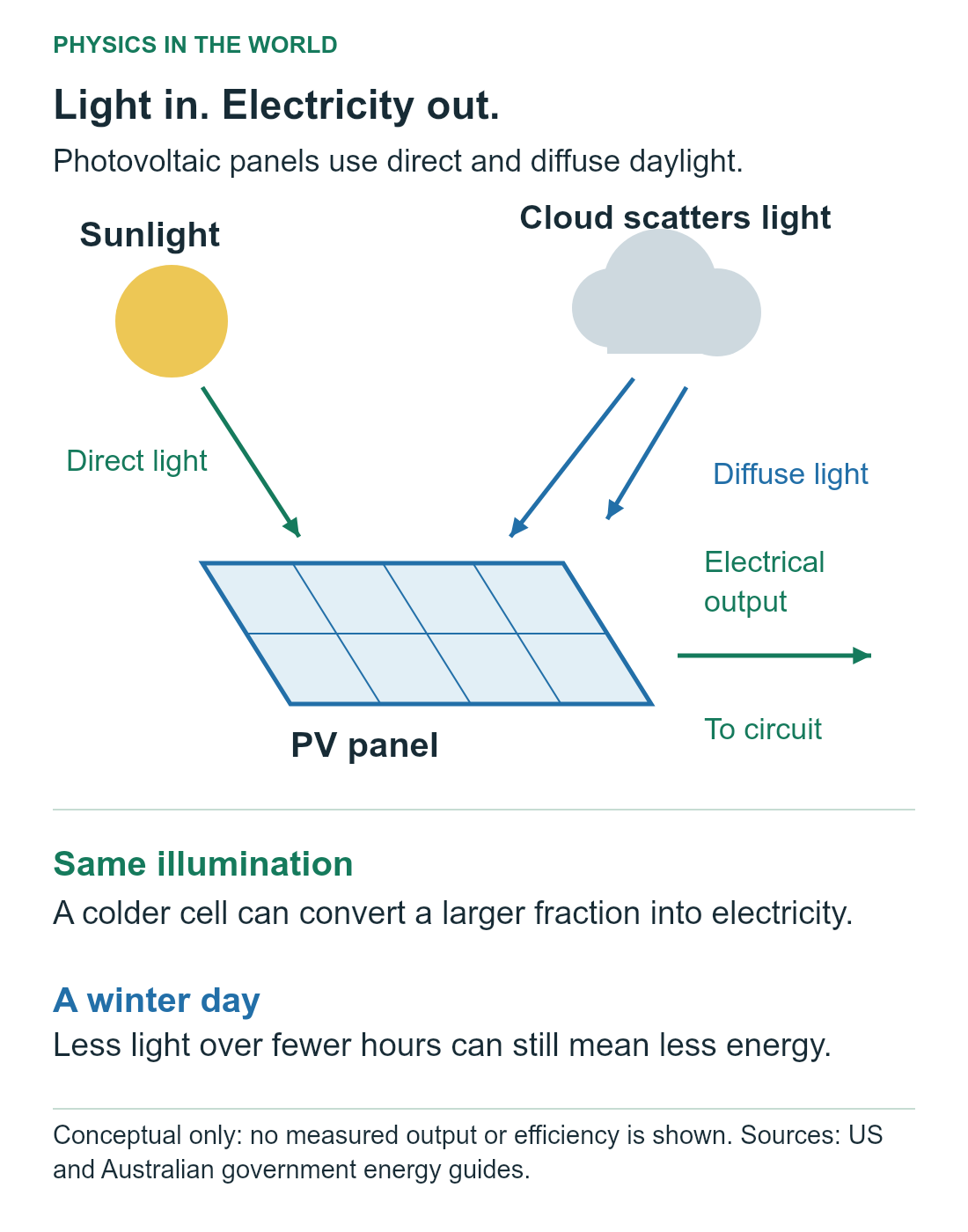
Yes, solar panels work in winter and on cloudy days when enough daylight reaches them. Panels can use direct sunlight and diffuse daylight arriving after scattering in the atmosphere. That is why a grey sky does not automatically mean zero generation.
For a UK household, winter usually brings fewer daylight hours and a lower Sun. The panel receives a different amount of solar energy across the day. You should not expect its summer energy total simply because it is still working.
This article concerns photovoltaic panels, which supply electricity. Solar thermal collectors heat water using a different process. The everyday word solar can refer to either, so check which technology a claim describes.
Do solar panels use light or heat?
Sunlight is electromagnetic radiation. A photovoltaic cell absorbs some of that radiation and transfers energy to electrons in a semiconductor, usually silicon. The structure of the cell helps separate electric charges, allowing a current to flow through a connected external circuit.
The panel is not waiting for the air to become hot. Light supplies the energy for this process. An ordinary warm room without suitable illumination cannot replace the sunlight falling on the cells.
Cloud changes the amount and direction of the light. Water droplets scatter sunlight, so some reaches the ground from different directions as diffuse daylight. A panel can use some of that light, but heavy cloud can reduce the available power substantially.
Temperature affects how the cell works. Under the same illumination, a cooler cell can convert a larger fraction of the incoming solar power into electrical power. That is a comparison with the incoming light held constant.
In winter, the incoming light is often reduced and available for fewer hours. A slightly better conversion fraction does not necessarily make up for receiving much less energy. Keep those two effects separate and the apparent contradiction disappears.
Worked equations
A simple way to separate power from energy
Power is the rate of energy transfer. As an illustrative example, an average output of 100 W for 4 hours gives 0.4 kWh. This is invented teaching data, not a typical winter forecast.
- Teaching example: 0.100 kW x 4 h = 0.400 kWh
Why winter output is usually lower
A low winter reading does not identify one cause. Short days, low Sun angle, cloud and shade can all matter. A nearby tree or building may cast a longer shadow when the Sun is low, even if the same roof looked clear in summer.
Snow covering the cells can block light. Snow and ice also introduce physical loads and installation concerns. Follow the system supplier's advice rather than climbing onto a roof to clear it.
Compare energy over a stated interval, such as a whole day or month. A sunny five-minute power reading and a cloudy day's energy total are different measurements. Our UK clock-change guide also explains why moving clocks back does not remove an hour of sunlight.
A battery can store energy supplied earlier, but it does not create extra solar energy. Keeping generation, storage and demand separate makes a household electricity graph much easier to understand.
The heat-pump explainer offers a useful comparison. A heat pump uses electricity to transfer energy from another place; a photovoltaic panel converts some incoming radiation into electrical energy. Their performance figures describe different jobs.
Power, energy and efficiency: the school physics
At GCSE, describe the input and useful output before discussing efficiency. The input is solar radiation reaching the panel. The useful output is energy transferred electrically to the circuit. Some incoming radiation is reflected or transmitted, and some absorbed energy becomes thermal energy.
Efficiency compares useful output with total input for the same system and interval. More sunlight can increase output without improving the conversion fraction. Equally, a higher efficiency does not guarantee more daily energy if the input is much smaller.
Watts measure power; joules and kilowatt-hours measure energy. One kilowatt-hour is the energy transferred at a constant power of one kilowatt for one hour. The current, charge and electrical energy worksheet gives practice with the quantities behind an electricity reading.
At AS and A level, the photon-model worksheet connects light frequency to photon energy. More intense light of the same frequency can supply more photons each second, rather than making every photon more energetic.
An electrical engineer designing a solar installation has to connect that physics to the rest of the circuit, including wiring, an inverter and protection equipment. A good cell alone is not a complete working electricity system.
A Level stretch: from a photon to a current
A semiconductor has allowed ranges of electron energies, called bands. Absorbing a suitable photon can produce mobile charge carriers. The cell's internal electric field helps separate them so they can contribute to current in an external circuit.
This is related to the quantum ideas in the photon model, but it is not the usual school experiment in which electrons are emitted from a metal surface. In a solar cell, the useful charge carriers move within the semiconductor and the circuit.
Not every arriving photon produces useful electrical output. A photon may be reflected, pass through, or be absorbed without contributing to collected charge. Some absorbed energy becomes heat, and charge carriers can recombine before they are collected.
A fair temperature test therefore keeps illumination and measurement conditions controlled. To investigate winter generation instead, record the incoming light, shading and energy output over time. Those experiments answer different questions.
Key words
Quick pupil questions
Do solar panels work in winter in the UK?
Yes, when daylight reaches the cells. Winter energy totals are usually lower because the days are shorter and the incoming sunlight, Sun angle and shading differ from summer.
Do solar panels work on cloudy days?
Yes. Some sunlight reaches the panels as diffuse light after scattering in the atmosphere. Output depends on how much light reaches the cells; thick cloud can reduce it substantially.
Do solar panels need light or heat?
Photovoltaic panels use absorbed light to supply electrical energy. They do not rely on hot air. Solar thermal collectors, which heat water, are a different technology.
Why can cold solar panels be more efficient but generate less in winter?
A colder cell can have a higher conversion efficiency under the same illumination. Winter can still supply much less light over fewer hours, reducing the total energy generated.