

What does the new black-hole research claim?
The Phys.org story published on 9 October is written by researcher Denys Dutykh. It brings together work with Davide Batic, and with Fabio Scardigli on two earlier papers, asking how quantum-inspired black-hole models might ring differently after a disturbance.
The latest paper studies a Hayward black hole, a mathematical model that replaces the central singularity with a finite core. It calculates possible oscillation frequencies and decay rates. The paper is useful for comparing models, but it is not a measurement of a real black hole's centre.
A central singularity is a place where the classical theory produces divergent quantities and stops giving a usable physical description. A finite core is one proposed way to alter that model. We do not yet have an established observation telling us that this is what an actual black hole contains.
What is black-hole ringdown?
After two black holes merge, the new black hole is disturbed. It settles towards a steady state, emitting a final, fading gravitational-wave signal. That stage is called ringdown. The name comes from the way the vibrations of a struck bell gradually die away.
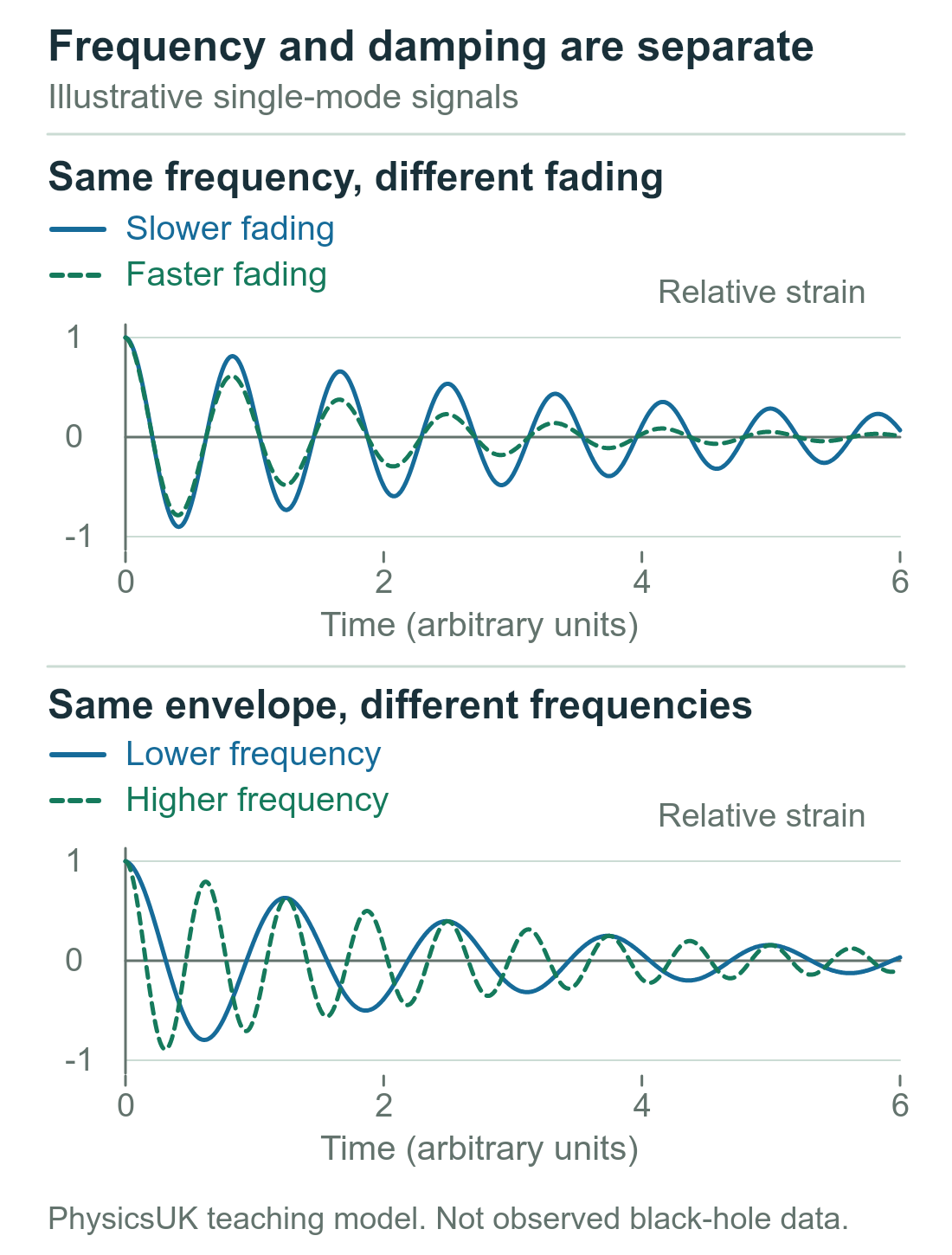
You do not need to know general relativity to recognise the shape of the signal. There are repeated peaks and troughs, but their size decreases. One feature describes the spacing of the oscillations. Another describes the rate at which the envelope around them shrinks.
A gravitational-wave detector measures strain: an extremely small fractional change in length. It is not recording a ball of matter bouncing up and down, or a pressure wave travelling through air. The graph looks familiar even though the physical quantity on its vertical axis is different.
That is the useful connection to a school oscillator. Pull a mass on a spring down and release it. If resistive forces are present, its displacement oscillates with a falling amplitude. The graph gives you two separate questions: how quickly does it repeat, and how quickly does it fade?
Look at the pairs of teaching curves below. The first pair keeps the oscillation rate fixed and changes the fading. The second keeps the same envelope and changes the oscillation rate. A smaller amplitude later on does not, by itself, mean a lower frequency.
Worked equations
Optional stretch: a single fading oscillation
This is a simplified single-mode ringdown model, not a required A-level equation. The strain h oscillates at frequency f. The initial envelope amplitude is multiplied by a decaying exponential, with damping time tau; phi sets the starting phase. The cosine repeats while the envelope falls. A longer damping time means slower fading. A real signal may contain several modes.
Why measure both frequency and damping?
For an ordinary astrophysical black hole in general relativity, the ringdown modes depend on its mass and spin. Measuring the signal provides a way to check whether those properties agree with the earlier stages of the merger. That is already part of gravitational-wave science.
The new calculations ask a different question: if the assumed black-hole structure changes, how does the predicted response change? In the models compared in the report, some changes shift the oscillation rate and fading in opposite directions to others. Those differences are what the author calls fingerprints.
A fingerprint in a calculation is not automatically a signature that an instrument can detect. It might be too small, hidden in noise, or similar to the effect of changing another parameter. A useful prediction needs to be both distinguishable and measurable.
This is work an astrophysicist might do with a data scientist: build a model, calculate the signal it predicts, and test whether different models can actually be told apart. Knowing how to compare graphs is a small but genuine part of that job.
Is the link to damped harmonic motion reasonable?
Yes, damped harmonic motion is a reasonable teaching link. LIGO's own explanations describe ringdown in terms of frequencies and damping times. The connection is strongest when you focus on the shape of the signal and what its features mean.
At A level, ideal simple harmonic motion has a restoring acceleration proportional to displacement and directed towards equilibrium. Its undamped amplitude stays constant. Real oscillators can lose energy from their motion, so the amplitude decreases. The OCR A damping and resonance worksheet gives practice with that distinction.
The AQA simple harmonic motion worksheet is useful for separating amplitude, period and frequency. Measure a period between equivalent points, such as one positive peak and the next. Do not measure from a positive peak to a negative trough and call that a full cycle.
The analogy has a limit. Air resistance can transfer a pendulum's energy to the surroundings as internal energy. Black-hole ringdown is a decaying disturbance of spacetime: energy can be carried away in gravitational waves and absorbed at the horizon. There is no requirement for surrounding air, and it is not friction rubbing a solid black-hole surface.
The gravitational fields worksheet supplies a starting point for thinking about mass and gravity. Newton's model is useful in many school problems, but it cannot describe an event horizon or a merger waveform. Being clear about where a model works is better physics than trying to make it answer every question.
A Level stretch: what would count as evidence?
There are two important cautions in this particular story. The largest contrasts discussed concern very small, near-Planck-scale model black holes, not the stellar-mass black holes in present merger detections. The report explicitly says those quantum-scale corrections are far too small for today's observations of stellar-mass black holes.
The primary paper also labels its gravitational perturbation calculation as an effective model. Specifying a background geometry does not uniquely settle how every physical disturbance should behave. Another assumption about that response can change a numerical prediction. More digits in a computer calculation do not remove that modelling uncertainty.
Nor does the signal give us a message escaping from inside the event horizon. The outgoing ringdown is associated with disturbances in the exterior region. A model may connect the assumed interior and exterior mathematically; that is different from directly seeing the core.
Suppose a measured signal differed from a prediction. Before announcing new physics, researchers would check detector noise, the estimated mass and spin, and errors in the waveform model. The measurements and errors worksheet introduces the same habit: investigate uncertainty before assigning a cause.
The LIGO-Virgo-KAGRA collaboration's July 2026 tests remained consistent with general relativity. The honest conclusion here is narrower than "quantum cores found": calculations suggest possible differences worth studying, and the fading-wave picture gives us a useful way to understand what is being compared.
Key words
Quick pupil questions
What is black-hole ringdown?
Ringdown is the fading gravitational-wave signal produced as a disturbed black hole settles after an event such as a merger. Its oscillation frequencies and damping times can be compared with a theoretical prediction.
Is black-hole ringdown the same as damped harmonic motion?
The signal can be modelled with damped oscillations, so the graph-reading connection is sound. The physical mechanism is different from a school spring or pendulum, and the detector measures gravitational-wave strain rather than displacement.
Have quantum cores inside black holes been discovered?
Not in this study. It compares calculated responses of quantum-inspired black-hole models. It does not report an observed quantum core or a direct view through an event horizon.
Does faster damping mean a lower frequency?
No. Damping describes how quickly the amplitude envelope falls; frequency describes the number of oscillations per second. They are separate properties and must be measured separately.