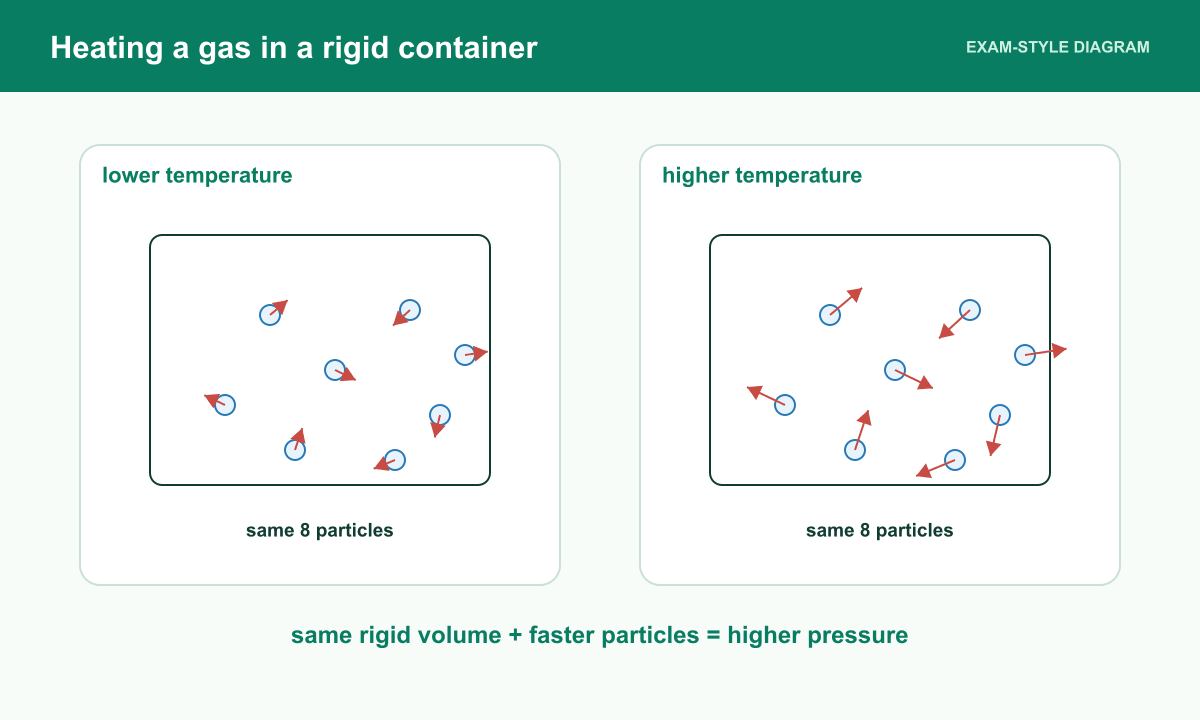
Gas pressure comes from repeated molecular impacts on a surface. Keep the amount of gas, volume and temperature conditions explicit before predicting a change.
Subsection scope: Molecular temperature/pressure is shared at both tiers. pV = constant is Physics only at both tiers; work on a gas is Physics Higher only.
Learn · practise · improve
Start here
The revision snapshot
Gas pressure comes from repeated molecular impacts on a surface. Keep the amount of gas, volume and temperature conditions explicit before predicting a change.
By the end, you should be able to:
Explain pressure through molecular wall impacts.
Predict pressure change in a heated rigid container.
Apply the Physics constant-temperature pV relationship.
Before you revise
Diagnostic question
Choose an answer from memory. Your result tells you what to watch for in the guide.
Core revision guide
Learn the model, then use it
Gas pressure comes from repeated molecular impacts on a surface. Keep the amount of gas, volume and temperature conditions explicit before predicting a change.
01
Heating a rigid sealed container
Scope: 8463 and 8464 · Foundation and Higher
Gas molecules move randomly and collide with walls, exerting a force per unit area. Higher temperature means larger average kinetic energy. In the same volume, molecules strike the walls more frequently and with larger momentum changes; the average force and pressure rise. The container must remain sealed and rigid for this comparison.
02
Compression at constant temperature
Scope: 8463 Physics only · Foundation and Higher
For a fixed mass at constant temperature, p₁V₁ = p₂V₂. A smaller volume makes wall collisions more frequent while average kinetic energy remains unchanged. Doubling volume halves pressure. Pressures must be absolute rather than pressure above atmospheric pressure; the two volumes may use the same unit because their ratio is used.
03
Doing work on a gas
Scope: 8463 Physics only · Higher only
Pushing a piston transfers energy mechanically into the enclosed gas. If the gas does not lose that energy by heating the surroundings, its internal energy and temperature can rise. This explains warming in a rapidly compressed bicycle pump. It is a different situation from slow compression held at constant temperature.
The particle count and volume stay constant; higher temperature increases mean kinetic energy and pressure.Open the full-size exam diagram
Physics only, both tiers: constant-temperature gasp₁V₁ = p₂V₂Pa; use consistent volume units
Misconception clinic
Replace the tempting answer
Read each belief, say what is wrong with it, then compare your correction.
Tempting idea: Its molecules become heavier.
Use instead: Molecular masses do not change. This raises the mean force per unit area.
Use absolute temperature and volume to compare pressure with a gas at 20 °C and its starting volume.
Model scope: Optional enrichment: quantitative absolute-temperature/volume gas model; qualitative temperature–pressure reasoning is shared GCSE content
What to notice: use the readout to describe how one variable changes when the other is controlled.
Worked examples
See the method being built
Apply heating a rigid sealed container in the worked reasoning, then try the changed-context questions below.
Example 1 · Heat a sealed can
Scope: 8463 and 8464 · Foundation and Higher
Explain why pressure rises when a sealed rigid gas container is heated.
Temperature raises average kinetic energy.
Particles move faster.
Collisions are more frequent and harder.
Show the answer
Faster particles collide with the walls more often and with greater force, so force per area and pressure increase.
Example 2 · Compress a syringe
Scope: 8463 Physics only · Foundation and Higher
Explain why pressure rises when a syringe is compressed at constant temperature.
Number of particles stays the same.
Volume decreases.
Wall collisions become more frequent.
Show the answer
In the smaller volume, particles hit the walls more often, increasing force per area and pressure.
Example 3 · Cooling a balloon
Scope: 8463 Physics only · Foundation and Higher
A balloon becomes smaller in a cold room. Explain using particles.
Cooling slows particles.
Internal pressure falls relative to outside pressure.
The flexible balloon contracts.
Show the answer
Slower particles collide less often/less forcefully, so internal pressure falls and the balloon contracts until pressures balance.
Exam precision
Use the physics precisely
Do this: State what stays fixed before explaining collisions or using pV. Distinguish constant-temperature compression from work that warms the gas.
Independent practice
Exam-style questions
Write an answer before opening the marking guidance. Then edit the exact phrase or step that would gain the next mark.
1. Explain why pressure rises when a sealed rigid gas container is heated.
[3 marks]
Scope: 8463 and 8464 · Foundation and Higher
Show marking guidance and model answer
Original PhysicsUK mark scheme: Point 1 (1 mark): Average molecular kinetic energy/speed increases. Point 2 (1 mark): Wall impacts become more frequent and involve larger momentum changes. Point 3 (1 mark): The average force per unit area and pressure increase. Award each distinct point once. Accept equivalent scientifically correct wording. No half marks.
Average molecular kinetic energy/speed increases. (1 mark)
Wall impacts become more frequent and involve larger momentum changes. (1 mark)
The average force per unit area and pressure increase. (1 mark)
Model answer: Faster molecules hit the walls more frequently with larger momentum changes, raising mean force per unit area.
2. Physics only: a fixed mass of gas occupies 80 cm³ at 120 kPa. Find its pressure at 50 cm³ at the same temperature.
[3 marks]
Scope: 8463 Physics only · Foundation and Higher
Show marking guidance and model answer
Original PhysicsUK mark scheme: Point 1 (1 mark): p₁V₁ = p₂V₂. Point 2 (1 mark): p₂ = 120 × 80/50. Point 3 (1 mark): p₂ = 192 kPa. Award each distinct point once. Accept equivalent scientifically correct wording. No half marks.
Acceptable answers: Expected result: p₂ = 192 kPa. Accept the unrounded value or a correctly rounded equivalent to two or more significant figures; accept equivalent units if converted correctly. No additional measurement interval is implied.
Marking notes: Method marks remain available after an arithmetic error. Carry an earlier numerical error into a later valid step; award that method point if the unit conversion and physics are correct. A fully correct answer with unit earns all marks unless working is expressly requested.
Questions pupils ask
Gas Pressure and Temperature FAQs
Why must gas volume be fixed when comparing pressure and temperature?
Changing volume also changes collision frequency, so it would introduce a second cause of pressure change.