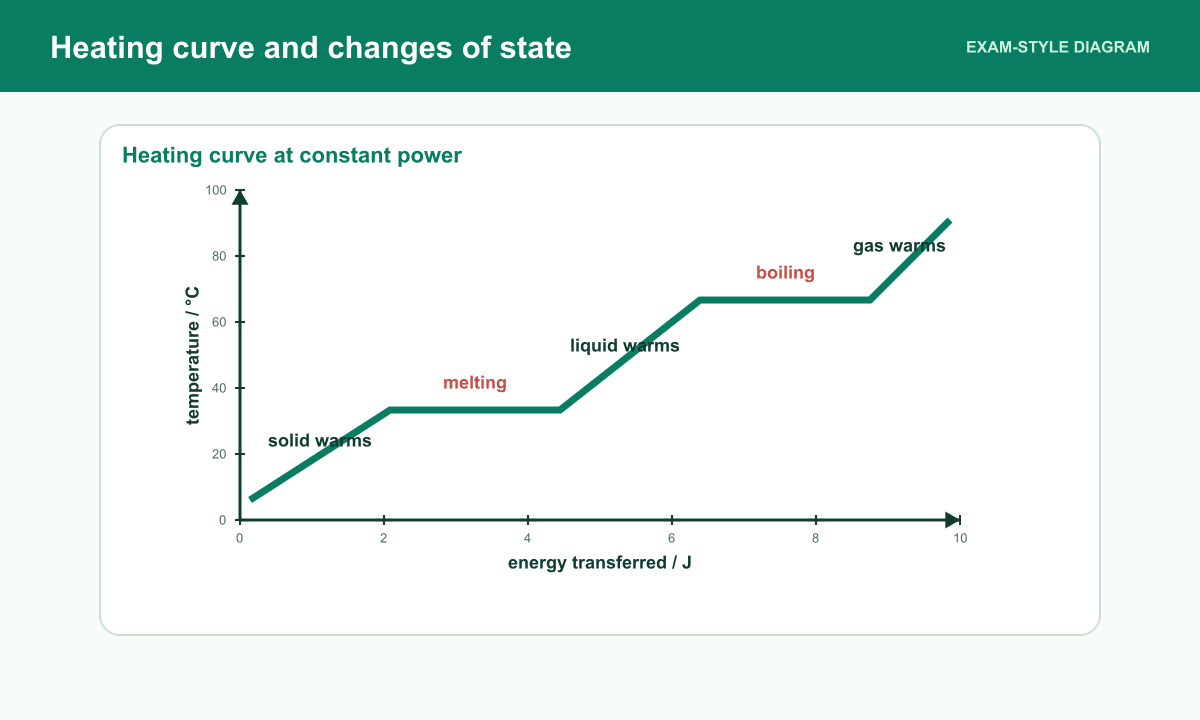
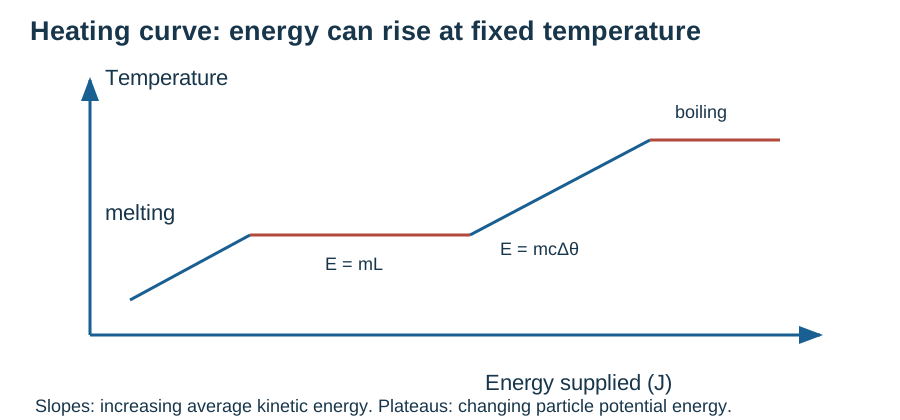
A temperature rise and a change of state both increase internal energy, but they require different equations and different particle explanations.
By the end, you should be able to:
Distinguish kinetic and potential contributions to internal energy.
Explain a state-change plateau.
Choose specific heat or latent heat for each stage.
Before you revise
Diagnostic question
Choose an answer from memory. Your result tells you what to watch for in the guide.
Core revision guide
Learn the model, then use it
A temperature rise and a change of state both increase internal energy, but they require different equations and different particle explanations.
01
Internal energy and temperature
Scope: 8463 and 8464 · Foundation and Higher
Internal energy is the total kinetic and potential energy of the particles. Temperature is related to their average kinetic energy, not their total internal energy. During a rising section of a heating curve particles gain average kinetic energy. E = mcΔθ uses c in J/(kg °C) and a temperature difference, not the final temperature.
02
Latent heat and a plateau
Scope: 8463 and 8464 · Foundation and Higher
Specific latent heat L is energy needed per kilogram to change state without changing temperature; its unit is J/kg. Fusion is solid to liquid; vaporisation is liquid to gas. E = mL. While a pure substance melts or boils at steady pressure, energy changes particle potential energy and arrangements rather than average kinetic energy. Constant temperature does not mean zero energy transfer.
03
A two-stage calculation
Scope: 8463 and 8464 · Foundation and Higher
Melting 0.20 kg of ice already at 0 °C, with L = 334000 J/kg, requires 66800 J. Warming the resulting water to 20 °C, with c = 4200 J/(kg °C), needs 16800 J. Add the two stages: 83600 J. Do not use E = mcΔθ across the melting plateau. Cooling reverses these store changes; freezing/condensation release energy.
Temperature rises within a state but stays constant during a change of state while energy changes the particle arrangement.Open the full-size exam diagram
Temperature rises use c; horizontal state-change regions use L.
Temperature changeE = mcΔθJ, kg, J/(kg °C), °CChange of stateE = mLJ, kg, J/kg
Misconception clinic
Replace the tempting answer
Read each belief, say what is wrong with it, then compare your correction.
Tempting idea: Temperature and average kinetic energy rise steadily.
Use instead: During the plateau average kinetic energy stays constant. Energy changes the particle potential energy/arrangement.
Tempting idea: E = mcΔθ.
Use instead: Δθ is zero during the ideal phase change. L is specific latent heat of vaporisation.
Retrieval practice
Quick checks
Explore the relationship
Heating curve reader
Use the energy position to locate a point on the heating curve. The heating rate then determines the time taken to supply that energy.
Model scope: 8463 and 8464 · Foundation and Higher
What to notice: use the readout to describe how one variable changes when the other is controlled.
Worked examples
See the method being built
Apply internal energy and temperature in the worked reasoning, then try the changed-context questions below.
Example 1 · Heating a block
Scope: 8463 and 8464 · Foundation and Higher
A 0.40 kg block has c = 900 J/kg °C and warms by 15 °C. Calculate energy transferred.
Use E = mcΔθ.
E = 0.40 × 900 × 15.
The unit is joules.
Show the answer
E = 5400 J.
Example 2 · Melting ice at a plateau
Scope: 8463 and 8464 · Foundation and Higher
A heating curve is flat while ice melts. Explain where the supplied energy goes.
Temperature measures average particle kinetic energy, which stays constant during melting.
Supplied energy increases particle potential energy as the ordered ice structure is rearranged and its binding interactions are weakened.
Melting ice becomes denser: average separation need not increase. Contrast vaporisation, where particles separate widely.
Show the answer
The energy changes particle arrangement and potential energy rather than average kinetic energy, so temperature remains constant. Ice’s open structure collapses during melting; universal separation is not the explanation.
Example 3 · Internal energy change
Scope: 8463 Physics only · Higher only
A gas is compressed without cooling. Describe its internal-energy change.
Work is done on the gas.
Energy enters mechanically without being lost by heating.
Average particle kinetic energy and temperature can rise.
Show the answer
Work done on the gas increases internal energy; temperature can rise.
Exam precision
Use the physics precisely
Do this: Name whether temperature or state changes. Use E = mcΔθ or E = mL accordingly, and explain a plateau through potential-energy change rather than hotter particles.
Independent practice
Exam-style questions
Write an answer before opening the marking guidance. Then edit the exact phrase or step that would gain the next mark.
1. How much energy melts 0.15 kg of ice at 0 °C? L = 334000 J/kg.
[3 marks]
Scope: 8463 and 8464 · Foundation and Higher
Show marking guidance and model answer
Original PhysicsUK mark scheme: Point 1 (1 mark): E = mL. Point 2 (1 mark): E = 0.15 × 334000. Point 3 (1 mark): E = 50100 J (5.01 × 10⁴ J). Award each distinct point once. Accept equivalent scientifically correct wording. No half marks.
E = mL. (1 mark)
E = 0.15 × 334000. (1 mark)
E = 50100 J (5.01 × 10⁴ J). (1 mark)
Model answer: E = mL. E = 0.15 × 334000. E = 50100 J (5.01 × 10⁴ J).
Acceptable answers: Expected result: E = 50100 J (5.01 × 10⁴ J). Accept the unrounded value or a correctly rounded equivalent to two or more significant figures; accept equivalent units if converted correctly. No additional measurement interval is implied.
Marking notes: Method marks remain available after an arithmetic error. Carry an earlier numerical error into a later valid step; award that method point if the unit conversion and physics are correct. A fully correct answer with unit earns all marks unless working is expressly requested.
2. A heating curve has a horizontal section while water boils. Explain why energy is still transferred.
[3 marks]
Scope: 8463 and 8464 · Foundation and Higher
Show marking guidance and model answer
Original PhysicsUK mark scheme: Point 1 (1 mark): The temperature/average kinetic energy remains constant. Point 2 (1 mark): Energy increases particle potential energy as particles separate into a gas. Point 3 (1 mark): Internal energy increases despite the constant temperature. Award each distinct point once. Accept equivalent scientifically correct wording. No half marks.
The temperature/average kinetic energy remains constant. (1 mark)
Energy increases particle potential energy as particles separate into a gas. (1 mark)
Internal energy increases despite the constant temperature. (1 mark)
Model answer: The temperature and average kinetic energy stay constant. Energy increases particle potential energy as the liquid becomes gas, so internal energy still rises.
Questions pupils ask
Internal Energy and Heating Curves FAQs
Can heating increase internal energy without increasing temperature?
Yes. During a phase change, supplied energy changes particle potential energy while the mean kinetic energy and temperature remain constant.