Density compares mass in an equal volume. A larger object need not be denser: its mass and volume may rise in the same ratio.
By the end, you should be able to:
Calculate density from mass and volume.
Convert cubic centimetres to cubic metres.
Relate density to particle arrangement without treating particles as expanding.
Before you revise
Diagnostic question
Choose an answer from memory. Your result tells you what to watch for in the guide.
Core revision guide
Learn the model, then use it
Density compares mass in an equal volume. A larger object need not be denser: its mass and volume may rise in the same ratio.
01
Particle arrangements explain state differences
Scope: 8463 and 8464 · Foundation and Higher
Solid particles are close and ordered, vibrating around fixed positions. Liquid particles are close but can move past one another. Gas particles are widely separated and move randomly, so an equal volume usually contains much less mass. Changes of state are physical changes; the particles retain their identity and mass is conserved in a closed system.
02
Convert volume as a cube
Scope: 8463 and 8464 · Foundation and Higher
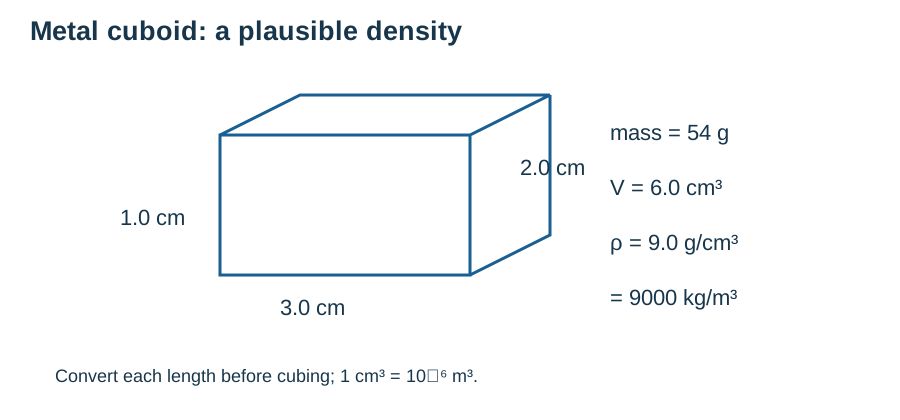
ρ = m/V. A metal cuboid of mass 54 g and dimensions 3 cm × 2 cm × 1 cm has volume 6 cm³ and density 9 g/cm³ = 9000 kg/m³. It is plausible for a dense metal. 1 cm³ = (0.01 m)³ = 10⁻⁶ m³, not 0.01 m³.
03
Expansion is not particle growth
Scope: 8463 and 8464 · Foundation and Higher
Heating usually increases average particle separation, enlarging the volume of a fixed mass and lowering its density. Do not say that each particle becomes larger or heavier. Some substances, notably water around freezing, depart from a simple “liquid denser than solid” rule; use the supplied data.
Read each belief, say what is wrong with it, then compare your correction.
Tempting idea: 9 kg/m³.
Use instead: 9 is the value in g/cm³. 54/6 = 9 g/cm³ = 9000 kg/m³.
Tempting idea: Doubles.
Use instead: Density is inversely proportional to volume. m/(2V) = ρ/2.
Retrieval practice
Quick checks
Worked examples
See the method being built
Apply particle arrangements explain state differences in the worked reasoning, then try the changed-context questions below.
Example 1 · Realistic metal cuboid
Scope: 8463 and 8464 · Foundation and Higher
A 54 g cuboid has dimensions 3 cm × 2 cm × 1 cm. Calculate density in kg/m³.
V = 3 × 2 × 1 = 6 cm³ = 6 × 10⁻⁶ m³.
m = 54 g = 0.054 kg; ρ = m/V.
ρ = 0.054/(6 × 10⁻⁶) = 9000 kg/m³.
Show the answer
9000 kg/m³, a plausible dense-metal value. Converting 9 g/cm³ by ×1000 gives the same result.
Exam precision
Use the physics precisely
Do this: Determine the sample volume using its shape or displacement. Convert volume with a cubed length factor before dividing mass by volume.
Independent practice
Exam-style questions
Write an answer before opening the marking guidance. Then edit the exact phrase or step that would gain the next mark.
1. A 54 g metal cuboid measures 3.0 cm × 2.0 cm × 1.0 cm. Calculate density in kg/m³.
[3 marks]
Scope: 8463 and 8464 · Foundation and Higher
Show marking guidance and model answer
Original PhysicsUK mark scheme: Point 1 (1 mark): V = lwh and ρ = m/V. Point 2 (1 mark): V = 6.0 cm³ = 6.0 × 10⁻⁶ m³; m = 0.054 kg. Point 3 (1 mark): ρ = 0.054/(6.0 × 10⁻⁶) = 9000 kg/m³. Award each distinct point once. Accept equivalent scientifically correct wording. No half marks.
V = lwh and ρ = m/V. (1 mark)
V = 6.0 cm³ = 6.0 × 10⁻⁶ m³; m = 0.054 kg. (1 mark)
ρ = 0.054/(6.0 × 10⁻⁶) = 9000 kg/m³. (1 mark)
Model answer: V = lwh and ρ = m/V. V = 6.0 cm³ = 6.0 × 10⁻⁶ m³; m = 0.054 kg. ρ = 0.054/(6.0 × 10⁻⁶) = 9000 kg/m³.
Acceptable answers: Expected result: ρ = 0.054/(6.0 × 10⁻⁶) = 9000 kg/m³. Accept the unrounded value or a correctly rounded equivalent to two or more significant figures; accept equivalent units if converted correctly. No additional measurement interval is implied.
Marking notes: Method marks remain available after an arithmetic error. Carry an earlier numerical error into a later valid step; award that method point if the unit conversion and physics are correct. A fully correct answer with unit earns all marks unless working is expressly requested.
2. Explain why a gas usually has much lower density than the same substance as a liquid.
[3 marks]
Scope: 8463 and 8464 · Foundation and Higher
Show marking guidance and model answer
Original PhysicsUK mark scheme: Point 1 (1 mark): Gas particles are much farther apart. Point 2 (1 mark): An equal volume therefore contains fewer particles/less mass. Point 3 (1 mark): Density is mass per unit volume, so it is lower. Award each distinct point once. Accept equivalent scientifically correct wording. No half marks.
Gas particles are much farther apart. (1 mark)
An equal volume therefore contains fewer particles/less mass. (1 mark)
Density is mass per unit volume, so it is lower. (1 mark)
Model answer: Gas particles are widely separated. An equal volume contains less mass and therefore has a lower density.
Questions pupils ask
Density and Particle Arrangement FAQs
Can an object have more mass but lower density?
Yes. Density is mass divided by volume. A sufficiently larger volume can outweigh the increase in mass.