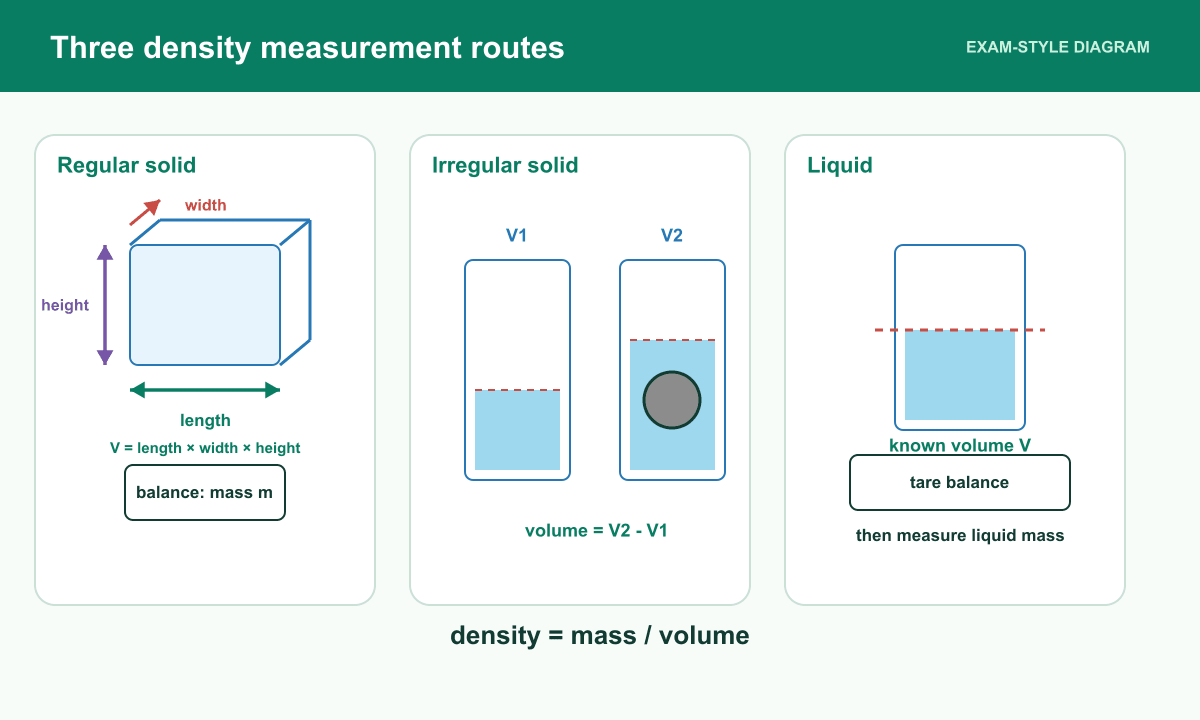
The density practical includes regular solids, irregular solids and liquids. Each needs an appropriate volume measurement and a mass that excludes its container.
The density practical includes regular solids, irregular solids and liquids. Each needs an appropriate volume measurement and a mass that excludes its container.
By the end, you should be able to:
Measure density for regular and irregular solids.
Measure liquid mass by tare or subtraction.
Identify displacement and meniscus errors.
Before you revise
Diagnostic question
Choose an answer from memory. Your result tells you what to watch for in the guide.
Core revision guide
Learn the model, then use it
The density practical includes regular solids, irregular solids and liquids. Each needs an appropriate volume measurement and a mass that excludes its container.
01
Regular and irregular solids
Scope: 8463 and 8464 · Foundation and Higher
Measure a dry object’s mass on a zeroed balance. Measure a cuboid’s length, width and height with suitable ruler/callipers and calculate lwh. Repeat dimensions at several positions if needed. For an insoluble sinking irregular object, record initial and final measuring-cylinder volumes on full submersion, or collect displaced water from an overflow can after excess dripping stops. Subtract the readings; remove bubbles and read the meniscus at eye level.
02
Liquids: subtract or tare the container
Scope: 8463 and 8464 · Foundation and Higher
Measure the mass of a clean empty cylinder, add liquid, and measure the cylinder-plus-liquid mass. Liquid mass = filled − empty; alternatively tare the empty vessel then add liquid. Read the liquid volume on the cylinder scale at eye level. 45 g in 50 cm³ gives 0.90 g/cm³ = 900 kg/m³. Do not use the full vessel mass as the liquid’s mass.
03
Uncertainty and validity
Scope: 8463 and 8464 · Foundation and Higher
Choose a scale suitable for the sample size. Bubbles or partial submersion distort displaced volume. A floating or soluble solid needs a different justified method; the simple submersion method is unsuitable. Repeat, compute mean values and use consistent units before ρ = m/V. Keep the balance dry and clean up spills.
Choose the volume method for the sample, find mass with a balance and calculate density as mass divided by volume.Open the full-size exam diagram
Densityρ = m ÷ Vkg/m³, kg, m³
Misconception clinic
Replace the tempting answer
Read each belief, say what is wrong with it, then compare your correction.
Tempting idea: 2.5 g/cm³.
Use instead: This includes the cylinder. Oil mass is 45 g; 45/50 = 0.90.
Tempting idea: It is too large.
Use instead: Apparent volume is too large, not too small. ρ = m/V falls when V is overestimated.
Retrieval practice
Quick checks
Worked examples
See the method being built
Apply regular and irregular solids in the worked reasoning, then try the changed-context questions below.
Example 1 · Regular-object method
Scope: 8463 and 8464 · Foundation and Higher
Describe how to find the density of a metal cuboid.
Measure mass with a balance.
Measure length, width and height with a ruler/calipers.
Calculate V then ρ = m/V.
Show the answer
Measure mass and dimensions, calculate volume = lwh, then divide mass by volume using consistent units.
Example 2 · Irregular-object method
Scope: 8463 and 8464 · Foundation and Higher
Describe how to find density of an irregular stone.
Measure mass on a balance.
Record water-level increase when fully submerged.
Use ρ = m/V.
Show the answer
The displaced-water volume equals the stone volume; divide its mass by this volume.
Example 3 · Spot a systematic issue
Scope: 8463 and 8464 · Foundation and Higher
Air bubbles cling to a submerged object. Explain the effect.
Bubbles increase apparent displacement.
Apparent volume is too large.
Use ρ = m/V.
Show the answer
The calculated density is too small because mass is divided by an overestimated volume.
Exam precision
Use the physics precisely
Do this: Choose one consistent mass route, tare or subtraction, and state the volume reading. Explain how bubbles, incomplete immersion or meniscus error changes the measured result.
Independent practice
Exam-style questions
Write an answer before opening the marking guidance. Then edit the exact phrase or step that would gain the next mark.
1. Describe how to determine the density of a liquid using a balance and measuring cylinder. Use either a tare method or a subtraction method.
[4 marks]
Scope: 8463 and 8464 · Foundation and Higher
Show marking guidance and model answer
Original PhysicsUK mark scheme: Point 1 (1 mark): Prepare a dry empty cylinder: tare the balance with it in place, or record its empty mass on a zeroed balance. Point 2 (1 mark): Add liquid and measure its mass reading and volume; read the meniscus at eye level. Point 3 (1 mark): Obtain liquid mass directly from the correctly tared reading, or subtract empty mass from filled mass. Point 4 (1 mark): Calculate ρ = liquid mass/volume using consistent units. Award each distinct point once. Accept equivalent scientifically correct wording. No half marks.
Prepare a dry empty cylinder: tare the balance with it in place, or record its empty mass on a zeroed balance. (1 mark)
Add liquid and measure its mass reading and volume; read the meniscus at eye level. (1 mark)
Obtain liquid mass directly from the correctly tared reading, or subtract empty mass from filled mass. (1 mark)
Calculate ρ = liquid mass/volume using consistent units. (1 mark)
Model answer: Tare the balance with the dry empty cylinder in place. Add liquid, read its volume at eye level and take the balance reading as the liquid mass directly. Divide this mass by volume in consistent units. Alternatively record empty and filled masses on a zeroed balance and subtract before dividing.
Marking notes: Either complete route earns 4/4. Taring removes the vessel mass from the displayed reading: no second subtraction is required. Do not award the liquid-mass point for using the untared filled-vessel mass.
2. An empty cylinder has mass 70 g; it has mass 110 g with 50 cm³ of liquid. Calculate liquid density in kg/m³.
[3 marks]
Scope: 8463 and 8464 · Foundation and Higher
Show marking guidance and model answer
Original PhysicsUK mark scheme: Point 1 (1 mark): mliquid = mfilled − mempty; ρ = m/V. Point 2 (1 mark): m = 40 g = 0.040 kg; V = 50 × 10⁻⁶ m³. Point 3 (1 mark): ρ = 800 kg/m³. Award each distinct point once. Accept equivalent scientifically correct wording. No half marks.
mliquid = mfilled − mempty; ρ = m/V. (1 mark)
m = 40 g = 0.040 kg; V = 50 × 10⁻⁶ m³. (1 mark)
ρ = 800 kg/m³. (1 mark)
Model answer: mliquid = mfilled − mempty; ρ = m/V. m = 40 g = 0.040 kg; V = 50 × 10⁻⁶ m³. ρ = 800 kg/m³.
Acceptable answers: Expected result: ρ = 800 kg/m³. Accept the unrounded value or a correctly rounded equivalent to two or more significant figures; accept equivalent units if converted correctly. No additional measurement interval is implied.
Marking notes: Method marks remain available after an arithmetic error. Carry an earlier numerical error into a later valid step; award that method point if the unit conversion and physics are correct. A fully correct answer with unit earns all marks unless working is expressly requested.
Questions pupils ask
Density Required Practical FAQs
Why subtract the container mass when measuring liquid density?
The density calculation needs the liquid mass alone. Including the container systematically overestimates that mass and the calculated density.