Static charge is an imbalance of electrons. It creates an electric field that can exert a force without contact.
AQA 8463GCSE PhysicsFoundationHigher
Learn · practise · improve
Start here
The revision snapshot
Static charge is an imbalance of electrons. It creates an electric field that can exert a force without contact.
By the end, you should be able to:
Explain electron transfer and charge conservation.
Draw electric-field direction around a charged sphere.
Explain attraction by polarisation and sparking.
Before you revise
Diagnostic question
Choose an answer from memory. Your result tells you what to watch for in the guide.
Core revision guide
Learn the model, then use it
Static charge is an imbalance of electrons. It creates an electric field that can exert a force without contact.
01
Charge transfer and sparking
Scope: 8463 Physics only · Foundation and Higher
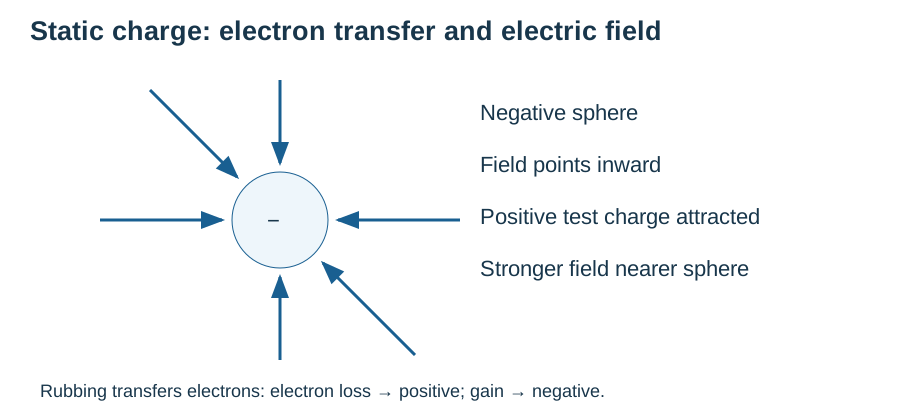
Rubbing two insulating materials transfers electrons. The object gaining electrons becomes negative; the one losing them becomes equally positive. Protons remain bound in nuclei. Like charges repel and unlike charges attract. A sufficiently strong field can ionise air, making a temporary conducting path in a spark that transfers charge and reduces the imbalance.
02
Draw and interpret a field
Scope: 8463 Physics only · Foundation and Higher
The field direction is the direction of force on a small positive test charge. Around an isolated positive sphere arrows point radially out; around a negative sphere they point in. Greater line density denotes a stronger field, generally nearer the charged sphere. A negative charge feels force opposite the field direction. Field lines show the model, not physical wires.
03
A useful observation
Scope: 8463 Physics only · Foundation and Higher
Repulsion is strong evidence that both objects are charged with the same sign. Attraction alone does not show opposite charges: a charged object can polarise an initially neutral object and attract it. Polarisation is useful enrichment. Keep charged demonstrations away from sensitive equipment and flammable vapours.
Read each belief, say what is wrong with it, then compare your correction.
Tempting idea: It becomes positive because electrons are positive.
Use instead: Electrons are negative. Electron transfer conserves total charge.
Tempting idea: Radially inwards.
Use instead: That describes a negative sphere. A positive test charge is repelled.
Retrieval practice
Quick checks
Worked examples
See the method being built
Apply charge transfer and sparking in the worked reasoning, then try the changed-context questions below.
Example 1 · Track transferred electrons
Scope: 8463 Physics only · Foundation and Higher
Electrons move from a rubbed plastic rod to a cloth. State each charge and explain conservation.
The rod loses negatively charged electrons.
The cloth gains those electrons.
The transferred charge is equal and opposite.
Show the answer
The rod becomes positive and the cloth negative; total charge is conserved.
Exam precision
Use the physics precisely
Do this: State which material gains or loses electrons. Keep field direction and force on the stated test charge distinct.
Independent practice
Exam-style questions
Write an answer before opening the marking guidance. Then edit the exact phrase or step that would gain the next mark.
1. Explain how rubbing two insulating materials leaves one positive and one negative.
[3 marks]
Scope: 8463 Physics only · Foundation and Higher
Show marking guidance and model answer
Original PhysicsUK mark scheme: Point 1 (1 mark): Electrons transfer from one material to the other. Point 2 (1 mark): The electron-losing material is positive and the gaining material negative. Point 3 (1 mark): Equal/opposite transferred charge leaves total charge conserved. Award each distinct point once. Accept equivalent scientifically correct wording. No half marks.
Electrons transfer from one material to the other. (1 mark)
The electron-losing material is positive and the gaining material negative. (1 mark)
Equal/opposite transferred charge leaves total charge conserved. (1 mark)
Model answer: Rubbing transfers electrons. Losing electrons leaves positive charge and gaining them leaves negative charge, with total charge conserved.
2. Describe the field around an isolated negative sphere and the force on a small positive test charge.
[3 marks]
Scope: 8463 Physics only · Foundation and Higher
Show marking guidance and model answer
Original PhysicsUK mark scheme: Point 1 (1 mark): Radial field arrows point towards the sphere. Point 2 (1 mark): The field/force is stronger nearer the sphere. Point 3 (1 mark): A positive test charge experiences attraction along the field towards the sphere. Award each distinct point once. Accept equivalent scientifically correct wording. No half marks.
Radial field arrows point towards the sphere. (1 mark)
The field/force is stronger nearer the sphere. (1 mark)
A positive test charge experiences attraction along the field towards the sphere. (1 mark)
Model answer: The radial field points inward and is stronger near the sphere. A positive test charge is attracted inward.