A circuit transfers energy while charge circulates. Track how much charge passes each second separately from how much energy each coulomb transfers.
By the end, you should be able to:
Define current and potential difference.
Calculate charge and transferred energy.
Choose correct meter connections.
Before you revise
Diagnostic question
Choose an answer from memory. Your result tells you what to watch for in the guide.
Core revision guide
Learn the model, then use it
A circuit transfers energy while charge circulates. Track how much charge passes each second separately from how much energy each coulomb transfers.
01
Current and charge
Scope: 8463 and 8464 · Foundation and Higher
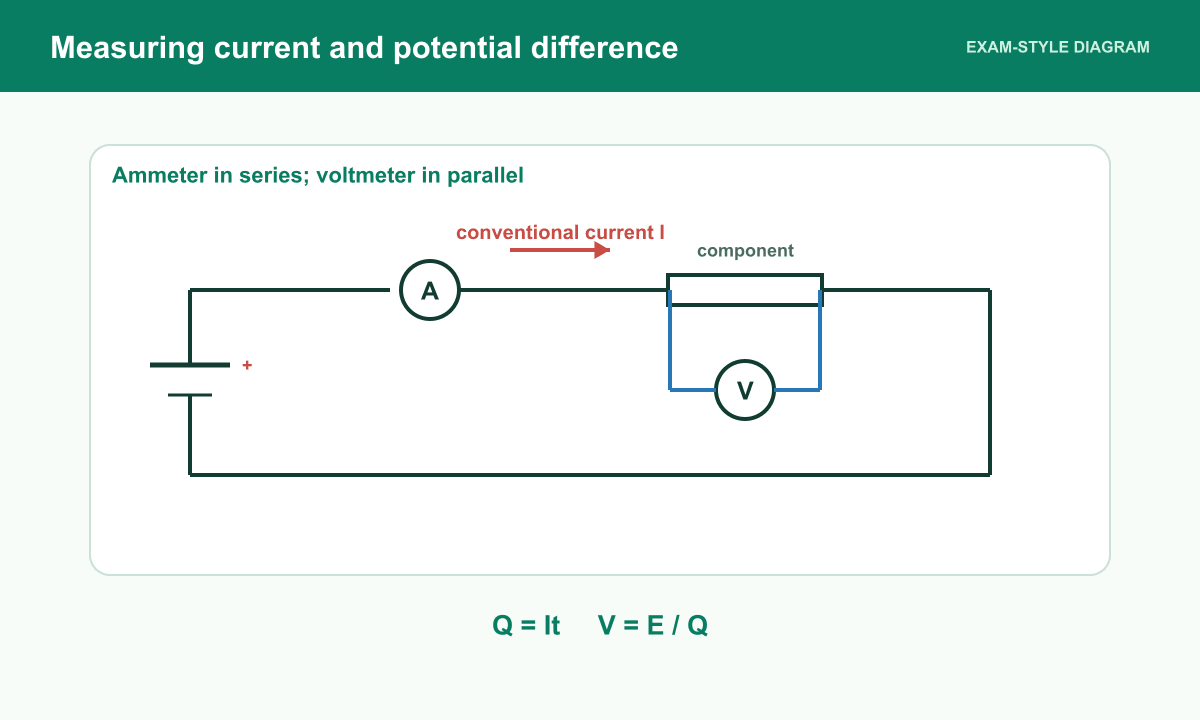
Current I is Q/t, measured in amperes: 1 A = 1 C/s. In metallic wires electrons move; conventional current is drawn from positive to negative around the external circuit. A complete path is needed for a steady current. Put the ammeter in series so the component’s charge flow passes through it.
02
Potential difference
Scope: 8463 and 8464 · Foundation and Higher
V = E/Q, measured in volts: 1 V = 1 J/C. A 6 V battery transfers 6 J per coulomb, rather than supplying 6 coulombs. A voltmeter spans the two terminals of the component and is connected in parallel. Charge does not disappear in a lamp; each passing coulomb transfers some energy to the lamp and surroundings.
03
Connect the models
Scope: 8463 and 8464 · Foundation and Higher
If 0.50 A flows for 20 s, Q = 10 C. Across 6.0 V, E = QV = 60 J. The same current can occur at different potential differences because resistance differs. A cell provides a direct potential difference; an alternating supply reverses its polarity periodically.
Current is measured through the component; potential difference is the energy transferred per coulomb across it.Open the full-size exam diagram
Charge flowQ = ItC, A, sPotential differenceV = E ÷ QV, J, C
Misconception clinic
Replace the tempting answer
Read each belief, say what is wrong with it, then compare your correction.
Tempting idea: 216 V.
Use instead: This multiplies rather than divides. 36/6 = 6 J/C = 6 V.
Tempting idea: I = 4 A; V = 2 V.
Use instead: The definitions have been swapped. Current is C/s, voltage is J/C.
Retrieval practice
Quick checks
Worked examples
See the method being built
Apply current and charge in the worked reasoning, then try the changed-context questions below.
Example 1 · Current from charge
Scope: 8463 and 8464 · Foundation and Higher
120 C passes a point in 60 s. Calculate current.
Use I = Q ÷ t.
Substitute 120 ÷ 60.
Give amperes.
Show the answer
I = 2.0 A.
Example 2 · Charge moved
Scope: 8463 and 8464 · Foundation and Higher
A current of 0.40 A flows for 3.0 min. Calculate charge.
Convert time to 180 s.
Use Q = It.
Substitute 0.40 × 180.
Show the answer
Q = 72 C.
Example 3 · Energy per charge
Scope: 8463 and 8464 · Foundation and Higher
A 12 V supply transfers energy to 5.0 C of charge. Calculate the energy.
Use E = VQ.
Substitute 12 × 5.0.
Give joules.
Show the answer
E = 60 J.
Exam precision
Use the physics precisely
Do this: Convert current and time units before Q = It. Identify the component across which p.d. is measured before using E = QV.
Independent practice
Exam-style questions
Write an answer before opening the marking guidance. Then edit the exact phrase or step that would gain the next mark.
1. A current of 0.40 A flows for 75 s. Calculate the charge passing a point.
[3 marks]
Scope: 8463 and 8464 · Foundation and Higher
Show marking guidance and model answer
Original PhysicsUK mark scheme: Point 1 (1 mark): Q = It. Point 2 (1 mark): Q = 0.40 × 75. Point 3 (1 mark): Q = 30 C. Award each distinct point once. Accept equivalent scientifically correct wording. No half marks.
Q = It. (1 mark)
Q = 0.40 × 75. (1 mark)
Q = 30 C. (1 mark)
Model answer: Q = It. Q = 0.40 × 75. Q = 30 C.
Acceptable answers: Expected result: Q = 30 C. Accept the unrounded value or a correctly rounded equivalent to two or more significant figures; accept equivalent units if converted correctly. No additional measurement interval is implied.
Marking notes: Method marks remain available after an arithmetic error. Carry an earlier numerical error into a later valid step; award that method point if the unit conversion and physics are correct. A fully correct answer with unit earns all marks unless working is expressly requested.
2. 60 C passes through a component across 12 V. Calculate the energy transferred.
[3 marks]
Scope: 8463 and 8464 · Foundation and Higher
Show marking guidance and model answer
Original PhysicsUK mark scheme: Point 1 (1 mark): E = QV. Point 2 (1 mark): E = 60 × 12. Point 3 (1 mark): E = 720 J. Award each distinct point once. Accept equivalent scientifically correct wording. No half marks.
E = QV. (1 mark)
E = 60 × 12. (1 mark)
E = 720 J. (1 mark)
Model answer: E = QV. E = 60 × 12. E = 720 J.
Acceptable answers: Expected result: E = 720 J. Accept the unrounded value or a correctly rounded equivalent to two or more significant figures; accept equivalent units if converted correctly. No additional measurement interval is implied.
Marking notes: Method marks remain available after an arithmetic error. Carry an earlier numerical error into a later valid step; award that method point if the unit conversion and physics are correct. A fully correct answer with unit earns all marks unless working is expressly requested.
Questions pupils ask
Current, Charge and Potential Difference FAQs
Does a lamp use up current?
No. In a steady series circuit the same charge per second passes each point. The lamp transfers energy carried by the charge.