V = IR can describe a measured operating point. Predicting another point with the same R requires evidence that resistance stays constant.
By the end, you should be able to:
Calculate resistance at a nonzero-current point.
Distinguish Ohmic proportionality from changing resistance.
Explain thermistor and LDR sensor responses.
Before you revise
Diagnostic question
Choose an answer from memory. Your result tells you what to watch for in the guide.
Core revision guide
Learn the model, then use it
V = IR can describe a measured operating point. Predicting another point with the same R requires evidence that resistance stays constant.
01
Resistance at a point and Ohmic behaviour
Scope: 8463 and 8464 · Foundation and Higher
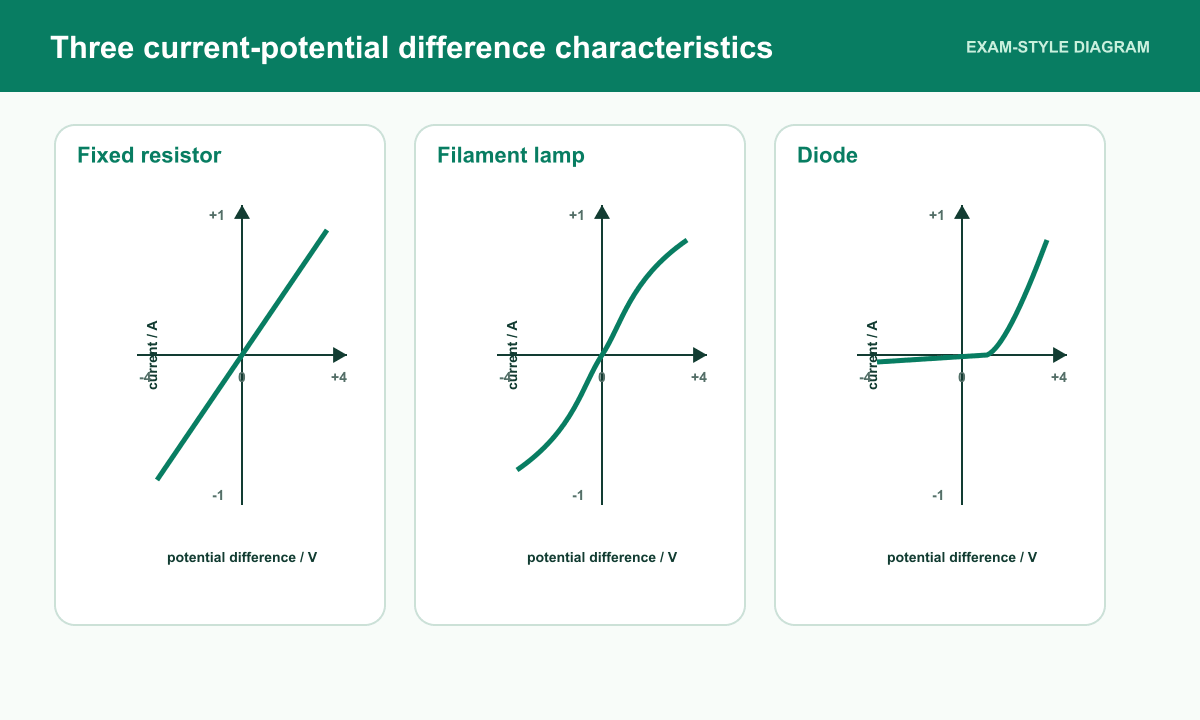
For any component with non-zero current, R = V/I gives resistance at that operating point. This includes lamps and forward-biased diodes. An ohmic conductor at constant temperature has I proportional to V and a straight line through the origin. Only then can one constant R be used to predict all points. On I (y) against V (x), a steeper straight line means smaller R because gradient = 1/R.
02
Why lamp and diode curves differ
Scope: 8463 and 8464 · Foundation and Higher
A lamp’s filament heats as current increases. Metal ions vibrate more, increasing collisions that impede electrons. Resistance rises, so the I–V curve becomes less steep at larger |V|. A diode conducts mainly in one direction; reverse current is very small within the safe operating range. The curve must include positive and negative potential differences.
03
Sensors change resistance
Scope: 8463 and 8464 · Foundation and Higher
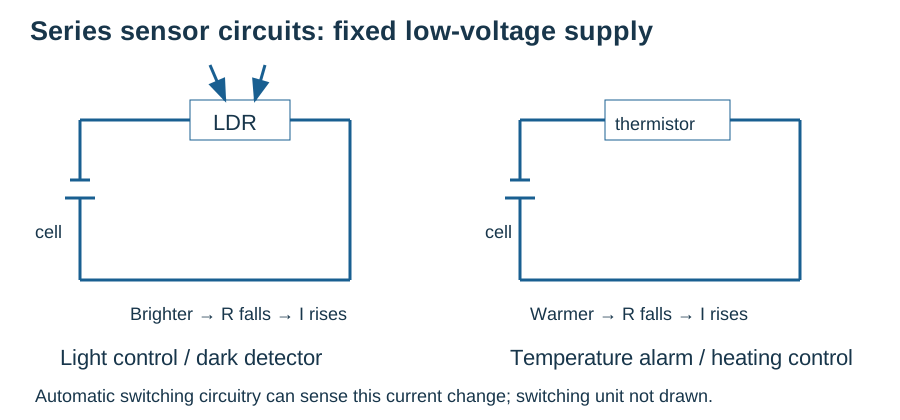
For the usual negative-temperature-coefficient thermistor, warming lowers resistance. For an LDR, brighter light lowers resistance. In a simple series sensor circuit at fixed supply voltage, lower sensor resistance gives a larger current. These behaviours can control heating or lighting circuits; an automatic switching device detects the change. Potential-divider calculations are optional enrichment, not required here.
A fixed resistor is linear at constant temperature, a lamp curve changes gradient, and a diode conducts mainly in one direction.Open the full-size exam diagram
Sensor mechanisms: LDR for a light-control signal; thermistor for a temperature-control signal.
ResistanceV = IRV, A, Ω
Misconception clinic
Replace the tempting answer
Read each belief, say what is wrong with it, then compare your correction.
Tempting idea: V = IR cannot be used for a filament lamp at any point.
Use instead: A non-linear graph still has a V/I ratio at each non-zero point. R = V/I gives the operating-point ratio.
Tempting idea: LDR resistance increases and current falls.
Use instead: The usual LDR behaves the other way. Lower total series resistance gives a larger current.
Retrieval practice
Quick checks
Explore the relationship
Resistance and I-V curve
Change potential difference or resistance, then use I = V ÷ R to predict the current through a fixed resistor.
Model scope: 8463 and 8464 · Foundation and Higher
What to notice: use the readout to describe how one variable changes when the other is controlled.
Worked examples
See the method being built
Apply resistance at a point and ohmic behaviour in the worked reasoning, then try the changed-context questions below.
Example 1 · Fixed resistor
Scope: 8463 and 8464 · Foundation and Higher
A fixed resistor has 6.0 V across it and 0.50 A through it. Calculate resistance.
Use R = V ÷ I.
Substitute 6.0 ÷ 0.50.
Give ohms.
Show the answer
R = 12 Ω.
Example 2 · Read a lamp graph
Scope: 8463 and 8464 · Foundation and Higher
A lamp’s current rises less for each extra volt. Explain the curve.
Describe the graph shape.
Link current to filament temperature.
Link temperature to resistance.
Show the answer
As current rises the filament heats up; its resistance increases, so current no longer rises proportionally with potential difference.
Example 3 · Diode choice
Scope: 8463 and 8464 · Foundation and Higher
Choose between a diode and fixed resistor for a circuit that must conduct in one direction only.
Identify the required behaviour.
Match it to the component characteristic.
State the direction condition.
Show the answer
Use a diode because it has very high resistance in the reverse direction and conducts mainly when forward biased.
Exam precision
Use the physics precisely
Do this: Use multiple I–V points to justify proportionality. For a sensor, connect the changed condition to resistance and then to current in the stated circuit.
Independent practice
Exam-style questions
Write an answer before opening the marking guidance. Then edit the exact phrase or step that would gain the next mark.
1. A filament lamp has 4.5 V across it and carries 0.25 A. Calculate its resistance at this point.
[3 marks]
Scope: 8463 and 8464 · Foundation and Higher
Show marking guidance and model answer
Original PhysicsUK mark scheme: Point 1 (1 mark): R = V/I. Point 2 (1 mark): R = 4.5/0.25. Point 3 (1 mark): R = 18 Ω. Award each distinct point once. Accept equivalent scientifically correct wording. No half marks.
R = V/I. (1 mark)
R = 4.5/0.25. (1 mark)
R = 18 Ω. (1 mark)
Model answer: R = V/I. R = 4.5/0.25. R = 18 Ω.
Acceptable answers: Expected result: R = 18 Ω. Accept the unrounded value or a correctly rounded equivalent to two or more significant figures; accept equivalent units if converted correctly. No additional measurement interval is implied.
Marking notes: Method marks remain available after an arithmetic error. Carry an earlier numerical error into a later valid step; award that method point if the unit conversion and physics are correct. A fully correct answer with unit earns all marks unless working is expressly requested.
2. Explain why a lamp’s I–V curve becomes less steep as its filament heats.
[3 marks]
Scope: 8463 and 8464 · Foundation and Higher
Show marking guidance and model answer
Original PhysicsUK mark scheme: Point 1 (1 mark): Filament ions vibrate more at higher temperature. Point 2 (1 mark): Electrons undergo more collisions, increasing resistance. Point 3 (1 mark): Each additional volt produces a smaller current increase, so the I-versus-V gradient decreases. Award each distinct point once. Accept equivalent scientifically correct wording. No half marks.
Filament ions vibrate more at higher temperature. (1 mark)
Electrons undergo more collisions, increasing resistance. (1 mark)
Each additional volt produces a smaller current increase, so the I-versus-V gradient decreases. (1 mark)
Model answer: Heating increases ion vibration and collisions with moving electrons. Resistance increases, so current rises less for each extra volt and the curve becomes less steep.
Questions pupils ask
Resistance and I-V Characteristics FAQs
Does V = IR prove a filament lamp is ohmic?
No. The ratio V/I gives resistance at that operating point; ohmic behaviour requires constant resistance and a straight I–V graph at constant temperature.