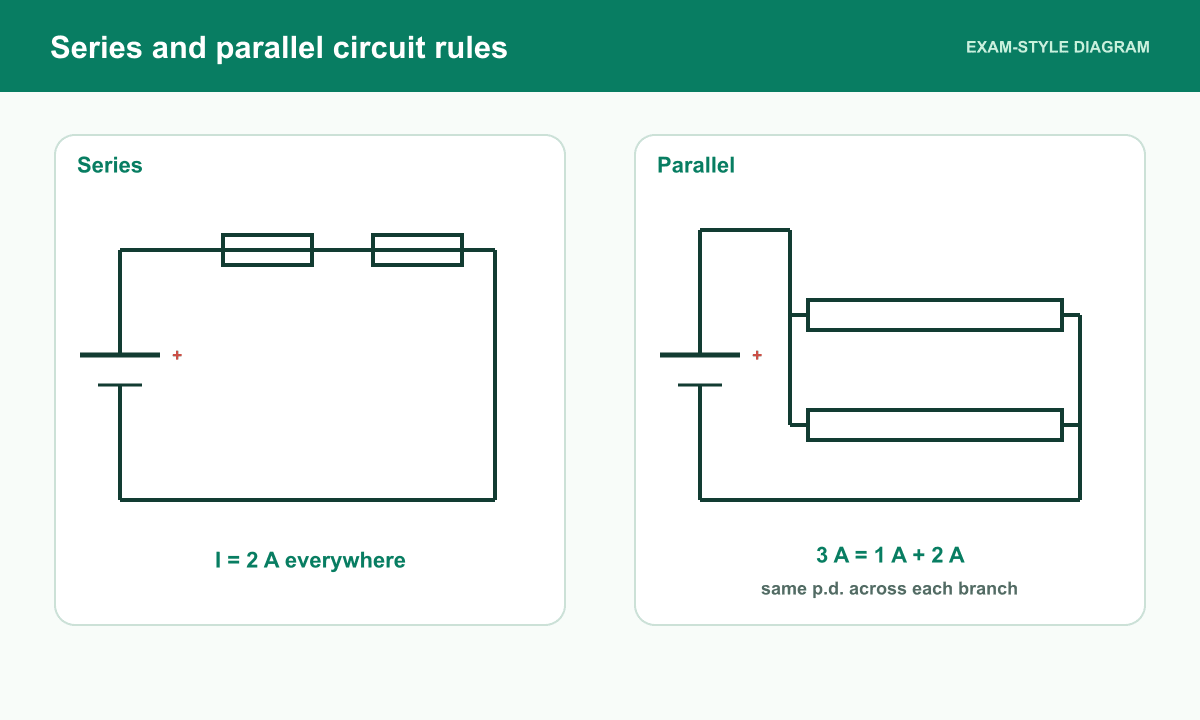
Current is equal throughout a single loop. Rtotal = R₁ + R₂ because each component impedes the same charge flow. The supply potential difference equals the sum across components. For a 12 V supply with 4 Ω and 8 Ω in series, Rtotal = 12 Ω, I = 1 A and the drops are 4 V and 8 V; equal current does not mean equal voltage.
Each branch has the same supply potential difference because it connects to the same terminals. Current entering a junction equals the sum leaving. Adding a parallel resistor offers another path, so total resistance falls below the smallest individual resistance. AQA requires this qualitative explanation; reciprocal-resistance calculation is not required.
03
Faults and complete loops
Scope: 8463 and 8464 · Foundation and Higher
A break in a series loop stops all its current. Breaking one parallel branch leaves another complete branch operating. Do not infer equal branch currents unless the branches have equal resistance. Identify nodes on a circuit diagram rather than relying on the shapes of wires.
In series the current is the same throughout; in parallel each branch has the supply potential difference and branch currents add.Open the full-size exam diagram
ResistanceV = IRV, A, Ω
Misconception clinic
Replace the tempting answer
Read each belief, say what is wrong with it, then compare your correction.
Tempting idea: 3 A.
Use instead: This uses only 4 Ω. Rtotal = 12 Ω and I = 12/12.
Tempting idea: It decreases because total resistance rises.
Use instead: Parallel addition lowers total resistance. The same voltage drives current in an extra path.
Retrieval practice
Quick checks
Worked examples
See the method being built
Apply series: add resistance, share potential difference in the worked reasoning, then try the changed-context questions below.
Example 1 · Series p.d.
Scope: 8463 and 8464 · Foundation and Higher
Two series lamps have potential differences 2.0 V and 4.0 V. Find the supply p.d.
Use the series rule.
Add the potential differences.
State volts.
Show the answer
Supply p.d. = 6.0 V.
Example 2 · Parallel current
Scope: 8463 and 8464 · Foundation and Higher
A 1.2 A current reaches a junction. One branch carries 0.50 A. Find the other branch current.
Use conservation of charge.
Subtract branch current from total.
State amperes.
Show the answer
Other branch current = 1.2 − 0.50 = 0.70 A.
Example 3 · Choose circuit type
Scope: 8463 and 8464 · Foundation and Higher
A student wants two lamps that work independently. Choose a circuit and explain.
Identify the required behaviour.
Choose series or parallel.
Use a circuit rule as the reason.
Show the answer
Use parallel. Each lamp has the supply potential difference and one branch can remain complete if the other lamp is removed.
Exam precision
Use the physics precisely
Do this: Mark series paths and junctions first. State the relevant conservation rule before calculating each current or potential difference.
Independent practice
Exam-style questions
Write an answer before opening the marking guidance. Then edit the exact phrase or step that would gain the next mark.
1. 3 Ω and 6 Ω are in series across 9 V. Calculate total resistance, current and the voltage across 6 Ω.
[3 marks]
Scope: 8463 and 8464 · Foundation and Higher
Show marking guidance and model answer
Original PhysicsUK mark scheme: Point 1 (1 mark): Rtotal = 3 + 6 = 9 Ω. Point 2 (1 mark): I = 9/9 = 1 A through both resistors. Point 3 (1 mark): V6 = 1 × 6 = 6 V. Award each distinct point once. Accept equivalent scientifically correct wording. No half marks.
Rtotal = 3 + 6 = 9 Ω. (1 mark)
I = 9/9 = 1 A through both resistors. (1 mark)
V6 = 1 × 6 = 6 V. (1 mark)
Model answer: Rtotal = 9 Ω. The series current is 1 A, and the 6 Ω resistor has 6 V across it.
Marking notes: Carry an incorrect total resistance into a correct I = V/R method, and an earlier current into V = IR; award the relevant later method points. Accept equivalent units.
2. Explain why adding a resistor in parallel lowers total resistance at fixed supply voltage.
[3 marks]
Scope: 8463 and 8464 · Foundation and Higher
Show marking guidance and model answer
Original PhysicsUK mark scheme: Point 1 (1 mark): The extra branch provides an additional route for charge. Point 2 (1 mark): The total current increases at the same potential difference. Point 3 (1 mark): Rtotal = Vsupply/Itotal therefore decreases. Award each distinct point once. Accept equivalent scientifically correct wording. No half marks.
The extra branch provides an additional route for charge. (1 mark)
The total current increases at the same potential difference. (1 mark)