An appliance rating connects charge flow to energy transfer. A protective earth path and a fuse work together when a metal case becomes live.
By the end, you should be able to:
Calculate electrical power and energy.
Describe live, neutral and earth roles.
Explain how protection interrupts dangerous current.
Before you revise
Diagnostic question
Choose an answer from memory. Your result tells you what to watch for in the guide.
Core revision guide
Learn the model, then use it
An appliance rating connects charge flow to energy transfer. A protective earth path and a fuse work together when a metal case becomes live.
01
Use consistent power and energy data
Scope: 8463 and 8464 · Foundation and Higher
P = VI and P = I²R give the same result at the same operating point. A 12 V heater carrying 2 A has R = 6 Ω and P = 24 W by either equation. In 30 s it transfers E = Pt = 720 J; Q = It = 60 C gives E = QV = 720 J too. Keep watts with seconds for joules; kilowatts with hours give kWh, not kW/h.
02
Mains wires and fault protection
Scope: 8463 and 8464 · Foundation and Higher
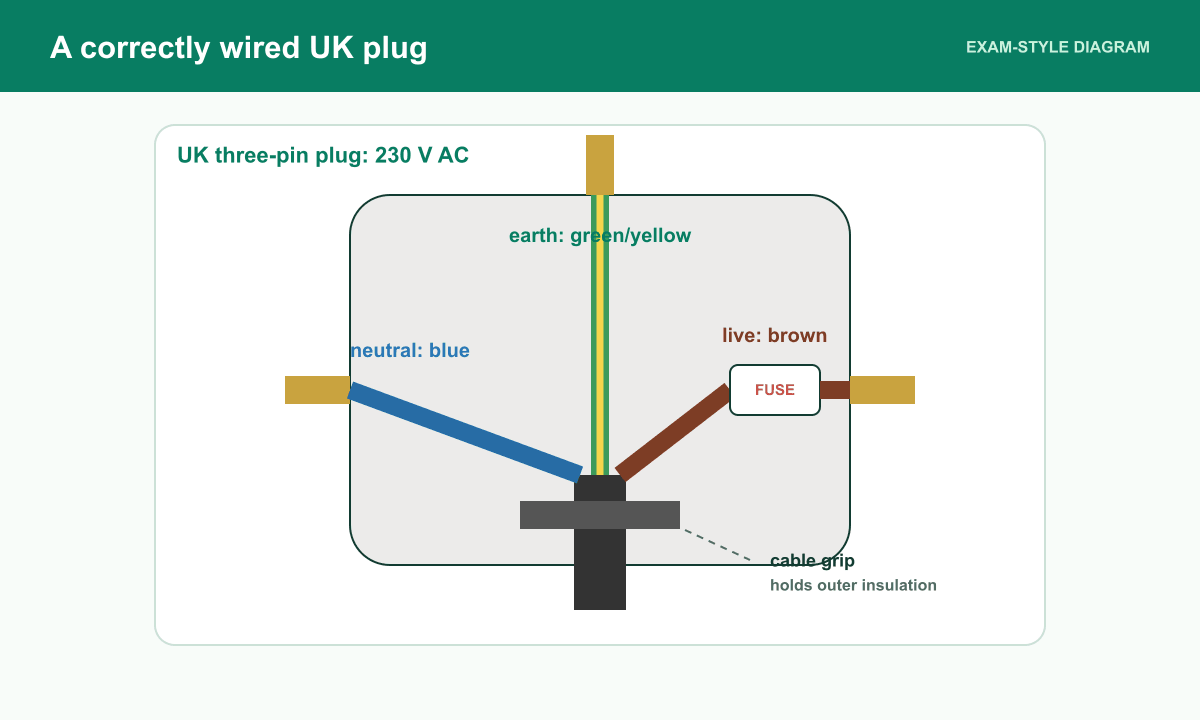
UK mains is about 230 V, 50 Hz alternating potential difference. Brown is live; blue is neutral, near earth potential; green/yellow is earth. If live touches an earthed metal case, the low-resistance earth path permits a large fault current. A suitable fuse in live melts, disconnecting the live supply. Plastic insulation and double-insulated cases prevent contact with live parts; a double-insulated appliance does not need an earth connection.
03
Why an open switch may not remove every hazard
Scope: 8463 and 8464 · Foundation and Higher
A live conductor upstream of an open switch can remain at high potential relative to earth. Contact bridging live to earth allows dangerous current through the person. Revision demonstrations use low-voltage equipment; mains fault explanations are conceptual tasks, not student experiments.
Trace the live wire through the fuse and check that the cable grip holds the outer cable rather than the individual wires.Open the full-size exam diagram
Read each belief, say what is wrong with it, then compare your correction.
Tempting idea: 12 W.
Use instead: I², rather than I, multiplies R. P = 2² × 6 = 24 W.
Tempting idea: A normal return path carrying all current in everyday use.
Use instead: Neutral is the usual return; earth normally carries no current. The fuse then breaks the live circuit.
Retrieval practice
Quick checks
Worked examples
See the method being built
Apply use consistent power and energy data in the worked reasoning, then try the changed-context questions below.
Example 1 · Appliance power
Scope: 8463 and 8464 · Foundation and Higher
A 230 V appliance draws 2.0 A. Calculate its power.
Use P = VI.
Substitute 230 × 2.0.
Give watts.
Show the answer
P = 460 W.
Example 2 · Domestic energy
Scope: 8463 and 8464 · Foundation and Higher
A 2.0 kW heater runs for 3.5 h. Calculate energy in kWh.
Keep kW and h for kWh.
Use E = Pt.
Multiply 2.0 × 3.5.
Show the answer
E = 7.0 kWh.
Example 3 · Fault protection
Scope: 8463 and 8464 · Foundation and Higher
A live wire touches a metal toaster case. Explain how the earth wire and fuse protect the user.
State the low-resistance route.
Explain the large current.
State what breaks the circuit.
Show the answer
The earth wire provides a low-resistance path so a large current flows, melting the fuse and disconnecting the live wire before the case can remain dangerously live.
Exam precision
Use the physics precisely
Do this: Separate normal energy calculations from fault behaviour. Explain a safety device as a sequence from fault, through current path, to disconnection.
Independent practice
Exam-style questions
Write an answer before opening the marking guidance. Then edit the exact phrase or step that would gain the next mark.
1. A 12 V heater carries 2.0 A for 90 s. Calculate the energy transferred.
[3 marks]
Scope: 8463 and 8464 · Foundation and Higher
Show marking guidance and model answer
Original PhysicsUK mark scheme: Point 1 (1 mark): P = VI and E = Pt. Point 2 (1 mark): P = 12 × 2.0 = 24 W; E = 24 × 90. Point 3 (1 mark): E = 2160 J. Award each distinct point once. Accept equivalent scientifically correct wording. No half marks.
P = VI and E = Pt. (1 mark)
P = 12 × 2.0 = 24 W; E = 24 × 90. (1 mark)
E = 2160 J. (1 mark)
Model answer: P = VI and E = Pt. P = 12 × 2.0 = 24 W; E = 24 × 90. E = 2160 J.
Acceptable answers: Expected result: E = 2160 J. Accept the unrounded value or a correctly rounded equivalent to two or more significant figures; accept equivalent units if converted correctly. No additional measurement interval is implied.
Marking notes: Method marks remain available after an arithmetic error. Carry an earlier numerical error into a later valid step; award that method point if the unit conversion and physics are correct. A fully correct answer with unit earns all marks unless working is expressly requested.
2. Explain how an earth wire and fuse protect a person when a live wire touches a metal case.
[3 marks]
Scope: 8463 and 8464 · Foundation and Higher
Show marking guidance and model answer
Original PhysicsUK mark scheme: Point 1 (1 mark): The earth connects the case to a low-resistance path to earth. Point 2 (1 mark): A large fault current flows, causing the fuse to melt. Point 3 (1 mark): The fuse breaks the live circuit and disconnects the case from the supply. Award each distinct point once. Accept equivalent scientifically correct wording. No half marks.
The earth connects the case to a low-resistance path to earth. (1 mark)
A large fault current flows, causing the fuse to melt. (1 mark)
The fuse breaks the live circuit and disconnects the case from the supply. (1 mark)
Model answer: The earth gives a low-resistance fault path. The resulting large current melts the fuse, which disconnects the live supply from the case.
Questions pupils ask
Mains Electricity, Power, Energy and Safety FAQs
When can I use both P = VI and P = I²R?
Use V, I and R for the same component and operating point; substituting V = IR then gives I²R.