Resistance is calculated from a measured pair of potential difference and current. Keep the wire’s temperature steady so changing length is the only intended cause.
Resistance is calculated from a measured pair of potential difference and current. Keep the wire’s temperature steady so changing length is the only intended cause.
By the end, you should be able to:
Plan a resistance investigation with one changed variable.
Measure paired current and p.d. readings.
Evaluate temperature and dimensional uncertainty.
Before you revise
Diagnostic question
Choose an answer from memory. Your result tells you what to watch for in the guide.
Core revision guide
Learn the model, then use it
Resistance is calculated from a measured pair of potential difference and current. Keep the wire’s temperature steady so changing length is the only intended cause.
01
Build the low-voltage circuit
Scope: 8463 and 8464 · Foundation and Higher
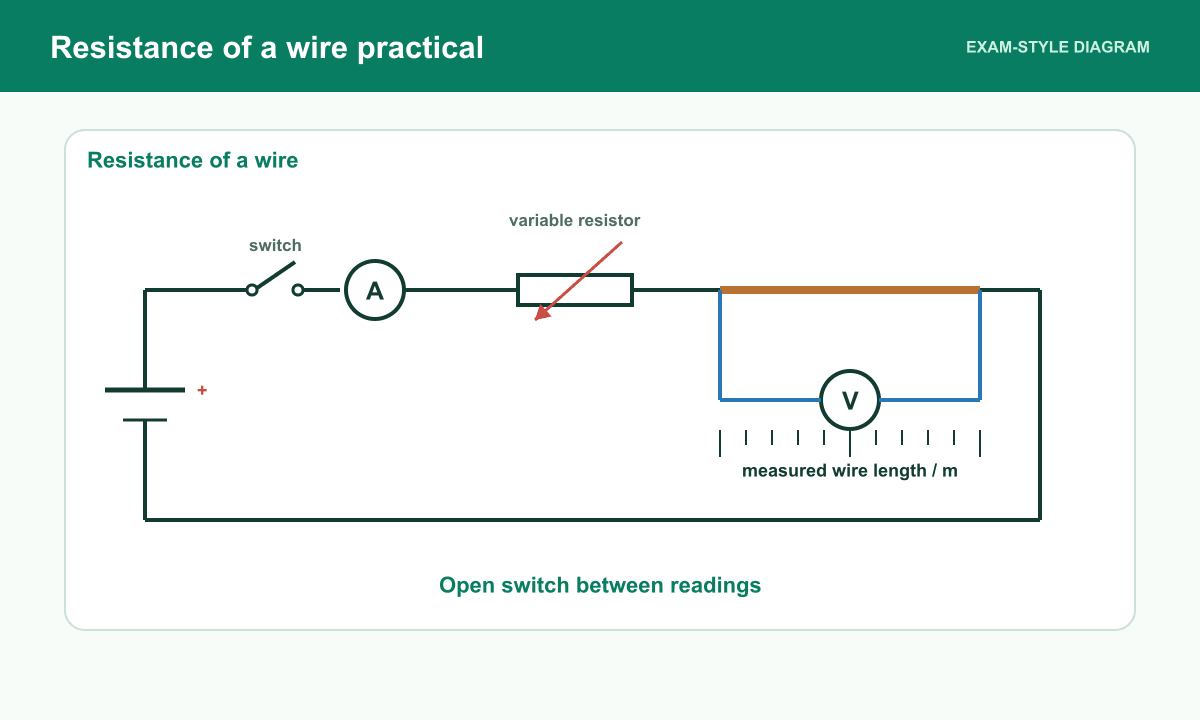
Connect a power supply, switch, ammeter and test wire in series. Connect a voltmeter across the measured wire length. Fix the wire beside a ruler; place contacts at a fixed start and an adjustable end. Use the same material and diameter throughout. Choose a low current, check connections with the supply off and avoid short circuits.
02
Collect and analyse
Scope: 8463 and 8464 · Foundation and Higher
Set several lengths, record length, V and I, then calculate R = V/I. Switch off between readings and allow cooling. Repeat for each length and calculate mean resistance; inspect anomalies. Plot R on y against length on x. For uniform wire at steady temperature, a straight proportional trend is expected because longer paths cause more collisions.
03
Complete the practical’s second comparison
Scope: 8463 and 8464 · Foundation and Higher
The AQA resistance practical also compares combinations of resistors in series and parallel. Measure total V and I for each low-voltage network. Calculate total resistance and compare with individual values: series increases resistance and parallel reduces it. Keep components and supply conditions comparable; the wire-length investigation alone is not the whole activity.
Change only the selected wire length, measure V and I, and open the switch between readings to limit heating.Open the full-size exam diagram
ResistanceR = V ÷ IΩ, V, A
Misconception clinic
Replace the tempting answer
Read each belief, say what is wrong with it, then compare your correction.
Tempting idea: To remove the wire’s mass.
Use instead: Mass is not changed. Temperature would confound the length test.
Tempting idea: V against time.
Use instead: Time is not the independent variable. R is calculated for each measured length.
Retrieval practice
Quick checks
Worked examples
See the method being built
Apply build the low-voltage circuit in the worked reasoning, then try the changed-context questions below.
Example 1 · Calculate resistance from readings
Scope: 8463 and 8464 · Foundation and Higher
A wire has 2.4 V across it and current 0.30 A. Calculate resistance.
Use R = V/I.
Substitute 2.4 ÷ 0.30.
State ohms.
Show the answer
R = 8.0 Ω.
Example 2 · Plan the variables
Scope: 8463 and 8464 · Foundation and Higher
Plan an investigation of how wire length affects resistance.
Change length.
Measure V and I and calculate R.
Keep material, diameter and temperature as constant as possible.
Show the answer
Use the same wire at different lengths, measure p.d. and current for each, calculate R = V/I, repeat, and control material, diameter and heating.
Example 3 · Evaluate heating
Scope: 8463 and 8464 · Foundation and Higher
Resistance rises during a long set of readings. Explain why this is a problem.
Identify the uncontrolled variable.
Link temperature to resistance.
Give a control.
Show the answer
The wire heats up and its resistance changes independently of length. Use low current and switch off between readings.
Exam precision
Use the physics precisely
Do this: Specify the wire factor varied, controls and meter positions. Explain how low current and switching off reduce the temperature confound.
Independent practice
Exam-style questions
Write an answer before opening the marking guidance. Then edit the exact phrase or step that would gain the next mark.
1. Describe a fair test of the effect of wire length on resistance.
[5 marks]
Scope: 8463 and 8464 · Foundation and Higher
Show marking guidance and model answer
Original PhysicsUK mark scheme: Point 1 (1 mark): Use the same wire material and diameter; measure length beside a ruler. Point 2 (1 mark): Connect an ammeter in series and a voltmeter across the selected length. Point 3 (1 mark): Use several lengths, recording paired V and I and calculating R = V/I. Point 4 (1 mark): Use low current, switch off between readings and allow cooling. Point 5 (1 mark): Repeat readings and plot mean R against length. Award each distinct point once. Accept equivalent scientifically correct wording. No half marks.
Use the same wire material and diameter; measure length beside a ruler. (1 mark)
Connect an ammeter in series and a voltmeter across the selected length. (1 mark)
Use several lengths, recording paired V and I and calculating R = V/I. (1 mark)
Use low current, switch off between readings and allow cooling. (1 mark)
Repeat readings and plot mean R against length. (1 mark)
Model answer: Use one uniform wire beside a ruler. Measure V across each selected length and I through it, then calculate R. Change length only, limit temperature rise by low current and switching off, repeat and plot mean R against length.
2. A 40 cm wire has 1.2 V across it and current 0.30 A. Calculate resistance.
[3 marks]
Scope: 8463 and 8464 · Foundation and Higher
Show marking guidance and model answer
Original PhysicsUK mark scheme: Point 1 (1 mark): R = V/I. Point 2 (1 mark): R = 1.2/0.30. Point 3 (1 mark): R = 4.0 Ω. Award each distinct point once. Accept equivalent scientifically correct wording. No half marks.
R = V/I. (1 mark)
R = 1.2/0.30. (1 mark)
R = 4.0 Ω. (1 mark)
Model answer: R = V/I. R = 1.2/0.30. R = 4.0 Ω.
Acceptable answers: Expected result: R = 4.0 Ω. Accept the unrounded value or a correctly rounded equivalent to two or more significant figures; accept equivalent units if converted correctly. No additional measurement interval is implied.
Marking notes: Method marks remain available after an arithmetic error. Carry an earlier numerical error into a later valid step; award that method point if the unit conversion and physics are correct. A fully correct answer with unit earns all marks unless working is expressly requested.
Questions pupils ask
Resistance Required Practical FAQs
Why is a fuse placed in the live lead?
Breaking the live connection disconnects the appliance from the high potential; opening only the neutral could leave internal parts live.