A sealed source outside the body and radioactive material inside the body require different controls. Both can cause irradiation, but only one involves contamination.
Subsection scope: Contamination and irradiation: both courses, both tiers. Background/dose, lifetime hazards and medical uses: Physics only, both tiers.
Learn · practise · improve
Start here
The revision snapshot
A sealed source outside the body and radioactive material inside the body require different controls. Both can cause irradiation, but only one involves contamination.
By the end, you should be able to:
Distinguish irradiation and contamination controls.
Interpret supplied Physics background and dose data.
Compare Physics isotope lifetime and medical-use risks.
Before you revise
Diagnostic question
Choose an answer from memory. Your result tells you what to watch for in the guide.
Core revision guide
Learn the model, then use it
A sealed source outside the body and radioactive material inside the body require different controls. Both can cause irradiation, but only one involves contamination.
01
Distinguish exposure from material transfer
Scope: 8463 and 8464 · Foundation and Higher
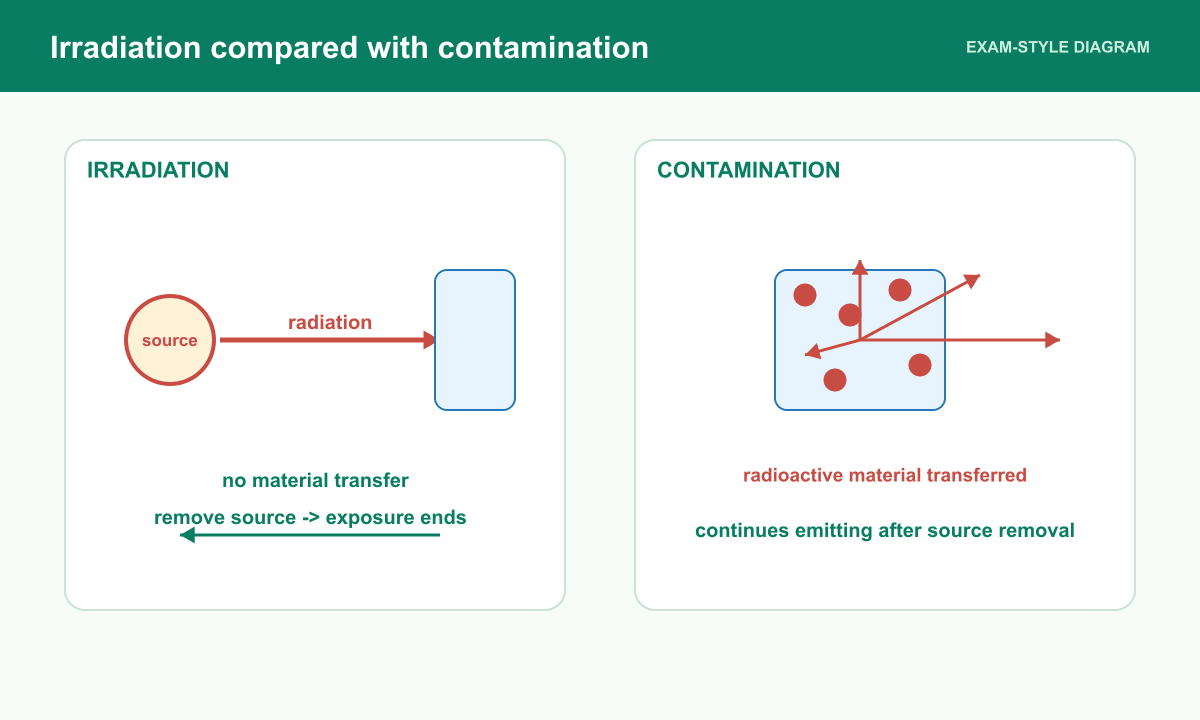
Irradiation means radiation reaches an object. Contamination means radioactive material is on or inside it; the material keeps emitting until removed or decayed. A normal medical X-ray exposure irradiates tissue without leaving radioactive material behind. Removing an external source stops that irradiation; contaminated material may continue exposing tissue from nearby.
02
Link harm to a mechanism and control
Scope: 8463 and 8464 · Foundation and Higher
Ionisation removes electrons from atoms and can damage biological molecules/DNA, causing cell death or mutations. External dose can be reduced by shorter exposure, greater distance and suitable shielding. Unsealed material also needs containment, gloves, contamination monitoring and measures preventing ingestion/inhalation. Alpha outside intact skin is readily absorbed; internal alpha contamination is hazardous because it strongly ionises nearby tissue.
03
Decide in context
Scope: 8463 and 8464 · Foundation and Higher
Risk depends on radiation type, dose, source location and duration. A useful medical procedure may justify controlled exposure when the benefit outweighs risk; it is not automatically risk-free. School demonstrations use approved sealed sources under trained staff procedures, with remote handling and secure storage.
04
Background radiation and supplied dose data
Scope: 8463 Physics only · Foundation and Higher
Background radiation is present continually. Natural sources include radioactive rocks and radon from the ground, and cosmic rays from space. Man-made contributions include fallout from nuclear testing or accidents. Occupation and location change exposure: a flight crew may receive more cosmic radiation, and local geology can change radon levels. Dose data use sieverts, with 1000 mSv = 1 Sv; the unit will be supplied rather than required from recall. Compare like time intervals and add supplied contributions. For example, an annual 1.8 mSv natural contribution plus 0.2 mSv man-made contribution gives 2.0 mSv = 0.0020 Sv. A dose value alone does not identify the source or prove that no risk exists.
05
Half-life: intensity versus persistence
Scope: 8463 Physics only · Foundation and Higher
State what is being held equal. For the same initial number of nuclei of the same radiation type, a shorter half-life gives a higher initial activity: more decays occur per second. Its activity then falls sooner. A long-lived contaminant can remain a source for much longer, requiring long-term control. For sources adjusted to the same initial activity, the short-lived one falls sooner without necessarily starting at a larger activity. Hazard also depends on emitted radiation, dose, location and whether material enters the body. Neither “shorter is always safer” nor “longer is always safer” is a valid rule.
06
Medical exploration and controlled tissue destruction
Scope: 8463 Physics only · Foundation and Higher
A tracer introduced into the body can emit penetrating gamma radiation detected outside it, showing the function or location of an organ. Choose a lifetime long enough for the investigation but short enough to limit continuing exposure; a lifetime much shorter than the procedure may leave an unusable signal. Radiotherapy uses ionising radiation to damage or destroy unwanted tissue. Exposure is planned to give the required effect while limiting healthy-tissue dose. Compare the expected benefit with supplied dose and consequence data; both methods carry risks. Do not treat a tracer choice as a universal clinical protocol or assume that a lower dose always gives enough diagnostic information.
Irradiation ends when the source is removed; contamination continues to emit until the material is removed or decays.Open the full-size exam diagram
Misconception clinic
Replace the tempting answer
Read each belief, say what is wrong with it, then compare your correction.
Tempting idea: Irradiation only; the glove contains no source.
Use instead: The powder itself is present. The glove can now carry a source and spread it.
Tempting idea: Alpha passes freely through the whole body.
Use instead: Its range is short. Short range concentrates damage near an internal source.
Retrieval practice
Quick checks
Worked examples
See the method being built
Apply distinguish exposure from material transfer in the worked reasoning, then try the changed-context questions below.
Example 1 · Classify a risk
Scope: 8463 and 8464 · Foundation and Higher
A worker handles an unsealed radioactive powder and later has it on gloves. Name the risk.
Identify material on the worker.
Use contamination, not irradiation.
State why it can spread/enter body.
Show the answer
This is contamination because radioactive material is on the gloves and could be transferred or taken into the body.
Example 2 · Reduce an external dose
Scope: 8463 and 8464 · Foundation and Higher
Give two ways to reduce dose from a sealed gamma source.
Use time, distance or shielding.
State the direction of change.
Link to exposure.
Show the answer
Minimise time near the source and maximise distance; thick shielding can also reduce the gamma radiation reaching the person.
Example 3 · Correct a claim
Scope: 8463 and 8464 · Foundation and Higher
A student says an X-ray makes every object radioactive. Correct them.
Identify X-rays as irradiation.
State what irradiation does.
Contrast contamination.
Show the answer
X-rays irradiate an object but do not leave radioactive material behind, so the object does not become radioactive in normal use.
Exam precision
Use the physics precisely
Do this: Name the exposure route and a control that interrupts it. For supplied medical data, weigh signal duration, dose and benefit before making a qualified choice.
Independent practice
Exam-style questions
Write an answer before opening the marking guidance. Then edit the exact phrase or step that would gain the next mark.
1. Compare irradiation with contamination and give one appropriate control for each.
[3 marks]
Scope: 8463 and 8464 · Foundation and Higher
Show marking guidance and model answer
Original PhysicsUK mark scheme: Point 1 (1 mark): Irradiation is exposure to radiation; contamination is radioactive material on/in an object. Point 2 (1 mark): A suitable irradiation control: reduce time, increase distance or use appropriate shielding. Point 3 (1 mark): A suitable contamination control: contain unsealed material/prevent inhalation, ingestion or spread. Award each distinct point once. Accept equivalent scientifically correct wording. No half marks.
Irradiation is exposure to radiation; contamination is radioactive material on/in an object. (1 mark)
A suitable irradiation control: reduce time, increase distance or use appropriate shielding. (1 mark)
A suitable contamination control: contain unsealed material/prevent inhalation, ingestion or spread. (1 mark)
Model answer: Irradiation is exposure and can be reduced by distance or shielding. Contamination is the presence of radioactive material and needs containment and prevention of spread/entry to the body.
2. Explain why removing an external X-ray source stops exposure but removing a nearby container may not stop exposure after contamination.
[2 marks]
Scope: 8463 and 8464 · Foundation and Higher
Show marking guidance and model answer
Original PhysicsUK mark scheme: Point 1 (1 mark): The X-ray source was external and leaves no radioactive material in ordinary diagnostic use. Point 2 (1 mark): Contamination leaves an emitting source on/in the person, so it continues until removed or decayed. Award each distinct point once. Accept equivalent scientifically correct wording. No half marks.
The X-ray source was external and leaves no radioactive material in ordinary diagnostic use. (1 mark)
Contamination leaves an emitting source on/in the person, so it continues until removed or decayed. (1 mark)
Model answer: Normal X-rays leave no radioactive material behind. A contaminated person retains a source that continues irradiating nearby tissue.
3. Physics only: a supplied annual dose table gives rocks/radon 1.4 mSv, cosmic rays 0.4 mSv and man-made sources 0.2 mSv. Use 1000 mSv = 1 Sv. Calculate the total in Sv and explain why a pilot’s total could differ.
[3 marks]
Scope: 8463 Physics only · Foundation and Higher
Show marking guidance and model answer
Original PhysicsUK mark scheme: Point 1 (1 mark): Total = 1.4 + 0.4 + 0.2 = 2.0 mSv. Point 2 (1 mark): 2.0 mSv = 0.0020 Sv. Point 3 (1 mark): A pilot’s occupation can increase cosmic-ray exposure at altitude (accept another justified supplied-location/occupation change). Award each distinct point once. Accept equivalent scientifically correct wording. No half marks.
Total = 1.4 + 0.4 + 0.2 = 2.0 mSv. (1 mark)
2.0 mSv = 0.0020 Sv. (1 mark)
A pilot’s occupation can increase cosmic-ray exposure at altitude (accept another justified supplied-location/occupation change). (1 mark)
Model answer: The total is 2.0 mSv, or 2.0/1000 = 0.0020 Sv. A pilot may receive a greater cosmic contribution because of time at altitude, so occupation can change the total.
4. Physics only: a one-hour organ investigation needs detectable gamma radiation throughout. Tracers A and B are adjusted to the same initial activity: A has a 10-minute half-life and gives too little signal after 30 minutes; B has a 3-hour half-life and remains detectable for the full procedure. Supplied estimated patient doses are A: 0.1 mSv and B: 0.3 mSv. Recommend a tracer using these data and explain one risk/benefit limit.
[4 marks]
Scope: 8463 Physics only · Foundation and Higher
Show marking guidance and model answer
Original PhysicsUK mark scheme: Point 1 (1 mark): Recommend B because it gives detectable gamma radiation throughout the required hour. Point 2 (1 mark): Gamma can leave the body and be detected to explore organ function/location. Point 3 (1 mark): B persists longer and has the larger supplied dose, so its benefit must justify added exposure/healthy-tissue risk. Point 4 (1 mark): A’s lower dose is insufficient reason to choose it because the stated signal fails; neither half-life alone proves universal safety. Award each distinct point once. Accept equivalent scientifically correct wording. No half marks.
Recommend B because it gives detectable gamma radiation throughout the required hour. (1 mark)
Gamma can leave the body and be detected to explore organ function/location. (1 mark)
B persists longer and has the larger supplied dose, so its benefit must justify added exposure/healthy-tissue risk. (1 mark)
A’s lower dose is insufficient reason to choose it because the stated signal fails; neither half-life alone proves universal safety. (1 mark)
Model answer: Choose B: its gamma emission can be detected outside the body throughout the one-hour investigation. A has a lower supplied dose but loses usable signal before completion. B’s longer persistence and 0.3 mSv dose increase continuing exposure, so the diagnostic benefit must justify the risk to healthy tissue. A shorter half-life is not automatically the safer useful choice.
Questions pupils ask
Radiation Hazards, Contamination and Irradiation FAQs
Does irradiation make an object contaminated?
Exposure alone does not mean radioactive material has been transferred. Contamination specifically means such material is on or inside the object.