Fission splits a heavy nucleus; fusion joins light nuclei. Both can release nuclear energy, but their requirements and control mechanisms differ.
AQA 8463GCSE PhysicsFoundationHigher
Learn · practise · improve
Start here
The revision snapshot
Fission splits a heavy nucleus; fusion joins light nuclei. Both can release nuclear energy, but their requirements and control mechanisms differ.
By the end, you should be able to:
Describe neutron-induced fission and a chain reaction.
Distinguish moderator and control-rod roles.
Compare fission with fusion in stars.
Before you revise
Diagnostic question
Choose an answer from memory. Your result tells you what to watch for in the guide.
Core revision guide
Learn the model, then use it
Fission splits a heavy nucleus; fusion joins light nuclei. Both can release nuclear energy, but their requirements and control mechanisms differ.
01
Induced fission and a chain reaction
Scope: 8463 Physics only · Foundation and Higher
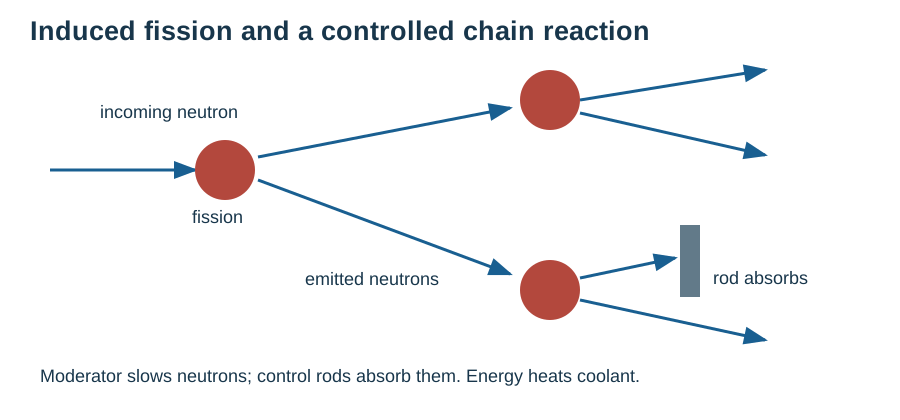
A suitable heavy nucleus such as uranium-235 absorbs a neutron and splits into smaller nuclei, emitting neutrons and gamma radiation and releasing energy. New neutrons can trigger further fissions: a chain reaction. The fragment kinetic energy transfers to the surrounding material. A power station transfers heating to coolant, produces steam and turns a turbine-generator.
02
Reactor control
Scope: 8463 Physics only · Foundation and Higher
A moderator slows neutrons so they are more likely to cause suitable further fission. Control rods absorb neutrons; inserting them further reduces the chain-reaction rate. Coolant carries away energy and shielding reduces radiation exposure. Do not say that the rods slow neutrons or that the moderator absorbs them to shut down the reactor.
03
Fusion and stars
Scope: 8463 Physics only · Foundation and Higher
Fusion joins light nuclei into a heavier nucleus and can release energy. Positive nuclei repel electrically; very high temperature gives enough kinetic energy for close approach and nuclear interaction. Stellar gravity provides conditions sustaining fusion. A fusion fuel is not made by splitting uranium. Fusion and fission are nuclear changes rather than ordinary combustion; radioactive-waste and engineering claims require context.
Physics both tiers: distinguish chain-reaction neutrons, moderator slowing and control-rod absorption.Open the full-size exam diagram
Misconception clinic
Replace the tempting answer
Read each belief, say what is wrong with it, then compare your correction.
Tempting idea: Slow neutrons without absorbing any.
Use instead: Slowing is the moderator’s role. This controls the chain reaction.
Tempting idea: Nuclei attract electrically at any distance.
Use instead: Like-charged nuclei repel electrically. This links conditions to the barrier.
Retrieval practice
Quick checks
Worked examples
See the method being built
Apply induced fission and a chain reaction in the worked reasoning, then try the changed-context questions below.
Example 1 · Control the next generation
Scope: 8463 Physics only · Foundation and Higher
Explain why inserting control rods can slow a reactor’s chain reaction.
Fission emits neutrons capable of causing more fission.
Inserted rods absorb more of those neutrons.
Fewer suitable nuclei are then struck by available neutrons.
Show the answer
Fewer further fissions occur per second because more emitted neutrons are absorbed.
Exam precision
Use the physics precisely
Do this: Begin induced fission with neutron absorption, then splitting and emitted neutrons. Explain how those neutrons continue or are removed from the chain.
Independent practice
Exam-style questions
Write an answer before opening the marking guidance. Then edit the exact phrase or step that would gain the next mark.
1. Explain how one induced fission can lead to a chain reaction.
[3 marks]
Scope: 8463 Physics only · Foundation and Higher
Show marking guidance and model answer
Original PhysicsUK mark scheme: Point 1 (1 mark): A suitable heavy nucleus absorbs a neutron and splits. Point 2 (1 mark): The fission emits further neutrons. Point 3 (1 mark): These neutrons can be absorbed by other suitable nuclei, causing further fissions. Award each distinct point once. Accept equivalent scientifically correct wording. No half marks.
A suitable heavy nucleus absorbs a neutron and splits. (1 mark)
The fission emits further neutrons. (1 mark)
These neutrons can be absorbed by other suitable nuclei, causing further fissions. (1 mark)
Model answer: A large unstable nucleus absorbs a neutron and splits into two smaller nuclei, releasing energy and two or three neutrons. Some emitted neutrons are absorbed by other large nuclei and cause further fissions, forming a chain reaction. Control rods absorb some neutrons to control the reaction rate.
2. Compare the roles of a moderator and control rods.
[2 marks]
Scope: 8463 Physics only · Foundation and Higher
Show marking guidance and model answer
Original PhysicsUK mark scheme: Point 1 (1 mark): Moderator slows neutrons to make suitable fission more likely. Point 2 (1 mark): Control rods absorb neutrons, reducing the rate of further fission. Award each distinct point once. Accept equivalent scientifically correct wording. No half marks.
Moderator slows neutrons to make suitable fission more likely. (1 mark)
Control rods absorb neutrons, reducing the rate of further fission. (1 mark)
Model answer: A moderator slows neutrons; control rods absorb them to control the chain reaction.