Atomic notation counts particles; scattering evidence explains why those particles are arranged in a tiny nucleus rather than spread through the atom.
By the end, you should be able to:
Infer a nuclear model from alpha scattering.
Describe how evidence changed atomic models.
Identify protons, neutrons and electrons in an isotope.
Before you revise
Diagnostic question
Choose an answer from memory. Your result tells you what to watch for in the guide.
Core revision guide
Learn the model, then use it
Atomic notation counts particles; scattering evidence explains why those particles are arranged in a tiny nucleus rather than spread through the atom.
01
Read A and Z and distinguish ions
Scope: 8463 and 8464 · Foundation and Higher
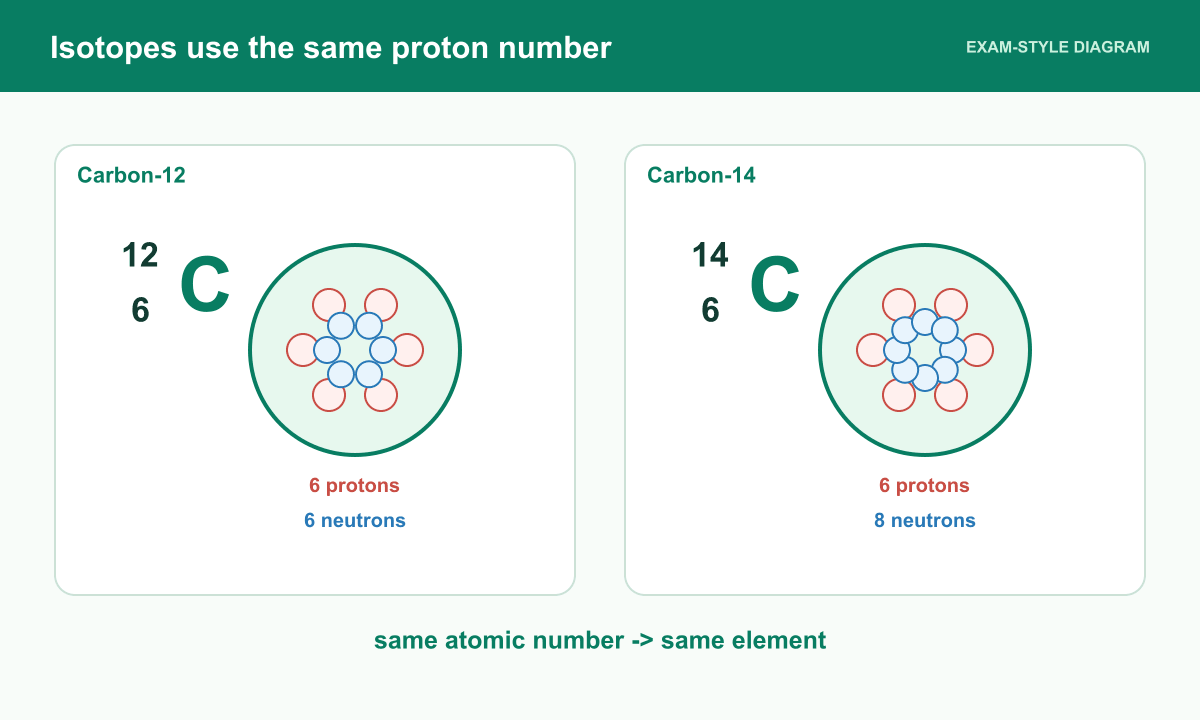
Z is proton number and identifies the element. A is protons plus neutrons, so neutrons = A − Z. A neutral atom has Z electrons; losing electrons makes a positive ion without changing its nucleus. Isotopes have the same protons and different neutrons. A typical atom radius is around 10⁻¹⁰ m; its nucleus is much smaller and holds most of its mass.
02
From plum pudding to a nucleus
Scope: 8463 and 8464 · Foundation and Higher
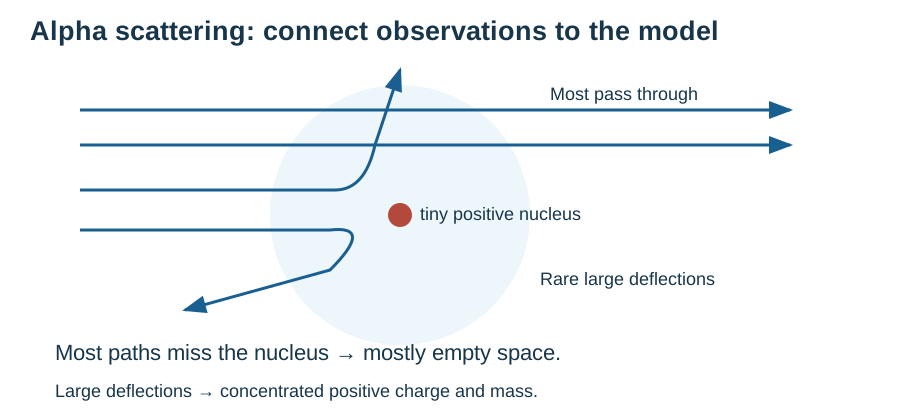
Discovery of electrons ruled out indivisible atoms and led to the plum pudding model: electrons embedded in spread-out positive charge. In the thin-foil experiment, most alpha particles passed straight through, showing that atoms are mostly empty space. A few were strongly deflected or returned backwards, showing a very small, concentrated, positively charged region containing most mass. The spread-out model could not account for those large deflections.
03
Later evidence refined the model
Scope: 8463 and 8464 · Foundation and Higher
Bohr proposed electrons at specific energy levels/distances, consistent with observations; absorbing radiation can raise electron energy and emitting it can lower it. Later work established protons and Chadwick’s work supplied evidence for neutrons in the nucleus. A new model must explain old successful observations as well as the new evidence; detailed Bohr and Chadwick experimental procedures are not required.
Atomic number fixes the element; isotopes differ in neutron number and therefore mass number.Open the full-size exam diagram
Schematic observations and model inferences, not paths to scale.
Mass numberA = protons + neutronsno unitAtomic numberZ = number of protonsno unit
Misconception clinic
Replace the tempting answer
Read each belief, say what is wrong with it, then compare your correction.
Tempting idea: The nucleus contains electrons.
Use instead: This observation locates empty space, not electrons in the nucleus. Most paths avoid the tiny nucleus.
Use instead: A includes protons and neutrons. Neutrons = 23 − 11; neutral electrons = protons.
Retrieval practice
Quick checks
Worked examples
See the method being built
Apply read a and z and distinguish ions in the worked reasoning, then try the changed-context questions below.
Example 1 · Read notation
Scope: 8463 and 8464 · Foundation and Higher
For carbon-14, atomic number 6, find protons, neutrons and electrons in a neutral atom.
Protons = atomic number.
Neutrons = 14 − 6.
Neutral electrons = protons.
Show the answer
It has 6 protons, 8 neutrons and 6 electrons.
Example 2 · Identify isotopes
Scope: 8463 and 8464 · Foundation and Higher
Compare chlorine-35 and chlorine-37.
Check atomic number.
Compare mass number.
State what changes.
Show the answer
They have the same number of protons but different numbers of neutrons, so they are isotopes of chlorine.
Example 3 · Ion calculation
Scope: 8463 and 8464 · Foundation and Higher
A magnesium atom has 12 protons and forms Mg²⁺. State its electrons.
A neutral atom has 12 electrons.
2+ means two electrons lost.
Subtract 2.
Show the answer
Mg²⁺ has 10 electrons.
Exam precision
Use the physics precisely
Do this: Link each observation to its own inference. Use atomic number for protons and mass number minus atomic number for neutrons.
Independent practice
Exam-style questions
Write an answer before opening the marking guidance. Then edit the exact phrase or step that would gain the next mark.
1. Explain how two observations from alpha scattering support the nuclear model.
[4 marks]
Scope: 8463 and 8464 · Foundation and Higher
Show marking guidance and model answer
Original PhysicsUK mark scheme: Point 1 (1 mark): Most particles pass through nearly undeflected: atom mostly empty space. Point 2 (1 mark): A few particles are deflected through large angles/backwards. Point 3 (1 mark): These large deflections require concentrated positive charge repelling alpha particles. Point 4 (1 mark): Their rarity shows the nucleus occupies a very small part of the atom; most mass is concentrated there. Award each distinct point once. Accept equivalent scientifically correct wording. No half marks.
Most particles pass through nearly undeflected: atom mostly empty space. (1 mark)
A few particles are deflected through large angles/backwards. (1 mark)
These large deflections require concentrated positive charge repelling alpha particles. (1 mark)
Their rarity shows the nucleus occupies a very small part of the atom; most mass is concentrated there. (1 mark)
Model answer: Most particles pass through, so atoms are mostly empty space. Rare large deflections show a tiny region of concentrated positive charge and mass that repels positive alpha particles.
2. A sodium isotope has mass number 23 and atomic number 11. State its neutron number and the electron number in Na⁺.
[2 marks]
Scope: 8463 and 8464 · Foundation and Higher
Show marking guidance and model answer
Original PhysicsUK mark scheme: Point 1 (1 mark): Neutrons = 23 − 11 = 12. Point 2 (1 mark): Na⁺ has 10 electrons because it loses one. Award each distinct point once. Accept equivalent scientifically correct wording. No half marks.
Neutrons = 23 − 11 = 12. (1 mark)
Na⁺ has 10 electrons because it loses one. (1 mark)
Model answer: 12 neutrons; 10 electrons in Na⁺.
Questions pupils ask
Atoms, Isotopes and Nuclear Notation FAQs
Why did rare large deflections matter more than most straight paths?
Straight paths showed empty space, while rare large deflections required a tiny concentration of positive charge and mass that the plum-pudding model could not explain.