Radiation changes an unstable nucleus. Identify what is emitted, how it interacts with matter and how the nuclear numbers must balance.
By the end, you should be able to:
Compare alpha, beta and gamma properties.
Balance mass and atomic numbers in decay equations.
Justify a radiation choice for a stated use.
Before you revise
Diagnostic question
Choose an answer from memory. Your result tells you what to watch for in the guide.
Core revision guide
Learn the model, then use it
Radiation changes an unstable nucleus. Identify what is emitted, how it interacts with matter and how the nuclear numbers must balance.
01
Particles, photons and shielding
Scope: 8463 and 8464 · Foundation and Higher
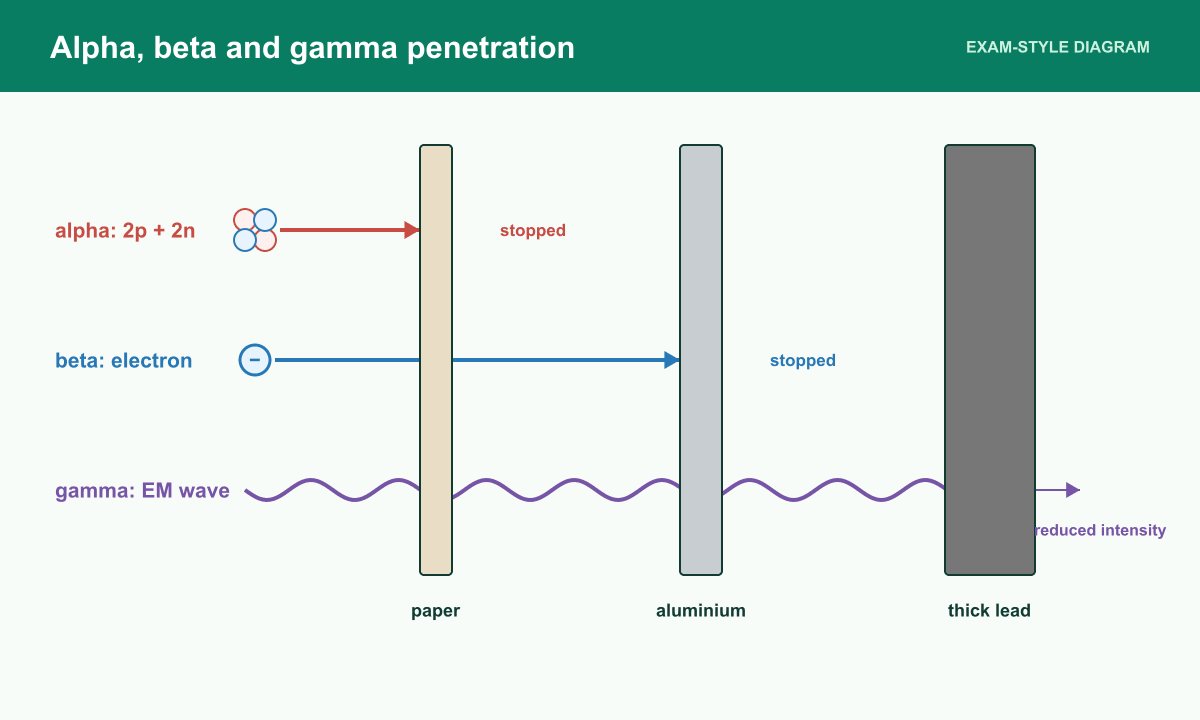
Alpha is a helium nucleus with two protons and two neutrons: charge +2, strong ionisation and short range, stopped by paper or skin externally. Beta-minus is a fast electron from the nucleus when a neutron becomes a proton: charge −1, intermediate penetration, often stopped by a few millimetres of aluminium. Gamma is electromagnetic radiation carried by photons, with no charge; it is highly penetrating and weakly ionising per unit path compared with alpha. Thick lead/concrete reduces gamma intensity, rather than guaranteeing complete removal.
02
Balance nuclear equations
Scope: 8463 and 8464 · Foundation and Higher
Alpha emission: ²³⁸₉₂U → ²³⁴₉₀Th + ⁴₂He. Both mass number and atomic number balance. Beta-minus: ¹⁴₆C → ¹⁴₇N + ⁰₋₁e. A stays the same; Z increases by one because a neutron becomes a proton. The emitted electron is newly produced in the decay, rather than an orbital electron. Neutrino notation is beyond the required GCSE treatment. Gamma emission leaves A and Z unchanged.
03
Choose a source for an application
Scope: 8463 Physics only applications; radiation properties shared by both courses
A tracer must emit radiation that can escape to a detector and have a suitable lifetime for the task; a gamma emitter may suit this. Alpha is especially hazardous if its source is inside the body because it deposits energy locally. The choice depends on penetration, ionisation, half-life and exposure route; “gamma is not a particle” is misleading because photons are quantum particles.
Read each belief, say what is wrong with it, then compare your correction.
Tempting idea: A falls by 4 and Z falls by 2.
Use instead: That is alpha emission. A neutron becomes a proton; the electron has A = 0, Z = −1.
Tempting idea: Gamma is a helium nucleus.
Use instead: That describes alpha. Photons carry electromagnetic radiation.
Retrieval practice
Quick checks
Worked examples
See the method being built
Apply particles, photons and shielding in the worked reasoning, then try the changed-context questions below.
Example 1 · Choose a smoke alarm source
Scope: 8463 Physics only · Foundation and Higher
Explain why alpha can be used in an ionisation smoke alarm.
State alpha’s ionising ability.
Link to ionising air.
State why short range reduces external risk.
Show the answer
Alpha strongly ionises the air in the detector and is easily stopped, so it has a short external range.
Example 2 · Shield a beta source
Scope: 8463 and 8464 · Foundation and Higher
Choose suitable shielding for beta radiation.
Recall beta’s medium penetration.
Choose a thin metal absorber.
Avoid claiming paper is enough.
Show the answer
A thin sheet of aluminium is suitable because beta is more penetrating than alpha but less than gamma.
Example 3 · Medical tracer
Scope: 8463 Physics only · Foundation and Higher
Explain why a gamma-emitting tracer can be detected outside the body.
State gamma penetration.
Link to escape from body.
Mention low dose/short half-life where relevant.
Show the answer
Gamma is penetrating enough to leave the body and be detected externally, while a suitable short half-life limits dose.
Exam precision
Use the physics precisely
Do this: Compare ionisation and penetration in the stated exposure route. Balance both A and Z when writing a nuclear equation.
Independent practice
Exam-style questions
Write an answer before opening the marking guidance. Then edit the exact phrase or step that would gain the next mark.
1. Complete and explain alpha decay of ²²⁶₈₈Ra. The daughter element is radon (Rn).
[3 marks]
Scope: 8463 and 8464 · Foundation and Higher
Show marking guidance and model answer
Original PhysicsUK mark scheme: Point 1 (1 mark): Daughter has A = 222. Point 2 (1 mark): Daughter has Z = 86 (Rn); emitted particle is ⁴₂He. Point 3 (1 mark): A and Z balance: 226 = 222 + 4; 88 = 86 + 2. Award each distinct point once. Accept equivalent scientifically correct wording. No half marks.
Daughter has A = 222. (1 mark)
Daughter has Z = 86 (Rn); emitted particle is ⁴₂He. (1 mark)
A and Z balance: 226 = 222 + 4; 88 = 86 + 2. (1 mark)
Model answer: ²²⁶₈₈Ra → ²²²₈₆Rn + ⁴₂He. The emitted alpha contains two protons and two neutrons, reducing A by four and Z by two.
2. Explain why a gamma-emitting tracer can be detected outside a patient.
[2 marks]
Scope: 8463 Physics only · Foundation and Higher
Show marking guidance and model answer
Original PhysicsUK mark scheme: Point 1 (1 mark): Gamma is sufficiently penetrating to escape tissue. Point 2 (1 mark): A detector outside the patient records some escaping photons. Award each distinct point once. Accept equivalent scientifically correct wording. No half marks.
Gamma is sufficiently penetrating to escape tissue. (1 mark)
A detector outside the patient records some escaping photons. (1 mark)
Model answer: Penetrating gamma photons escape tissue and some are detected outside the patient.
Questions pupils ask
Alpha, Beta and Gamma Radiation FAQs
Does gamma emission change the element?
No. It reduces nuclear energy without changing proton number or nucleon number.