

Why does a football curve after it is kicked?
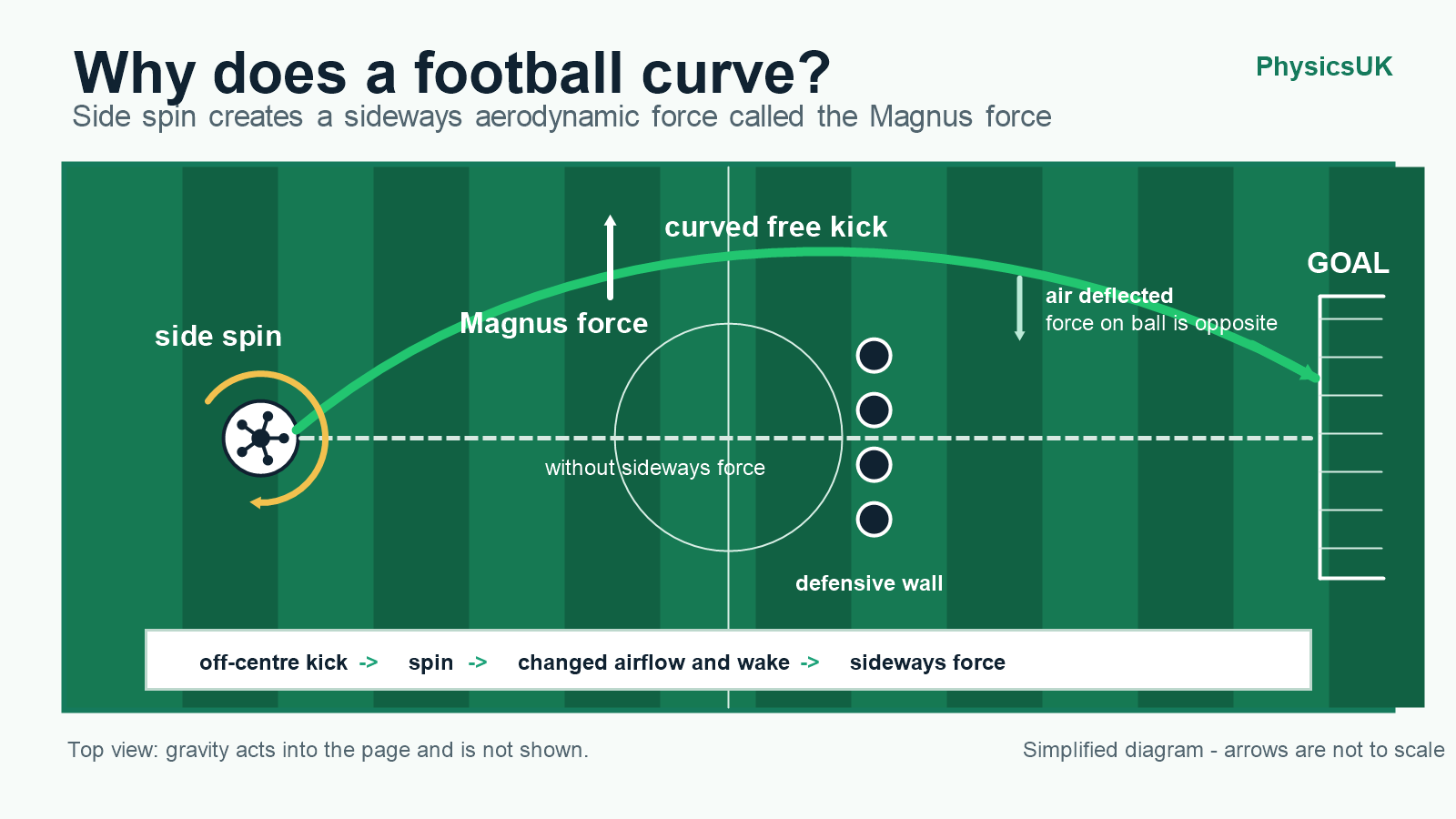
A football curves when an off-centre kick makes it spin. The spinning surface changes the flow around the ball and sends the wake sideways. The ball pushes air in one direction, and the air pushes the ball in the opposite direction. This sideways push is called the Magnus force.
Once the ball has left the foot, three main forces shape its flight. Weight pulls it down, drag acts mostly against its motion, and the Magnus force acts across the motion when the ball is spinning. The combined or resultant force produces an acceleration, so the ball's velocity changes as it travels.
Velocity includes direction as well as speed. A shot can therefore have a nearly steady speed for a short time but still be accelerating because its direction is changing. A curved path is visible evidence that a sideways force is acting.
The foot does not keep pushing the ball around the corner after contact ends. It sets the initial speed and spin. The surrounding air then supplies the force that bends the flight.
How does the Magnus effect make a football swerve?
Imagine watching the ball from above. As it moves forwards, air flows around both sides. A thin layer of air next to the surface is dragged by friction, and the flow eventually separates from the curved surface to form a wake behind the ball.
Side spin makes the two sides behave differently. On one side, the surface motion works with the passing airflow; on the other, it works against it. This changes the separation points, makes the pressure distribution uneven and deflects the wake sideways.
Deflecting air means changing its momentum. The ball has exerted a force on that air, so the air exerts an equal and opposite force on the ball. That reaction is the Magnus force shown in the diagram.
You may also meet an explanation based on faster airflow and lower pressure on one side. Pressure difference is a useful part of the picture, but it should not be treated as a separate trick. The pressure pattern, boundary-layer separation and sideways wake are connected descriptions of the same fluid motion.
Four shots, four different physics stories
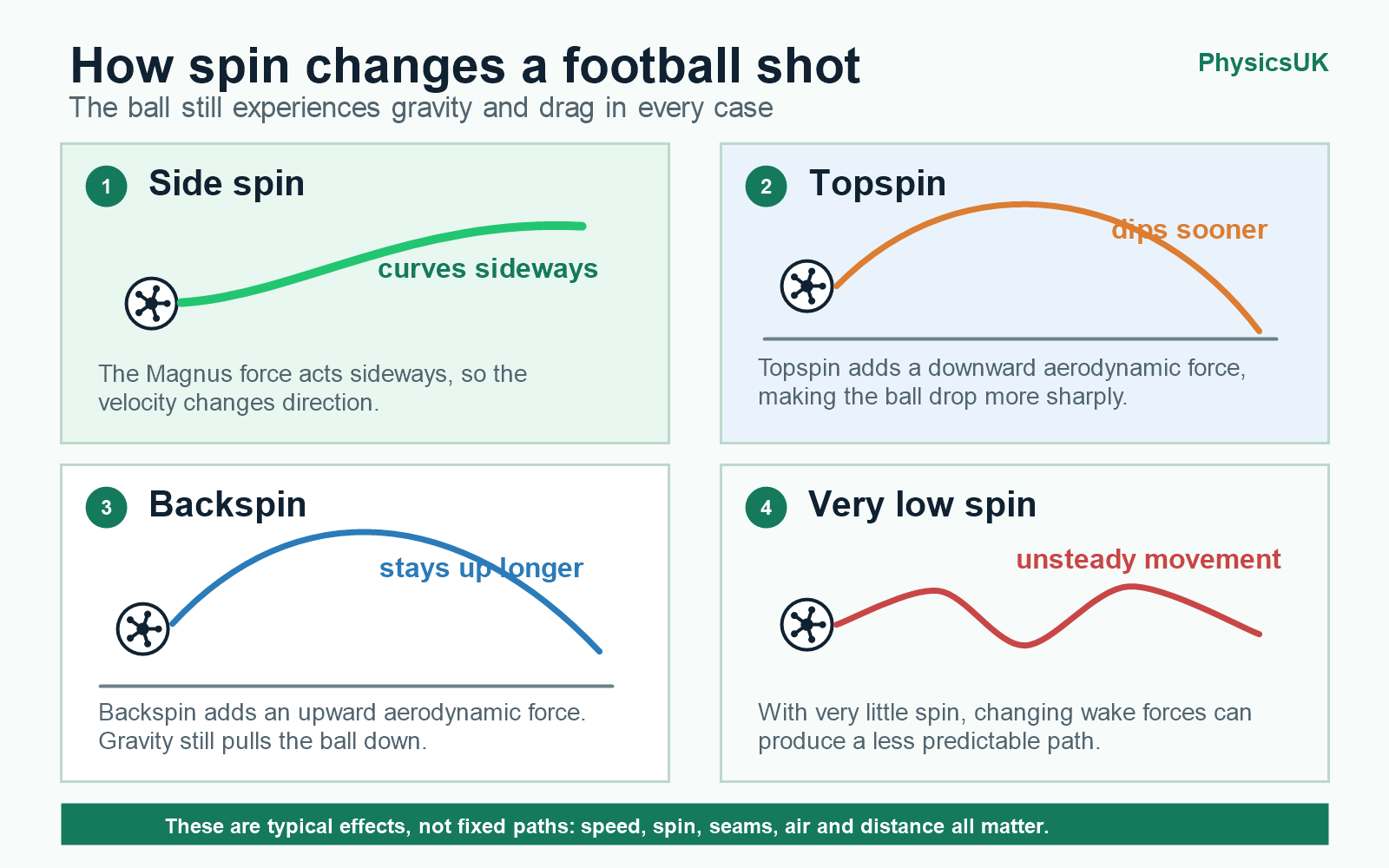
Real kicks can combine several kinds of spin, so these are useful starting points rather than four rigid categories.
Straight power shot
A strike close to the centre gives little side spin. Gravity and drag still act, but there is less steady sideways Magnus force.
Curling free kick
An off-centre strike creates side spin. The sideways Magnus force turns the velocity and carries the ball around a wall.
Dipping shot
Topspin adds a downward force, allowing the ball to drop more sharply after clearing an obstacle.
Knuckleball
A firm, low-spin strike can produce a shifting wake and an irregular path. It is not simply an extreme version of normal curl.
Why do some free kicks curl, dip or wobble?
Side spin is what makes a normal curling free kick bend left or right. The player strikes to one side of the ball's centre, giving it rotation around a roughly vertical axis. Reverse the spin and the sideways force reverses too.
Topspin rotates the ball around a horizontal axis and adds a downward aerodynamic force. That can help a shot climb over a defensive wall and then dip towards the goal sooner than gravity and drag alone would make it fall.
Backspin produces an aerodynamic force with an upward component. It does not switch gravity off, but it can make the ball stay up for longer or follow a shallower descent.
A knuckleball is deliberately struck with very little spin. Without one steady spin direction to hold the wake in place, the wake can shift as seams and panels move through the airflow. The resulting forces vary, so the ball may wobble or change direction in a way that is hard for a goalkeeper to predict.
The school physics behind a curved free kick
Newton's laws give the basic chain of reasoning. A resultant sideways force produces a sideways acceleration. That acceleration changes the sideways part of the velocity, so the direction of motion keeps turning and the path curves.
In ideal projectile motion, the only force after launch is weight, so the horizontal velocity stays constant while the vertical velocity changes. A real football is not an ideal projectile: drag slows it and spin can add a Magnus force in another direction.
Use the projectile motion worksheet to practise separating horizontal and vertical motion, then try the projectile-motion simulator to see the baseline path before adding the more complicated effects of air and spin.
Engineers use the same ideas for far more than sport. A mechanical engineer may test rotating machinery, model airflow around vehicles or use computational fluid dynamics to predict forces that would be difficult to measure directly.
Science ideas to understand
Force changes velocity
A force can change speed, direction, or both. Curving is a change in velocity even if the speed changes only slightly.
Spin is set at contact
An off-centre force from the foot gives the ball a turning effect as well as forward momentum.
Air causes the curve
The Magnus force is aerodynamic. In a vacuum, a spinning football would not curl sideways.
Knuckle is low spin
A knuckleball relies on an unsteady wake and very little spin, unlike a normal curling free kick.
A Level stretch: airflow, wakes and real footballs
The air touching the ball forms a boundary layer. Whether that layer stays attached or separates depends on speed, surface roughness, seams and the state of the flow. Spin shifts the separation points, and the resulting wake is no longer centred behind the ball.
Two useful comparison quantities are the Reynolds number, which compares inertial and viscous effects in the flow, and the spin parameter, which compares the surface rotation speed with the forward speed. Neither speed nor spin alone completely describes the flight.
A 2026 peer-reviewed simulation study modelled the full three-dimensional flight of a spinning football. It found that spin rate strongly affected lateral deviation, while initial speed strongly affected range and flight time. It also found that surface details changed the aerodynamics, which is why panel shape and seams cannot simply be ignored.
The momentum and pressure explanations agree with each other. A sideways pressure force on the ball is the surface-level result; the deflected wake records the sideways momentum given to the air. Both must point to the same net force.
Key words
Football curve and Magnus effect: common questions
Why does a football curve in the air?
An off-centre kick gives the ball side spin. The spin changes the airflow and deflects the wake, so the air exerts a sideways Magnus force on the ball. That force changes the direction of its velocity and bends the path.
What is the Magnus effect in football?
The Magnus effect is the sideways aerodynamic force on a spinning ball moving through air. In football it can make a shot curl left or right, dip more sharply or stay up for longer, depending on the spin axis.
Which way will a spinning football curve?
Reverse the spin and the Magnus force reverses. The exact left or right direction depends on whether the ball has clockwise or anticlockwise side spin from the observer's viewpoint, so the viewpoint must always be stated.
Why do free kicks dip?
A player can apply topspin by striking below and across the ball. Topspin adds a downward aerodynamic force, so the ball can clear a wall and then fall towards the goal more sharply.
Does kicking a football harder make it curve more?
Not automatically. A faster ball experiences different aerodynamic forces but also spends less time in flight. The curve depends on speed, spin rate, spin direction, surface, air conditions and distance.
Why does a knuckleball move unpredictably?
A knuckleball has very little spin. The wake can shift as the slowly turning panels and seams meet the airflow, so the sideways force changes during flight and the ball can wobble or veer.
Can wind make a football curve?
Yes. Wind changes the air velocity relative to the ball and can push the flight sideways. That is separate from, but can combine with, the Magnus force caused by spin.
Does the air pressure inside a football make it curve?
Internal pressure mainly affects the ball's stiffness, bounce and how it deforms during the kick. The main cause of a curling flight is the external airflow around a spinning ball.
Would a spinning football curve in a vacuum?
No. Without air there is no drag, pressure pattern or Magnus force. After the kick, gravity would still bend the path downwards, but there would be no aerodynamic sideways curl.
Is Bernoulli's principle the whole explanation for a curving football?
No. A pressure difference is part of the result, but a fuller explanation also tracks the boundary layer, where the flow separates and how the wake is deflected. The pressure and momentum descriptions must agree.
Do football panels and seams affect the curve?
Yes. Surface texture and seam pattern affect the boundary layer and wake. Modern simulations and experiments show that a real panelled football can behave differently from an ideal smooth sphere.
How does a curved free kick link to GCSE and A Level Physics?
It applies resultant force, acceleration, velocity, Newton's laws, momentum, drag and projectile motion. At A Level it also provides a useful route into vectors, pressure, fluid flow and computational modelling.