

What did LUX-ZEPLIN actually detect?
On 1 September 2026, the LUX-ZEPLIN team reported an interaction that is difficult to account for using its known backgrounds. The detector is at the Sanford Underground Research Facility in South Dakota, with UK researchers among the international collaboration.
The analysis examined an extended range of recoil energies. One event had the light and charge characteristics of a xenon nucleus being knocked into motion. That fits a possible dark-matter interaction, but it does not uniquely identify one.
The result was presented at a conference and released as a research preprint submitted for journal publication. The collaboration is continuing to collect data. A cautious headline is part of telling this story accurately: a candidate signal and a discovery are different stages of an investigation.
How can a tank of xenon detect an invisible particle?
Start with something familiar: if one moving object hits another, it can transfer energy and momentum. LZ looks for the microscopic equivalent. A hypothetical dark-matter particle might occasionally collide with a xenon nucleus and make it recoil.
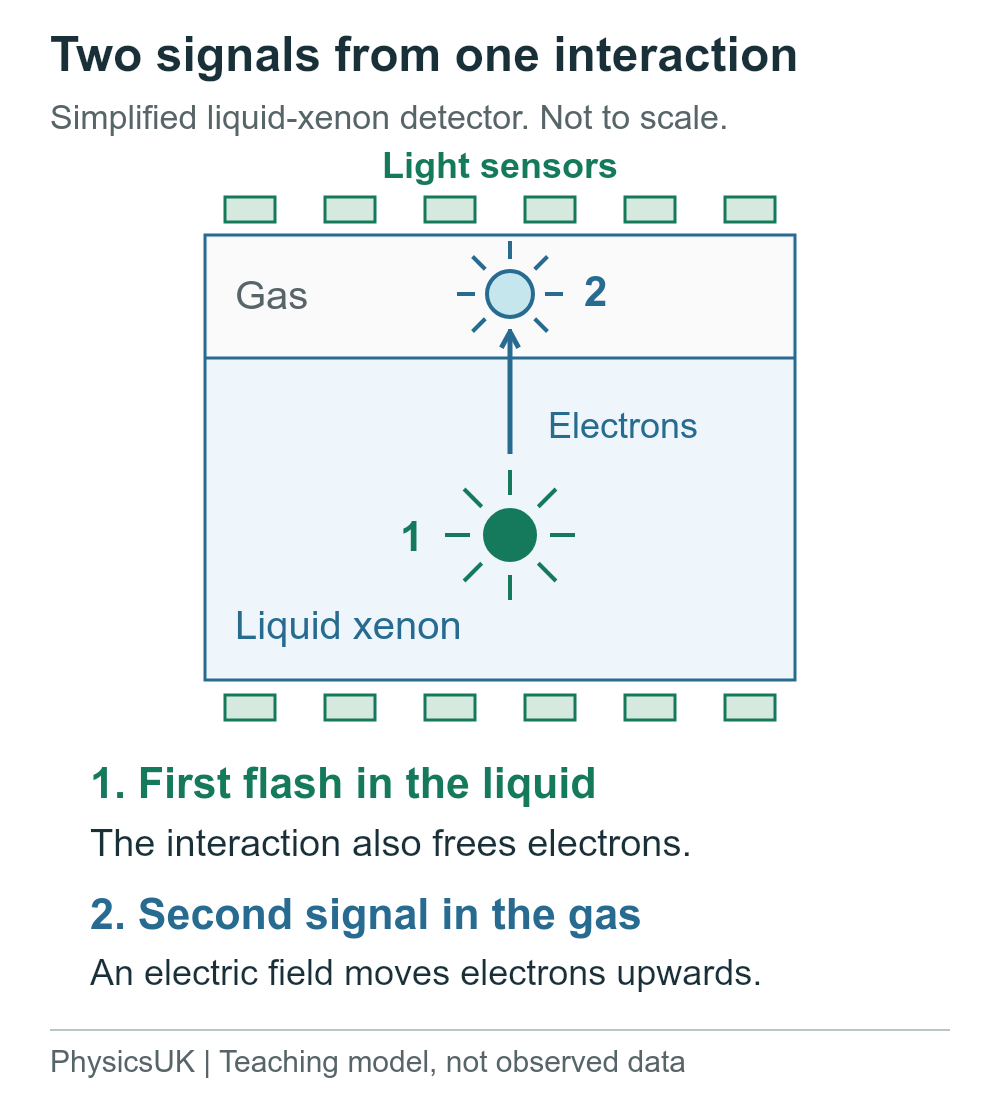
The detector contains very pure liquid xenon. An interaction can excite atoms, producing a small flash of light, and can free electrons by ionisation. Sensors detect the light; an applied electric field moves the freed electrons towards a gas layer, where a second light signal is produced.
The delay between signals helps locate the interaction vertically. The pattern across the sensors helps locate it horizontally. Comparing the signals also helps distinguish types of interaction. Researchers combine these clues rather than treating every flash as a dark-matter candidate.
Ordinary particles can also deposit energy. That is why the instrument sits deep underground and uses shielding, very clean materials and surrounding detectors. Rock reduces cosmic-ray backgrounds, while the other systems help identify events that could imitate the sought signal.
A useful comparison is hearing a quiet knock in a noisy room. Making the room quieter helps, but it does not tell you who knocked. In LZ, establishing the source of a signal is as important as detecting it.
Why finding the particle would matter
Astronomers already have evidence for additional gravitating matter: galaxy motions, gravitational lensing and the large-scale structure of the Universe do not fit a model containing only the ordinary matter we can inventory. Dark matter is the name for this unseen component in the standard cosmological picture.
That evidence does not tell us the particle identity. A WIMP, or weakly interacting massive particle, is one proposed explanation. Its properties are hypotheses to test, not a description of a particle already in the school periodic table.
A confirmed laboratory detection would connect astronomical evidence to a measurable microscopic interaction. Researchers could then compare how often events occur, the energy transferred and the results from different detector materials.
There are useful outcomes even when a search does not confirm a signal. It can rule out combinations of particle mass and interaction strength. That narrows the next experiment instead of leaving every idea equally plausible.
The work brings together the research scientist developing the experiment and the data scientist testing whether a pattern survives careful checks. Both need the habit pupils practise in the lab: ask what else could explain the reading.
The GCSE and A-level physics behind the detector
The AQA GCSE resource on alpha, beta and gamma radiation introduces ionisation, penetration and shielding. Ionisation means removing or adding electrons so an atom or molecule becomes charged. In this detector the relevant process frees electrons. The tiny electrical signal is useful evidence of an interaction.
Random radioactive decay also matters. Repeated counts from an unchanged source fluctuate, so a slightly larger count is not automatically evidence that something new has appeared. A background measurement gives a comparison, and longer observations usually make the average rate more reliable.
At AS and A Level, the photon model of electromagnetic radiation explains why light can be counted as individual packets of energy. A light sensor turns the optical signal into a measurable electrical response.
The notes on uncertainties in measurements and data analysis help with a separate question: how precisely was the signal measured? Measurement uncertainty and uncertainty about what caused the event are related, but they are not the same thing.
Science ideas to understand
Dark matter is not dark energy
Dark matter contributes to gravitational clustering. Dark energy names the component associated with accelerated cosmic expansion. The similar names do not make them the same thing.
A recoil is not necessarily a decay
A nucleus can move after a collision without changing its proton number. Do not write an alpha-decay equation simply because a nuclear detector is involved.
A Level stretch: what does 2.6 sigma tell us?
The reported global significance is 2.6 sigma after allowing for the range of models searched. This summarises how surprising the result is under the specified background-only model. It is not the probability that dark matter exists.
Searching many possibilities gives chance fluctuations more opportunities to look interesting. The look-elsewhere correction accounts for that. The collaboration reports a higher local significance for a particular model, but the global value is the appropriate headline measure.
The usual five-sigma benchmark is not a substitute for checking the apparatus. A convincing claim also needs a sound background model, stable calibration and further evidence. A wrongly understood background can make an apparently striking number misleading.
Think of two questions: how well do we know the energy deposited, and how well do we know what deposited it? A precise answer to the first does not automatically answer the second.
Key words
Quick pupil questions
Has dark matter been detected in 2026?
LUX-ZEPLIN has reported an unusual candidate event, not a confirmed direct detection of a dark-matter particle. Further data and background checks are needed.
Why is a dark-matter detector underground?
The overlying rock reduces the cosmic-ray background. Shielding and other detectors then help identify ordinary interactions that could imitate a rare signal.
What does LUX-ZEPLIN stand for?
The name combines LUX and ZEPLIN, two earlier liquid-xenon detector programmes. LZ is the current experiment, which looks for tiny energy deposits in xenon.
Is dark matter the same as a black hole?
No. Dark matter describes the unseen gravitating component inferred from observations. Black holes are a particular kind of compact object; LZ is searching for particle interactions.