Where is Hera, and when will it arrive?
ESA's Hera spacecraft is approaching Didymos and its small companion, Dimorphos. The mission page gives November 2026 as the rendezvous date. Hera will investigate the target of NASA's DART impact, four years after that deliberate collision.
ESA's 7 October update scheduled braking manoeuvres for 15 and 22 October, followed by smaller adjustments. Those dates describe the published plan; this article does not treat a planned burn as a confirmed success. Mission operations can change as navigation data improve.
Reaching the right place is only part of the job. Hera must reduce its velocity relative to the asteroids so it can study them nearby. Passing the target at high speed would give a very different opportunity from accompanying it.
How did DART change an asteroid's motion?
DART was a kinetic impactor: a spacecraft deliberately sent into a target to change its motion. It struck Dimorphos in September 2022. Dimorphos orbits the larger asteroid Didymos, so astronomers could look for a change in that orbit afterwards.
Think first about a moving trolley striking another trolley. During contact, each exerts a force on the other. Momentum is transferred, and the motion after the collision differs from the motion before it. An asteroid impact uses the same conservation principle, though the material response is much more complicated.
The goal is a controlled change in trajectory. With enough warning, even a small velocity change can build up into a substantial change in position later. Whether a particular intervention would prevent an impact depends on the orbit, direction, timing and uncertainty.
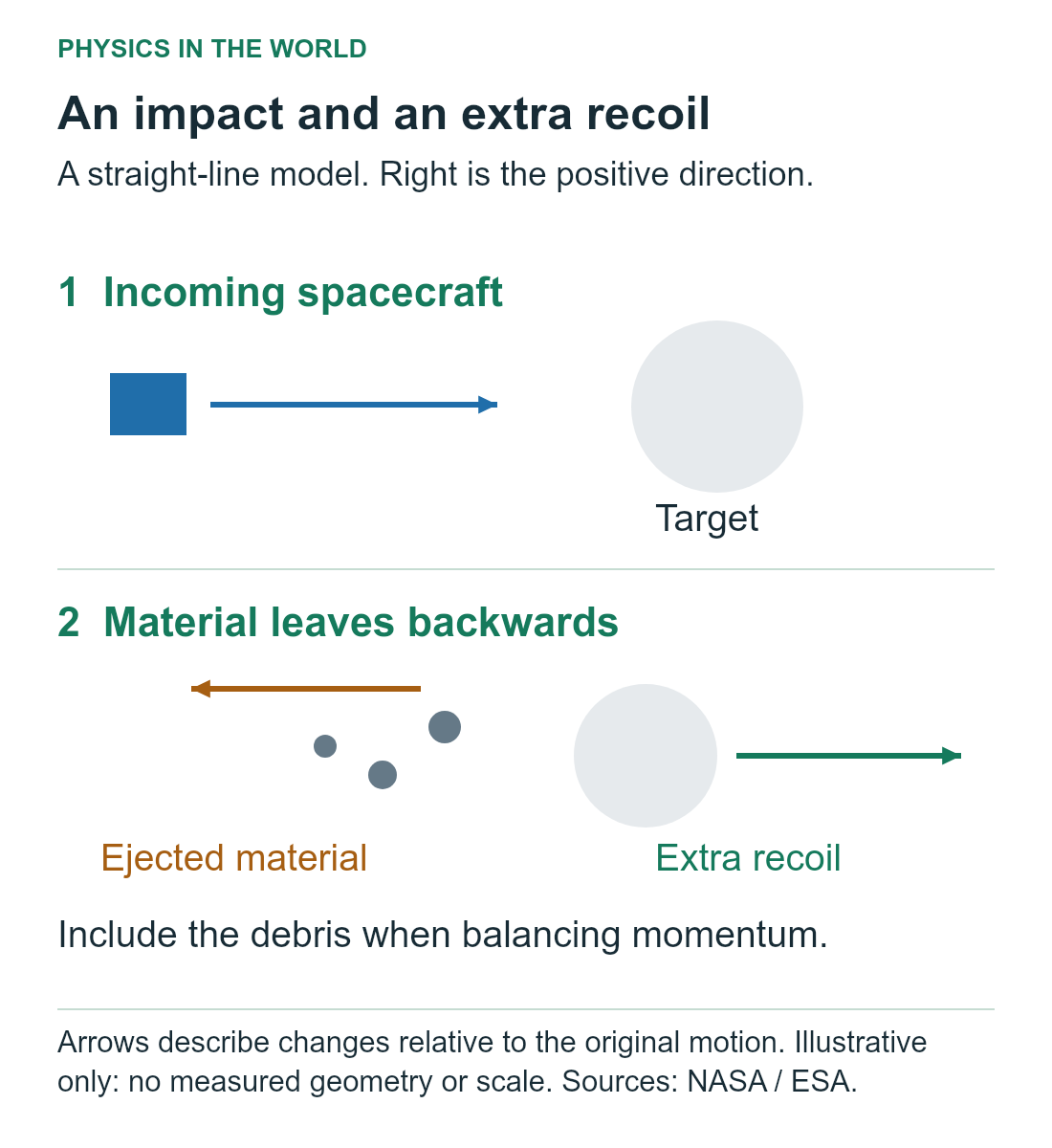
DART also threw material off the asteroid. That material carried momentum away, giving the remaining asteroid an extra recoil. It is similar in principle to a rocket gaining momentum as exhaust leaves in the opposite direction, although an impact plume is far less controlled.
The diagram deliberately removes the orbital geometry and shows a straight-line model. Its arrows describe momentum changes relative to the original motion. A real asteroid is already moving, and the direction of the impact matters.
What can Hera measure that DART could not?
Watching an orbit change tells us the impact had an effect. It does not, by itself, tell us everything about the target. Hera's close observations will help establish properties such as mass, surface structure and how the body responded to the collision.
Mass matters because the same momentum change gives a smaller velocity change to a more massive object. The surface and interior matter too: a loose collection of rocks can respond differently from a solid body held firmly together.
NASA reported in March 2026 that DART also produced a measurable change in the asteroid pair's motion around the Sun. That adds another observation of the impact's consequences. It does not mean every asteroid would respond by the same amount.
An aerospace engineer working on a mission like Hera has to connect those scientific questions with practical instruments and navigation. The spacecraft needs to collect measurements precise enough to distinguish between competing explanations of the impact.
Momentum and forces: the school physics
Momentum is mass multiplied by velocity, so it has a direction. When studying motion along a straight line, choose one direction as positive and use negative values for motion the other way. The momentum and collisions worksheet gives practice with this.
During the short collision, we can treat the total momentum as conserved if outside forces have too little time to change it appreciably. At A level, we say the external impulse is negligible: impulse is the momentum change caused by a force acting over a time interval. Include the spacecraft, asteroid and ejected material in the system. Leaving out the debris can make the balance appear to fail.
Newton's third law says the interacting objects exert equal and opposite forces on each other. Their changes in velocity need not be equal, because their masses differ. Nor do the two forces cancel on one object: they act on different objects.
Kinetic energy needs separate treatment. A violent impact can transfer energy into deformation, fracture, internal energy and moving debris. Total energy is conserved, but the initial kinetic energy does not all remain as the bulk motion of the two original objects.
After the collision, gravity continues to govern the orbit. The solar system and orbital motion resource explains why changing velocity changes the subsequent motion even though gravity has not been switched off. Our straight-line teaching model describes the short impact, not the whole orbit.
A Level stretch: why thrown-out debris matters
Imagine a projectile arriving from the left. If material is then thrown back towards the left, it carries negative momentum in that chosen direction. The rest of the system can acquire more positive momentum than in a model where the projectile simply sticks and nothing escapes.
Scientists describe this extra effect using a momentum enhancement factor. It compares the momentum change of the remaining asteroid with the incoming spacecraft momentum along a chosen direction. A value above one means recoil has increased that change. A large cloud in a photograph is not enough to find the factor: we need to know how much material left and how fast it moved in each direction.
Researchers must also distinguish changes in Dimorphos's orbit around Didymos from changes in the pair's orbit around the Sun. Those are related measurements of a system, but they are not the same orbit or the same reported quantity.
Hera's measurements should help rule out models that do not match the evidence. The measurements and errors worksheet is useful preparation. A very uncertain measurement can fit several explanations; more precise measurements can help tell them apart.
Key words
Quick pupil questions
When will ESA's Hera reach the asteroid?
ESA currently lists rendezvous with the Didymos system in November 2026. The October mission update describes planned braking manoeuvres; arrival should be checked against subsequent ESA confirmations.
Did DART successfully change an asteroid's orbit?
Yes. DART changed Dimorphos's orbit around Didymos. NASA has also reported a measurable change in the pair's motion around the Sun. Hera will investigate the target and aftermath in detail.
Was Dimorphos going to hit Earth?
No. The Didymos system was selected for an asteroid-deflection experiment, not an emergency interception of a body on a collision course with Earth.
Why does asteroid debris increase the deflection?
Ejected material carries momentum away. When debris leaves in a suitable direction, its recoil gives the remaining asteroid an additional momentum change. The effect depends on the amount and motion of the debris.