
Free worksheet and solutions · OCR A A Level · H556
OCR A A Level Physics Motion Graphs: Displacement, Velocity and Acceleration Worksheet
Free OCR A motion graphs worksheet on gradients, signed areas, displacement and distance. Follow a shuttle journey with printable questions and worked answers.
What is covered
Questions and skills covered
The worksheet contains 5 pages of printable questions. A separate 5-page solutions PDF makes it easy to mark, review or share answers after the activity.
- Reading values and describing trends on motion graphs
- Acceleration from velocity-time graph gradients
- Signed displacement and total distance from graph areas
- Instantaneous velocity from displacement-time graph gradients
About this activity
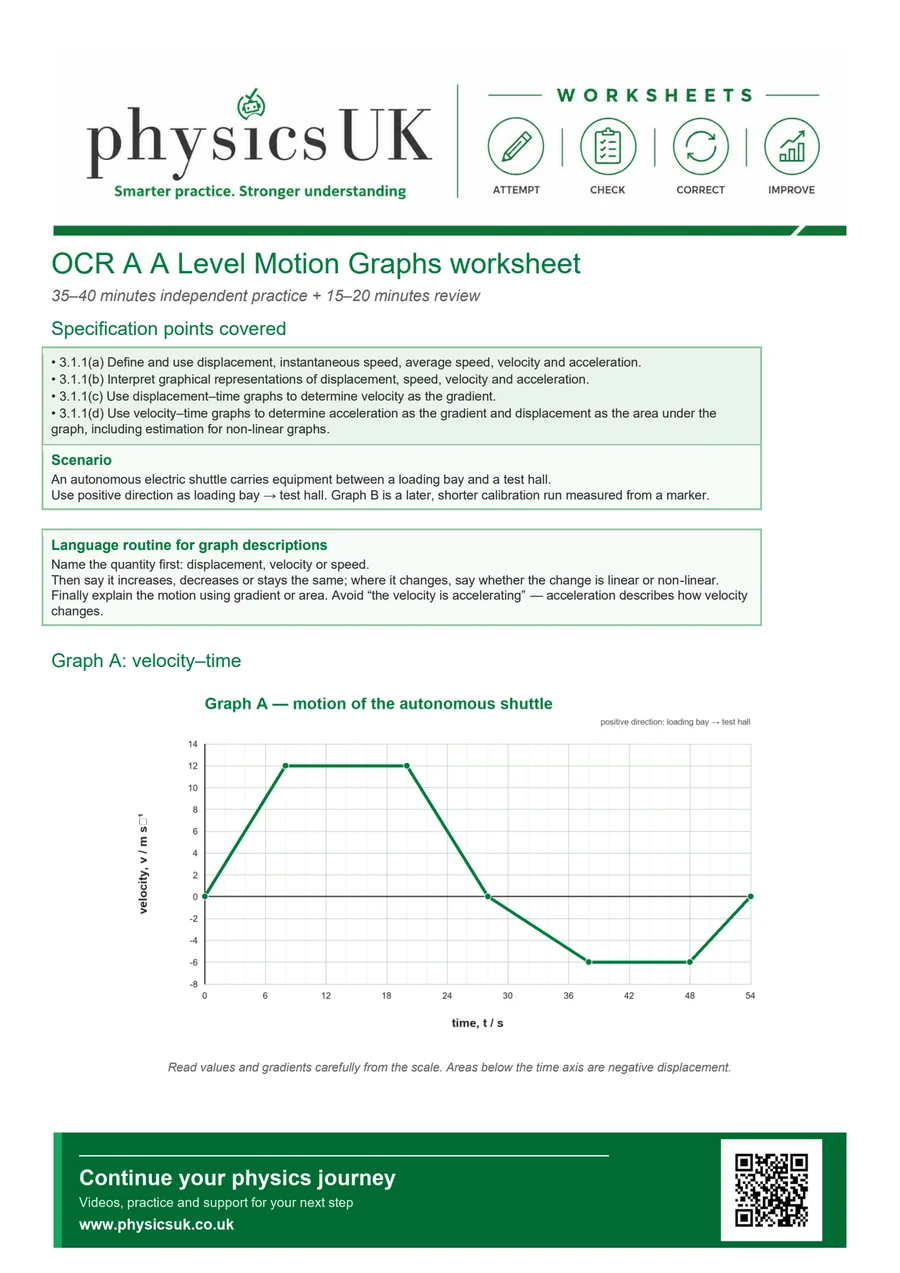
Follow an electric shuttle travelling between a loading bay and a test hall, including motion in the negative direction. This sheet emphasises signed areas, the difference between distance and displacement, and accurate descriptions of curved and straight graph sections. It is distinct from the Linear Motion 2 sheet on comparing journeys.
Before you start
Distinguish speed from signed velocity. Be ready to find gradients and split the area under a graph into simple shapes, retaining the sign of areas below the time axis.
A question from the worksheet
Question 1, worksheet page 2; graph-independent extract
For a velocity-time graph, state what (i) its gradient and (ii) its signed area between the graph and the time axis represent.
Show the answer
(i) The gradient represents acceleration. (ii) The signed area represents displacement.
Common error: Adding the magnitudes of all areas gives distance travelled. Displacement requires the negative contributions from below the time axis.
Revise the physics
Specification fit
OCR A A Level Physics Worksheets
H556 · 3.1.1(a), 3.1.1(b), 3.1.1(c), 3.1.1(d)
Classroom use
Use the worksheet for class practice, homework, intervention, cover work or revision. Keep the PhysicsUK attribution intact when sharing copies with pupils.