
Free worksheet and solutions · OCR A A Level · H556
OCR A A Level Physics Linear Motion 2: Motion Graphs Worksheet
Free OCR A motion graphs worksheet with answers: gradients, areas, comparing journeys and overtaking. Download Linear Motion 2 and its worked solutions.
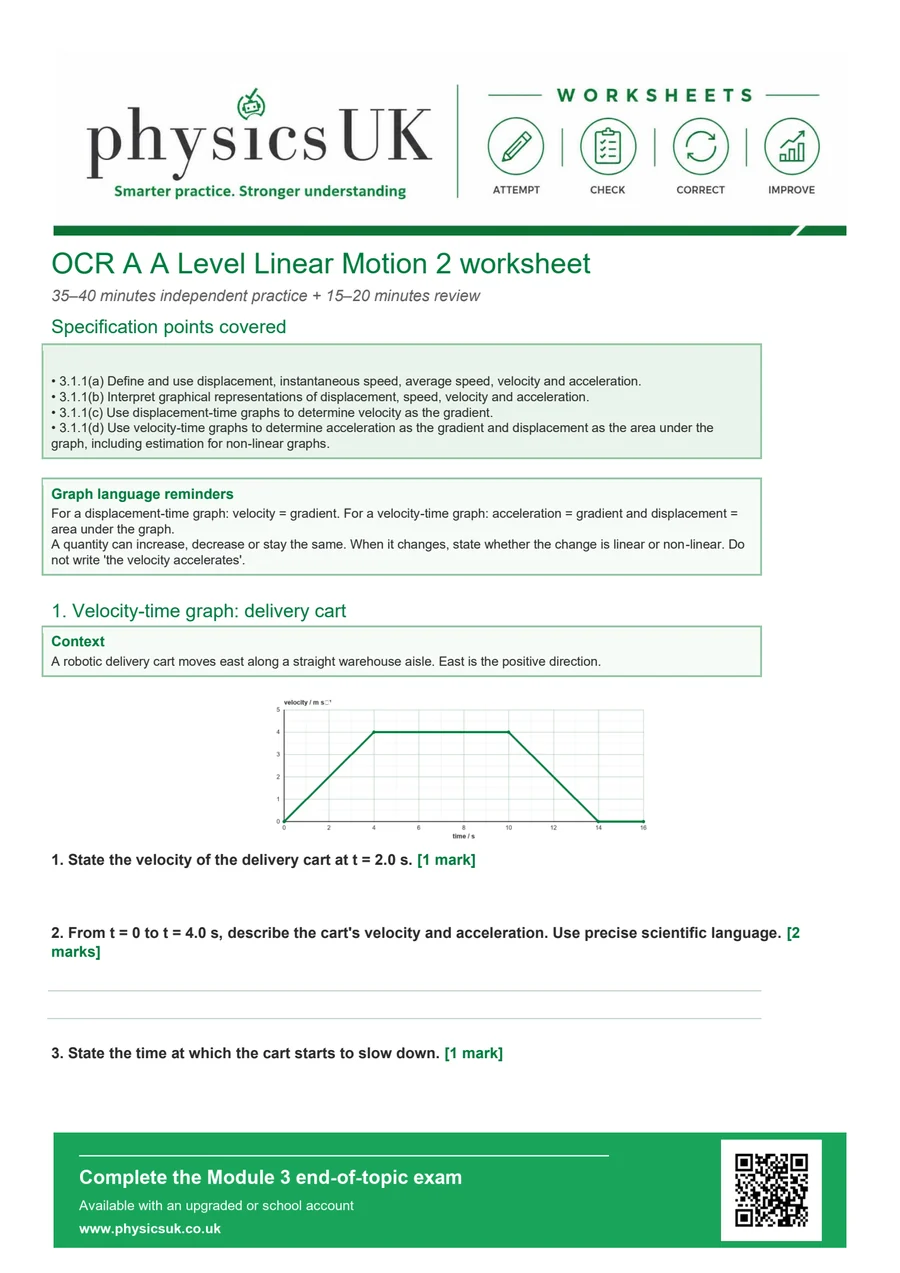
What is covered
Questions and skills covered
The worksheet contains 4 pages of printable questions. A separate 4-page solutions PDF makes it easy to mark, review or share answers after the activity.
- Interpreting displacement-time and velocity-time graphs
- Velocity and acceleration from graph gradients
- Displacement from the area under a velocity-time graph
- Comparing journeys and identifying an overtaking point
About this activity
Linear Motion 2 uses a delivery-cart velocity-time graph and a safety-trolley displacement-time graph before comparing journeys and finding an overtaking point. Choose this sheet for translating graph features into precise descriptions and comparing the motion of two objects.
Before you start
Read graph scales and calculate a straight-line gradient and the areas of triangles and rectangles. Recall that velocity is the gradient of a displacement-time graph.
A question from the worksheet
Adapted from question 2, worksheet page 1; graph values stated in words
From 0 to 4.0 s, the delivery cart velocity increases along a straight line from 0 to +4.0 m/s on a velocity-time graph. Describe its velocity and acceleration.
Show the answer
The velocity increases linearly from 0 to +4.0 m/s. The acceleration is constant and positive because the graph has a constant positive gradient.
Common error: Say that velocity increases. Do not say that the velocity accelerates.
Revise the physics
Specification fit
OCR A A Level Physics Worksheets
H556 · 3.1.1(a), 3.1.1(b), 3.1.1(c), 3.1.1(d)
Classroom use
Use the worksheet for class practice, homework, intervention, cover work or revision. Keep the PhysicsUK attribution intact when sharing copies with pupils.