
Free worksheet and solutions · AQA GCSE · 8463
AQA GCSE Physics Sound Ultrasound and Seismic Exploration Worksheet
AQA GCSE Separate Physics Higher sound worksheet with answers. Calculate echo distances, analyse ultrasound tests and interpret seismic-wave evidence.
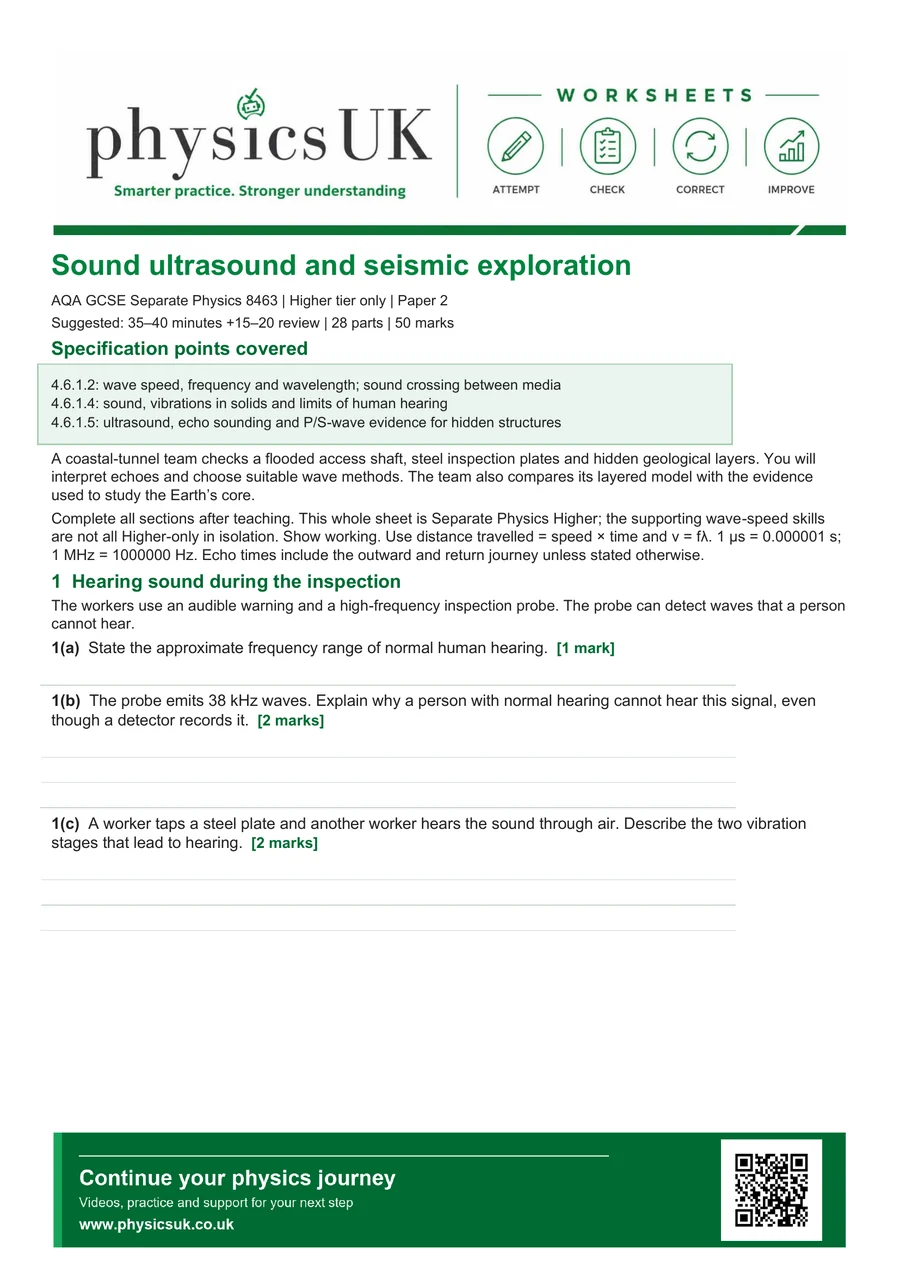
What is covered
Questions and skills covered
The worksheet contains 6 pages of printable questions. A separate 6-page solutions PDF makes it easy to mark, review or share answers after the activity.
- Normal human hearing range and ultrasound
- Vibrating solid, sound through air and vibrations in the ear
- Repeated outward-and-return echo calculations in air, water and steel
- Microseconds and megahertz conversions
- Sent pulse at 5 microseconds; internal echo at 25 and back-face echo at 45
- Internal-gap depth 0.060 m and plate thickness 0.120 m
- Partial reflection and energy continuing through steel past a localised gap
- Probe wavelengths 3.0 mm and 1.5 mm
- Probe Q suitable at 80 mm; neither probe resolves 2.0 mm separation at 160 mm under stated limits
- Frequency unchanged and wavelength increased on entry into faster steel
- P longitudinal and S transverse
- Liquid-layer inference from reliable P/S transmission data
- P-wave refraction and liquid outer-core evidence
- No echo or one missing S signal is not a complete diagnosis
- Repeated spatial records and models constrain core extent
About this activity
A coastal-tunnel team must locate reflecting boundaries, select usable inspection probes and judge what wave records actually establish.
Before you start
Separate Physics Higher sound and exploration content; distance = speed × time, v = fλ, unit conversions and graph reading. No A-level ultrasound equations are required.
A question from the worksheet
Questions 3(a)–3(c), pupil page 3
The sent pulse peaks at 5 microseconds and the internal echo at 25 microseconds. What is the reflecting-boundary depth in steel at 6000 metres per second?
Show the answer
Elapsed time is 20 microseconds. The out-and-back path is 0.120 m, so the depth is 0.060 m.
Common error: Using the absolute 25-microsecond display reading, or failing to halve the total travel distance.
Revise the physics
Specification fit
AQA GCSE Physics Worksheets
8463 · 4.6.1.2, 4.6.1.4, 4.6.1.5
- 8463: 4.6.1.2, 4.6.1.4, 4.6.1.5
Choose the correct pathway: Whole worksheet: Separate Physics 8463 Higher only, Paper 2. Shared wave-speed calculations support Higher-only sound/ultrasound and seismic applications; no Combined route.
Classroom use
Use the worksheet for class practice, homework, intervention, cover work or revision. Keep the PhysicsUK attribution intact when sharing copies with pupils.