
Free worksheet and solutions · AQA GCSE · 8463
AQA GCSE Physics Reflection and Refraction Required Practical Worksheet
AQA GCSE Separate Physics reflection and refraction worksheet with answers. Trace rays, analyse angles and evidence, and write a ray-box practical method.
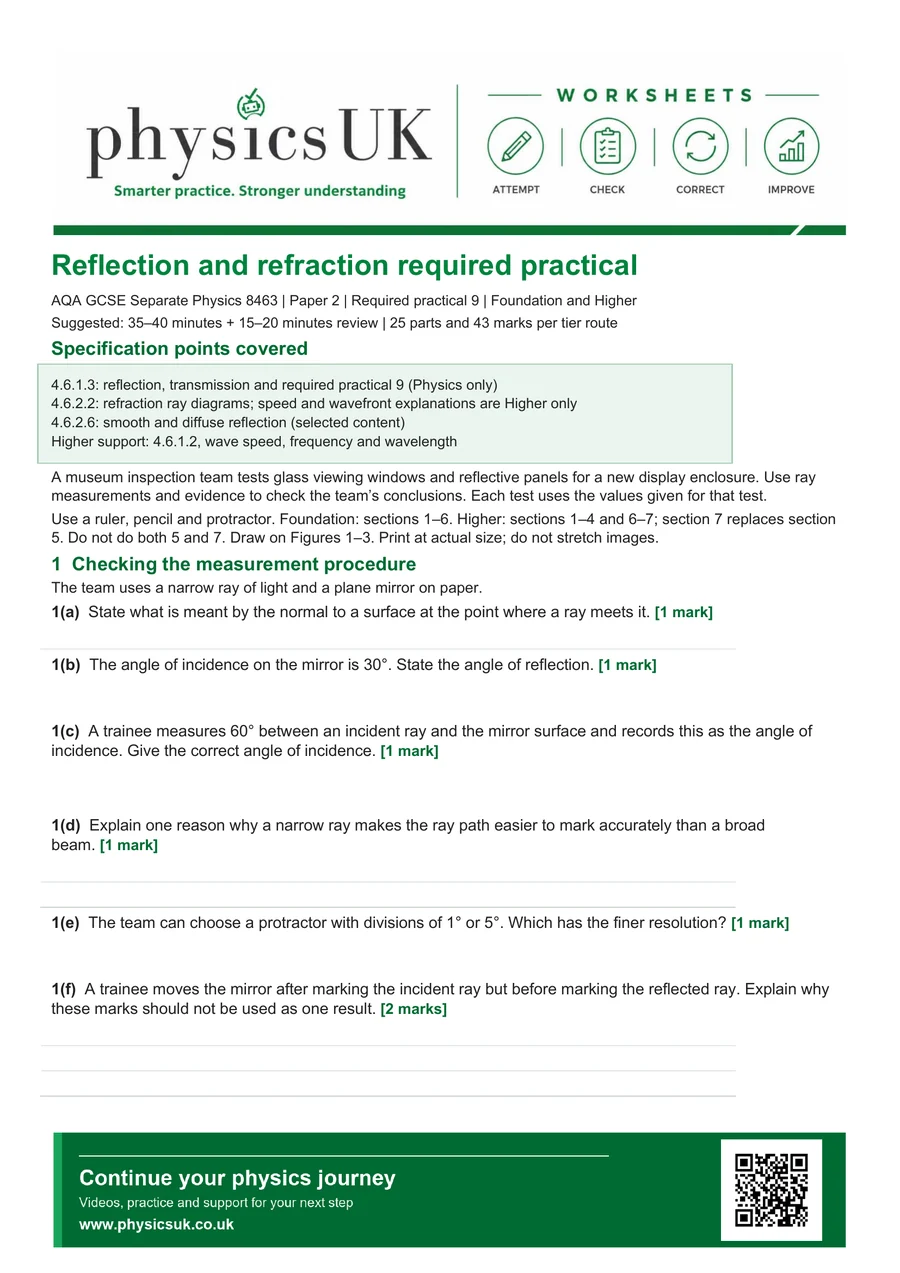
What is covered
Questions and skills covered
The worksheet contains 7 pages of printable questions. A separate 7-page solutions PDF makes it easy to mark, review or share answers after the activity.
- Reflection and angles from a normal
- Refraction through a parallel-faced window sample
- Specular and diffuse reflection
- Reflection graph and paired angle data
- Mean, resolution, repeats and systematic error
- Six-mark ray-box refraction method
- Higher wavefront, speed and wavelength explanations
About this activity
Museum inspection scenario: check reflective panels and transparent viewing windows using ray tracing and evidence.
Before you start
After teaching reflection, refraction and ray-box measurements; use a ruler/protractor, plot a simple graph and calculate a mean.
A question from the worksheet
Question 1(c), worksheet page 1
A ray makes 60° with a mirror surface. Find its angle of incidence.
Show the answer
90° − 60° = 30°, measured from the normal.
Common error: Measuring from the surface rather than the normal, or confusing a refracted ray with a reflected ray.
Revise the physics
Specification fit
AQA GCSE Physics Worksheets
8463 · 4.6.1.3, 4.6.2.2, 4.6.2.6, 4.6.1.2
- 8463: 4.6.1.3, 4.6.2.2, 4.6.2.6, 4.6.1.2
Choose the correct pathway: Separate Physics 8463 only, both tiers, RP9 preparation. Complete common Sections 1–4 and 6, then Foundation Section 5 OR Higher Section 7, not both.
Classroom use
Use the worksheet for class practice, homework, intervention, cover work or revision. Keep the PhysicsUK attribution intact when sharing copies with pupils.