
Free worksheet and solutions · AQA GCSE · 8463
AQA GCSE Physics Lenses Ray Diagrams and Magnification Worksheet
AQA GCSE Separate Physics lenses worksheet with answers. Construct convex and concave ray diagrams, compare images and calculate magnification.
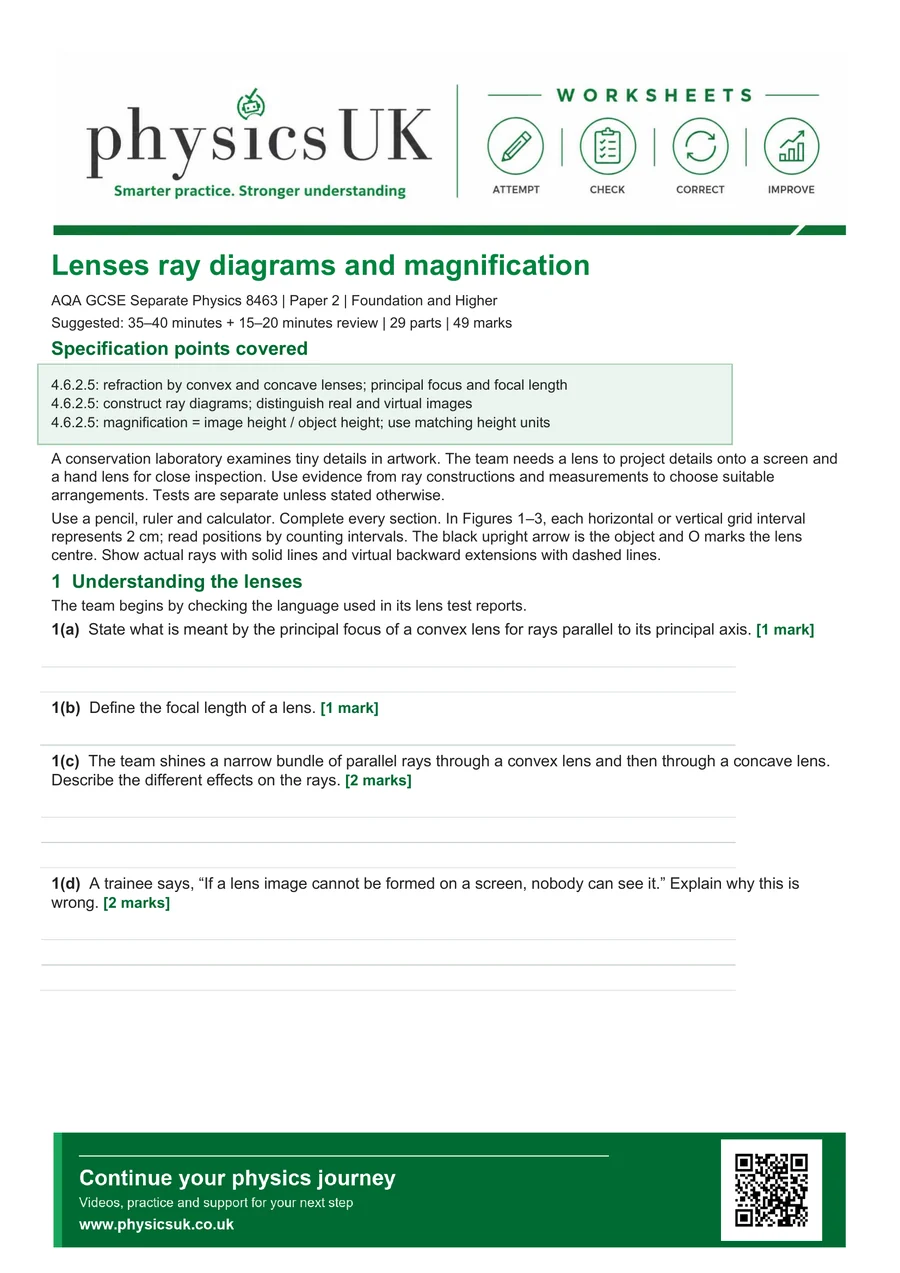
What is covered
Questions and skills covered
The worksheet contains 6 pages of printable questions. A separate 6-page solutions PDF makes it easy to mark, review or share answers after the activity.
- Convex and concave lens behaviour
- Principal focus and focal length
- Three principal-ray constructions
- Real and virtual images
- Upright, inverted, enlarged and diminished images
- Magnification, height rearrangements and units
- Projection and hand-magnifier selection
- Focal-length measurement using parallel rays
About this activity
Conservation-laboratory scenario comparing projection onto a screen with direct hand-lens inspection of artwork.
Before you start
After teaching lens ray rules, image terminology, grid interpretation and magnification.
A question from the worksheet
Question 5(d), worksheet page 5
A detail is0.50cm high and its image is15mm high. Calculate magnification.
Show the answer
0.50cm=5.0mm; magnification=15/5.0=3.0, without a unit.
Common error: Dividing heights in different units, or treating a virtual image as invisible.
Revise the physics
Specification fit
AQA GCSE Physics Worksheets
8463 · 4.6.2.5
- 8463: 4.6.2.5
Choose the correct pathway: Separate Physics 8463 only, both tiers. Three pupil construction grids; solutions give exact ray steps and image coordinates rather than completed ray-diagram images. No thin-lens equation.
Classroom use
Use the worksheet for class practice, homework, intervention, cover work or revision. Keep the PhysicsUK attribution intact when sharing copies with pupils.