
Free worksheet and solutions · AQA GCSE · 8463
AQA GCSE Physics Solar System Orbits and Satellites Worksheet
AQA GCSE Separate Physics orbits worksheet with answers. Calculate satellite speeds, interpret mission evidence and explain the correct tier orbit model.
What is covered
Questions and skills covered
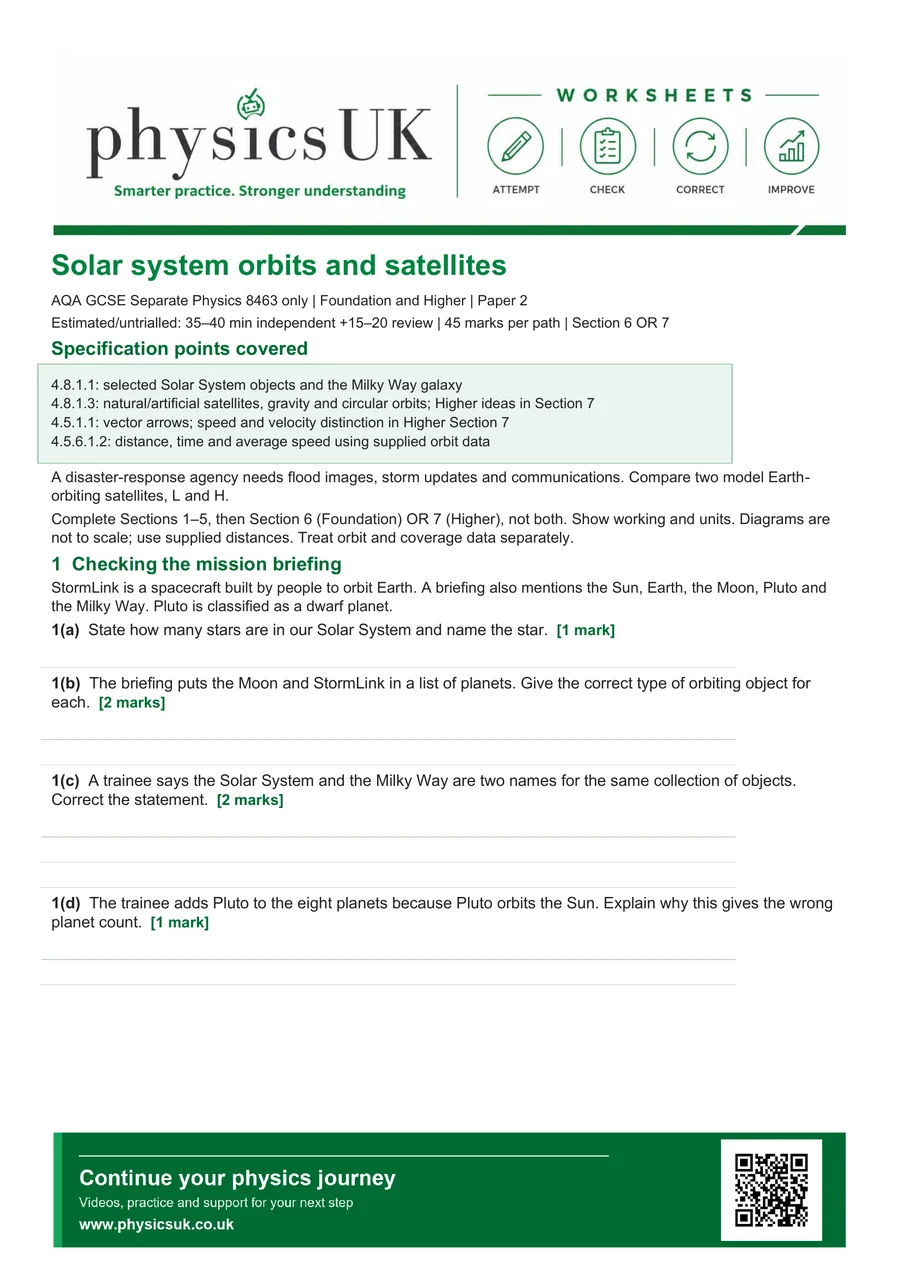
The worksheet contains 7 pages of printable questions. A separate 7-page solutions PDF makes it easy to mark, review or share answers after the activity.
- Solar System within Milky Way; one Sun, eight planets, dwarf planets and natural/artificial satellites
- Interpret four orbit-relationship arrows without treating them as distance or force vectors
- Earth gravity maintains both natural and artificial satellite orbits
- Draw inward force arrows at rightmost and top orbital positions; no magnitude inferred from an unscaled drawing
- Use full orbital path, unit conversions and average speed: L 7.5 km/s, H about 3.1 km/s
- Three complete L circuits in six hours, not four from rounding up 3.6
- Choose flood, storm and relay options from separate resolution, viewing-gap and contact-window data
- Distinguish orbital period/speed from continuous coverage and revisit gaps
- Foundation: time, outage path length, half-period path, percentage contact and combined-constraint decision
- Higher only: equal-length anticlockwise tangent velocity arrows, inward acceleration and changing direction/velocity at constant speed
- Higher only: changed speed in a final stable circular orbit requires changed radius; no outward balancing force
- Higher only: model comparison refutes larger-orbit/higher-speed claim but establishes no exact inverse-proportion rule
About this activity
Use supplied orbital and operational evidence for justified physics decisions, not recalled satellite fact lists. Distinguish force, speed, velocity, period and useful coverage.
Before you start
After teaching selected Separate Physics Solar System/orbit content and speed calculations; Higher pupils also taught circular-motion acceleration and qualitative stable-orbit reasoning. No A-level mechanics.
A question from the worksheet
Question 5(d), pupil page 5
Does L’s faster orbital speed prove more continuous useful views of the target?
Show the answer
No. L has 80 min useful-image gaps while H has none in the supplied region. Orbital speed/period does not determine useful viewing coverage by itself.
Common error: Equating one faster orbit with uninterrupted useful views or a continuous ground-station link.
Revise the physics
Specification fit
AQA GCSE Physics Worksheets
8463 · 4.8.1.1, 4.8.1.3, 4.5.1.1, 4.5.6.1.2
- 8463: 4.8.1.1, 4.8.1.3, 4.5.1.1, 4.5.6.1.2
Choose the correct pathway: Separate Physics 8463 only. Common Sections 1–5, then Foundation Section 6 OR Higher Section 7. Changing velocity and inward acceleration are reserved for Higher.
Classroom use
Use the worksheet for class practice, homework, intervention, cover work or revision. Keep the PhysicsUK attribution intact when sharing copies with pupils.