
Free worksheet and solutions · AQA GCSE · 8463
AQA GCSE Physics Life Cycle of Stars and Element Formation Worksheet
AQA GCSE Separate Physics stars worksheet with answers. Explain star formation and stability, compare stellar life cycles and trace element formation.
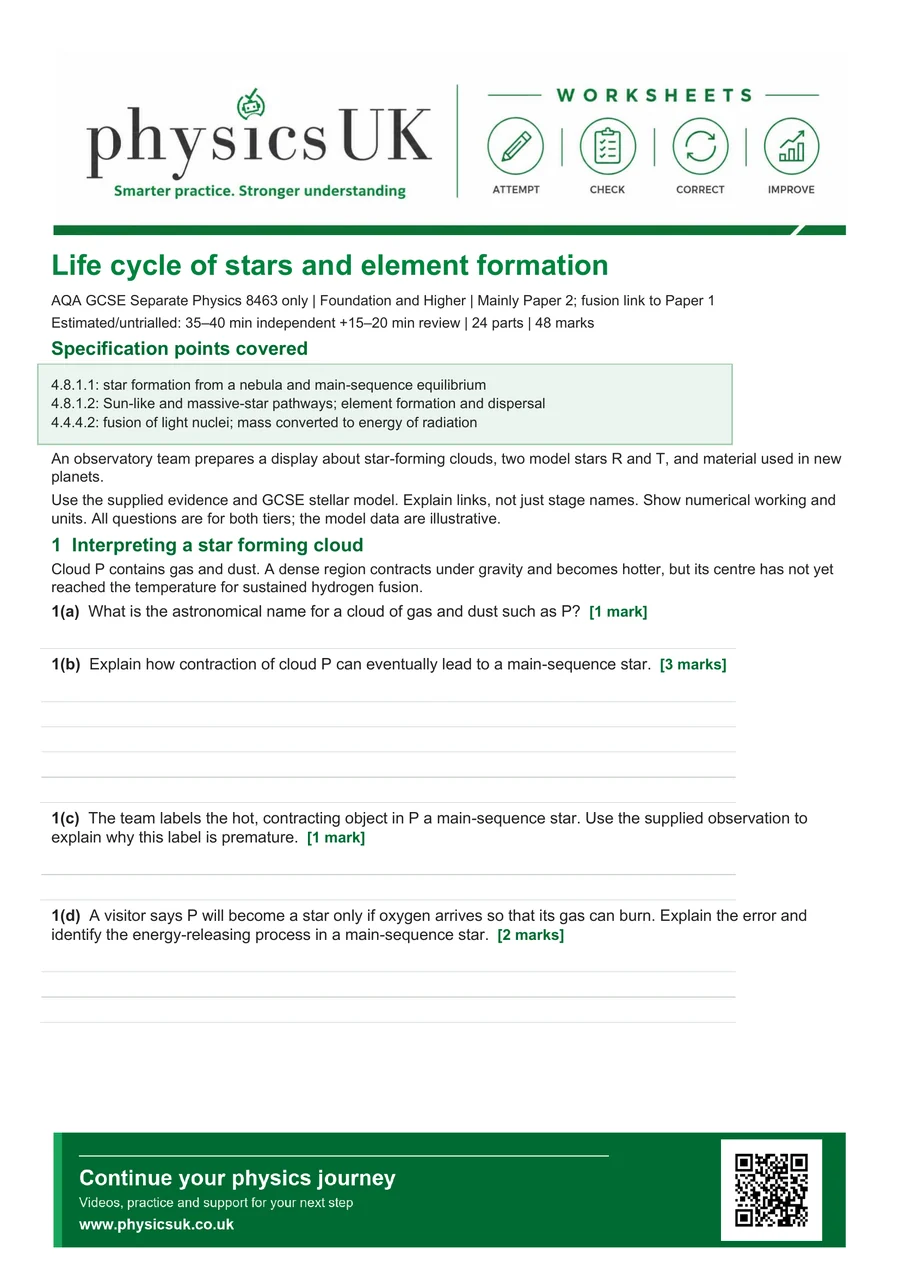
What is covered
Questions and skills covered
The worksheet contains 6 pages of printable questions. A separate 6-page solutions PDF makes it easy to mark, review or share answers after the activity.
- Nebula/protostar formation through gravitational contraction and increasing central temperature
- Sustained hydrogen fusion marks the main-sequence stage, not chemical combustion with oxygen
- Main-sequence equilibrium: inward gravity opposed by outward pressure supported by fusion energy
- Initial mass rather than present radius or colour determines the broad lifecycle route
- R: red giant, hot white dwarf after outer material loss, then future cooled black dwarf
- T: red supergiant, supernova, then alternative neutron-star or black-hole remnants
- Supplied model lifetimes: 10 000 versus 8 million years; more fuel alone does not imply longer lifetime
- Hydrogen nuclei fuse to helium; a small amount of mass becomes energy of radiation
- Successive fusion can build heavier nuclei up to iron in the GCSE account
- Supernova nuclear processes can produce elements heavier than iron and eject material into space
- Production of carbon/iron distinguished from ejection, mixing and incorporation into a later planet
- R mass budget: 8.0 × 10²⁹ kg expelled, 40% of initial mass
- T initial mass is 20 Sun masses; remaining core is 1.5, so remnant mass is not initial mass
- White dwarf radiation while cooling does not prove sustained main-sequence fusion
- Six-mark-style synthesis comparing R and T; observing different stages versus following a whole lifetime in one night
About this activity
Use the stellar model to explain observational evidence, not simply recite stage labels. Distinguish initial mass, current size, nuclear production and material dispersal.
Before you start
After teaching star formation and the two stellar lifecycle routes, nuclear fusion and basic standard-form arithmetic/percentages. No A-level astrophysics required.
A question from the worksheet
Question 5(c), pupil page 5
T’s remnant is only 1.5 Sun masses. Does this prove T never started much more massive than the Sun?
Show the answer
No. The core is only what remains after material is expelled; the supplied initial mass is 20 Sun masses. The broad route is selected by initial mass, not remnant mass.
Common error: Treating present radius or final remnant mass as the star’s initial mass.
Revise the physics
Specification fit
AQA GCSE Physics Worksheets
8463 · 4.8.1.1, 4.8.1.2, 4.4.4.2
- 8463: 4.8.1.1, 4.8.1.2, 4.4.4.2
Choose the correct pathway: Separate Physics 8463 only, both tiers. Primarily Paper 2 stars and element formation with a Paper 1 fusion link. Supplied model data are not precise stellar predictions.
Classroom use
Use the worksheet for class practice, homework, intervention, cover work or revision. Keep the PhysicsUK attribution intact when sharing copies with pupils.