
Free worksheet and solutions · AQA GCSE · 8463
AQA GCSE Physics Red Shift and the Expanding Universe Worksheet
AQA GCSE Separate Physics red-shift worksheet with answers. Interpret spectral fingerprints, evaluate expansion evidence and explain what the data establish.
What is covered
Questions and skills covered
The worksheet contains 6 pages of printable questions. A separate 6-page solutions PDF makes it easy to mark, review or share answers after the activity.
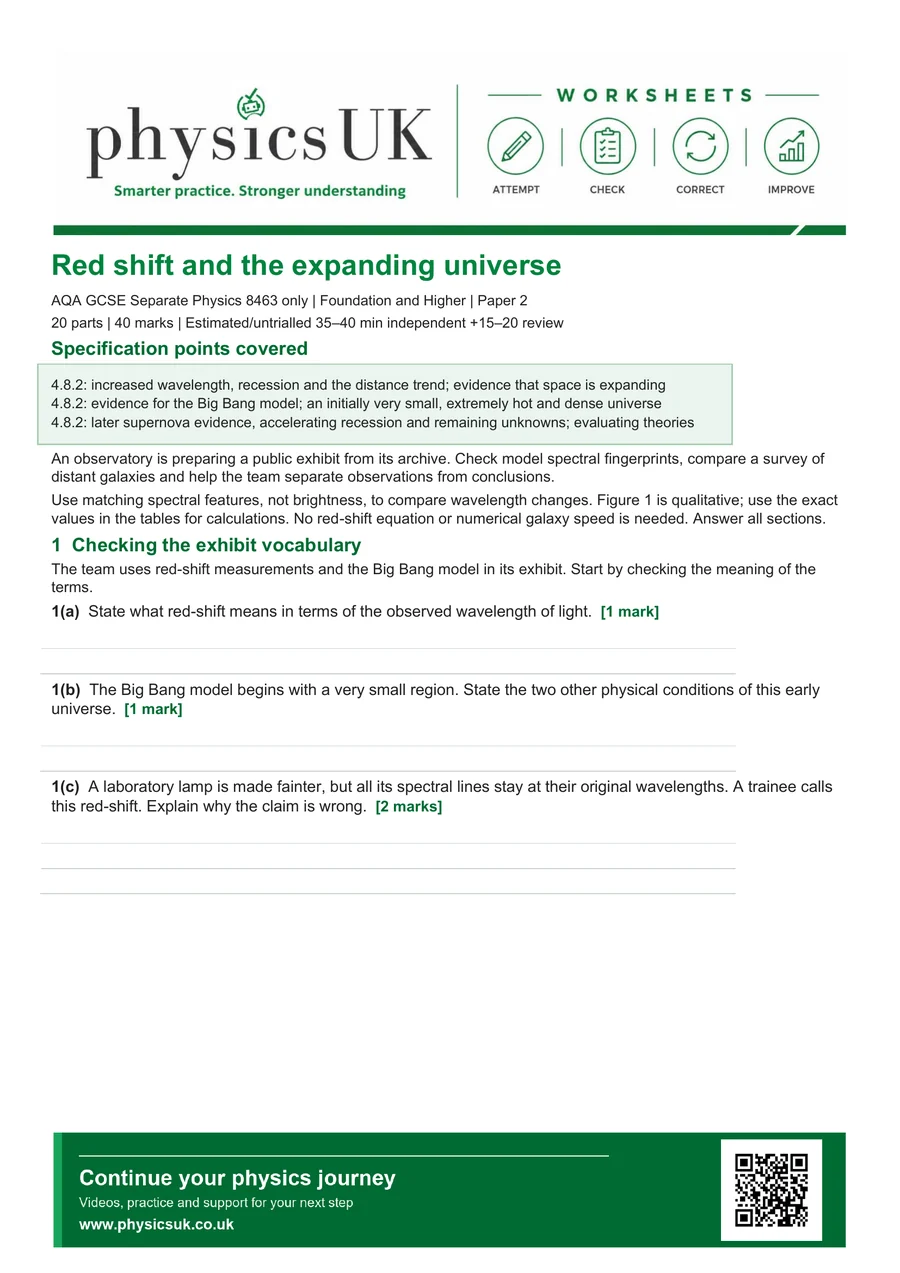
- Red-shift is an increased corresponding wavelength, not dimming or all light becoming red
- Big Bang model initially very small, extremely hot and dense
- Corresponding absorption-feature patterns and confidence from multiple matches
- Both galaxies recede; larger shift indicates faster recession
- Exact wavelength changes and rejecting equal added nm for all model lines
- Consistent fractional wavelength shifts in author model; no red-shift equation required
- One common reference feature across distance survey; greater distance with greater shift and recession speed
- Expanding space/separation is not automatically growing galaxy size
- Backwards expansion supports smaller past, not a direct initial-temperature measurement
- Calibration, independent repeats and peer review with linked confidence reasons
- Distance comparisons do not alone establish speed change with time
- Separate supernova observations from1998 onwards and accelerating recession
- Refining models to account for new and earlier evidence
- Dark mass and dark energy are not fully understood; uncertainty does not erase separate evidence
- Scaffolded six-mark-style observation→inference→limitation argument, original best-fit rubric
About this activity
Link measured wavelength changes to recession and expansion; distinguish observation, inference and claims beyond the data.
Before you start
After teaching4.8.2. Compare corresponding spectral features, subtract nm values and explain qualitative trends. Both-tier GCSE only.
A question from the worksheet
Question4(d), pupil page4
Does a survey of different galaxies at different distances establish that each is speeding up with time?
Show the answer
No. It compares different galaxies rather than tracking an individual speed change with time. Later supernova observations provide separate acceleration evidence.
Common error: Treating more distant galaxies receding faster as the same statement as speeds increasing with time.
Revise the physics
Specification fit
AQA GCSE Physics Worksheets
8463 · 4.8.2
- 8463: 4.8.2
Choose the correct pathway: Separate Physics 8463 only, both tiers, Paper 2. Original spectral and distance-survey evidence. Distinguish a distance–speed trend from evidence of accelerating expansion.
Classroom use
Use the worksheet for class practice, homework, intervention, cover work or revision. Keep the PhysicsUK attribution intact when sharing copies with pupils.