
Free worksheet and solutions · AQA GCSE · 8463
AQA GCSE Physics Loudspeakers Microphones and Electromagnetic Devices Worksheet
AQA GCSE Separate Physics Higher devices worksheet with answers. Apply motor and generator effects to loudspeakers, microphones and current traces.
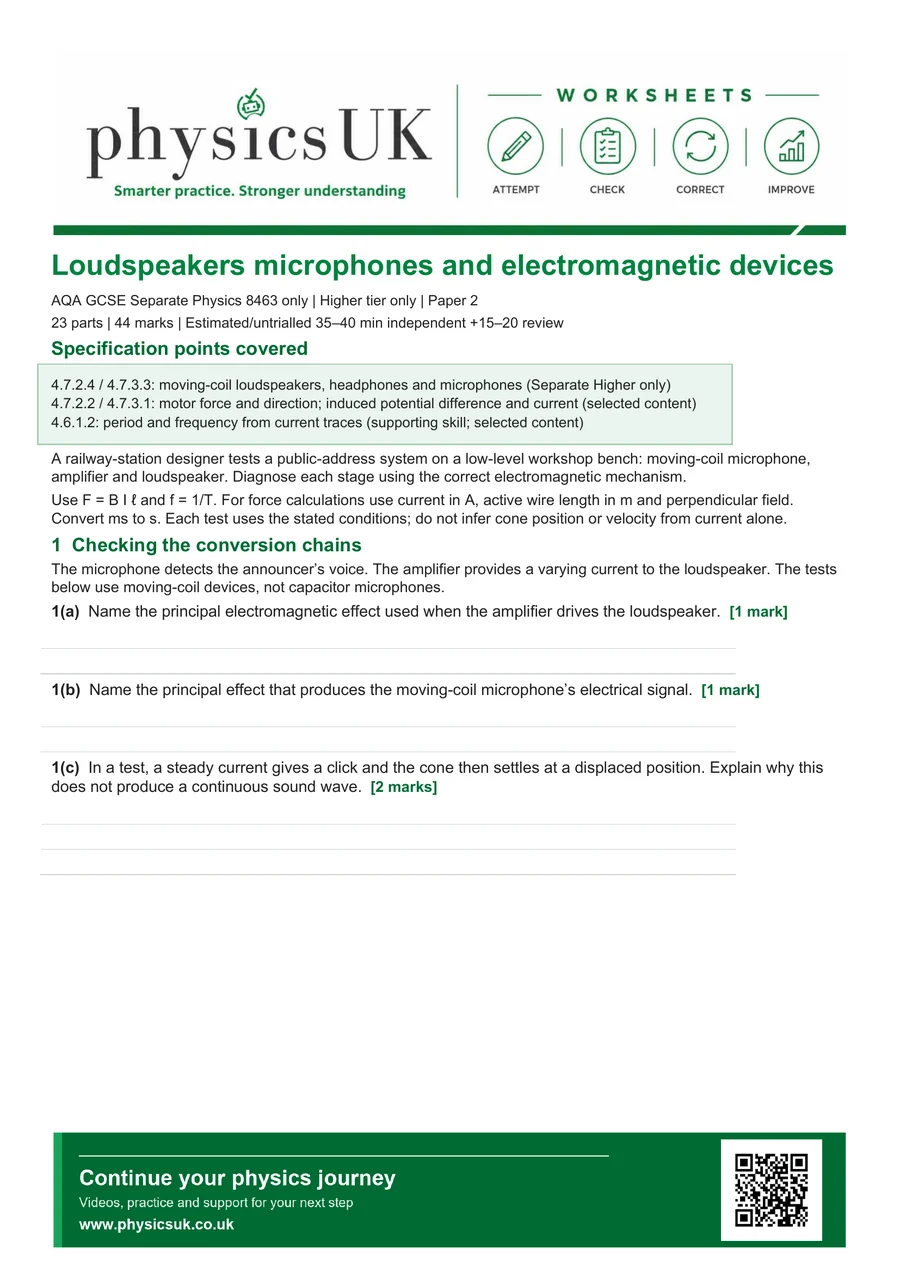
What is covered
Questions and skills covered
The worksheet contains 6 pages of printable questions. A separate 6-page solutions PDF makes it easy to mark, review or share answers after the activity.
- Motor versus generator effect in moving-coil devices
- Steady displaced cone does not produce sustained sound
- Fleming left-hand rule: opposite local field/current directions give additive coil forces; reversal changes force
- Current field interacting with permanent field; alternating force, vibrating coil/cone and sound-pressure variations
- F=B I ℓ with current conversion, rearrangement, active perpendicular wire and justified replacement-coil choice
- Sound-pressure variation drives diaphragm/coil; relative field motion induces alternating pd/current
- Stationary coil in static field; open circuit pd without current; amplitude at fixed frequency and induced pd; magnet reversal
- Reciprocity: mechanically driven spare speaker as dynamic microphone
- Peak current, period, frequency and force at a selected graph instant
- Loudness under stated fixed-frequency linear response; unchanged pitch at unchanged frequency
- Mechanical speaker fault despite correct current; reversing single isolated speaker leads does not stop sound
- Headphone earpiece uses motor effect in normal driven use
About this activity
Name the moving part and correct causal chain; distinguish driven force from induced signal and pd from current.
Before you start
After teaching Separate Higher speakers/microphones, motor force and induction. Read signed periodic traces and use period/frequency. No numerical Faraday law.
A question from the worksheet
Question3(c), pupil page3
At0.080A in0.40T, coilX has3.0m active wire and Y3.5m. Which reaches at least0.10N?
Show the answer
X gives0.096N; Y gives0.112N. Choose Y: it exceeds0.10N, while X does not.
Common error: Substituting total coil/lead length instead of active perpendicular length in the field.
Revise the physics
Specification fit
AQA GCSE Physics Worksheets
8463 · 4.7.2.4, 4.7.3.3, 4.7.2.2, 4.7.3.1, 4.6.1.2
- 8463: 4.7.2.4, 4.7.3.3, 4.7.2.2, 4.7.3.1, 4.6.1.2
Choose the correct pathway: Whole worksheet: Separate Physics 8463 Higher only, Paper 2. No Foundation or Combined route. Device mechanisms are assessed in words with precise local-conductor figures.
Classroom use
Use the worksheet for class practice, homework, intervention, cover work or revision. Keep the PhysicsUK attribution intact when sharing copies with pupils.