
Free worksheet and solutions · AQA GCSE · 8463 / 8464
AQA GCSE Physics Energy Resources and Electricity Supply Decisions Worksheet
Compare energy resources in an AQA GCSE worksheet with answers. Use supply data, costs and environmental evidence to justify an electricity plan.
What is covered
Questions and skills covered
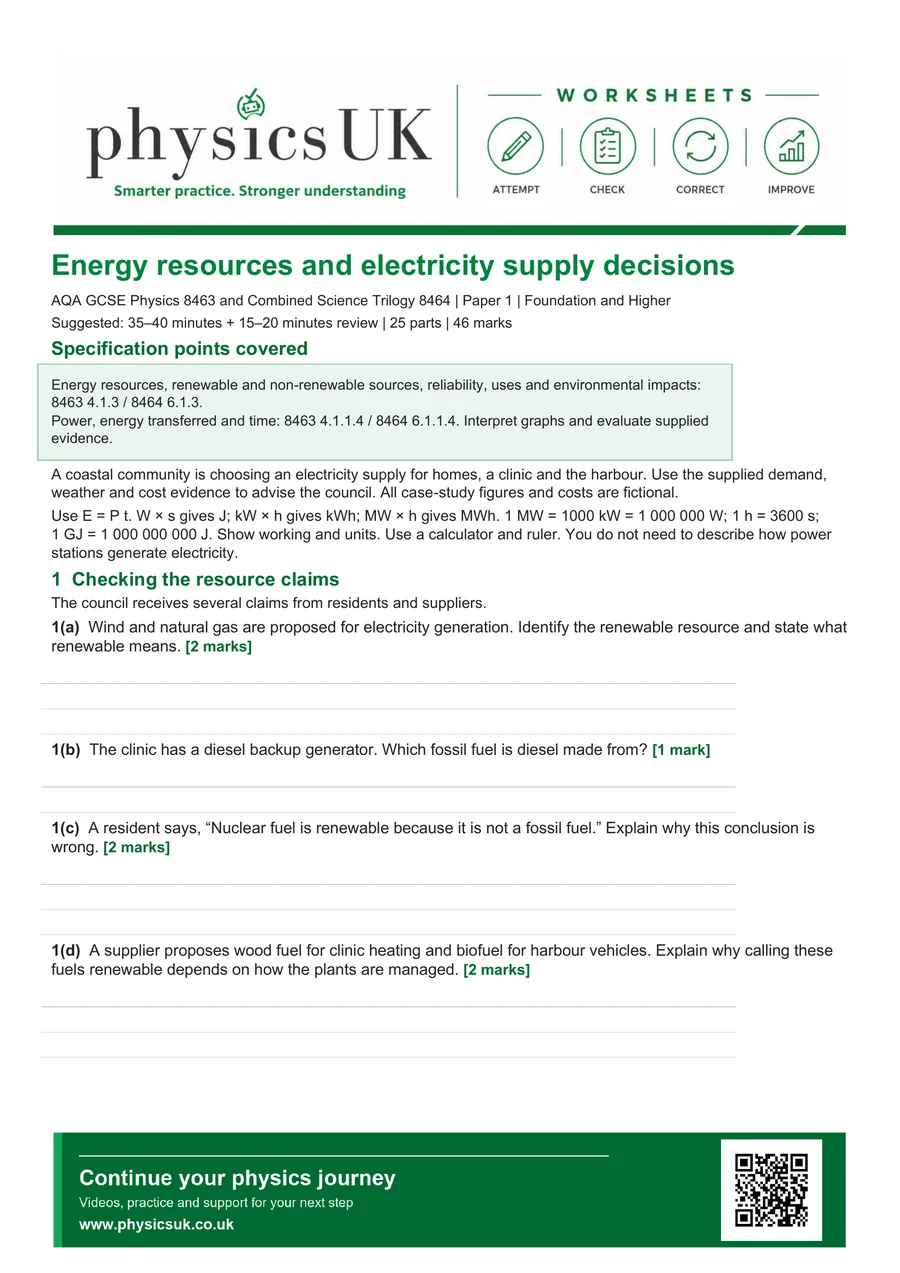
The worksheet contains 6 pages of printable questions. A separate 6-page solutions PDF makes it easy to mark, review or share answers after the activity.
- Renewable and non-renewable energy resources
- Demand and available generation graphs
- Power, energy, time and usable battery storage
- Tidal, wave, solar, hydroelectric and geothermal reliability
- Greenhouse gases, acid rain and nuclear waste
- Evidence-based electricity supply recommendation
About this activity
Original coastal-community scenario with a clinic and harbour. Pupils distinguish renewable status from reliable output, calculate backup requirements and justify a supply mix.
Before you start
Use E=Pt, read a linear graph and convert prefixes/time using supplied conventions.
A question from the worksheet
Question 2(c), worksheet page 2
Demand is 12 MW at 18 h and available wind power is 4 MW. Calculate the extra power needed.
Show the answer
12 − 4 = 8 MW.
Common error: Giving MWh for a power shortfall, or treating surplus output at a different time as automatic backup.
Revise the physics
Specification fit
AQA GCSE Physics Worksheets
8463 and 8464 · 4.1.3, 4.1.1.4, 6.1.3, 6.1.1.4
- 8463: 4.1.3, 4.1.1.4
- 8464: 6.1.3, 6.1.1.4
Choose the correct pathway: Combined Trilogy 8464 and Separate Physics 8463, both tiers, Paper 1. Fictional planning data and supplied percentage-point guidance; no advanced generation mechanisms.
Classroom use
Use the worksheet for class practice, homework, intervention, cover work or revision. Keep the PhysicsUK attribution intact when sharing copies with pupils.