
What did the optical-fibre experiment show?
Researchers at the Max Planck Institute for the Science of Light and Leibniz University Hannover have made light and sound waves interact strongly inside a cooled optical fibre. Physicists call this coupling: a connection that lets two systems exchange energy. Their paper was published in Nature Physics on 16 October.
The unusual part is that the interaction happens during a single journey through the fibre. Earlier strong-coupling experiments commonly used resonators to keep waves around for repeated interactions. This experiment did not need an optical or mechanical resonator.
The team tested how the waves responded at different frequencies. The response split into two branches in a pattern expected when the waves interact strongly. We explain that evidence in the A-level section below. An earlier version of the paper was already available as a preprint, a research paper shared before journal publication.
How can light interact with sound?
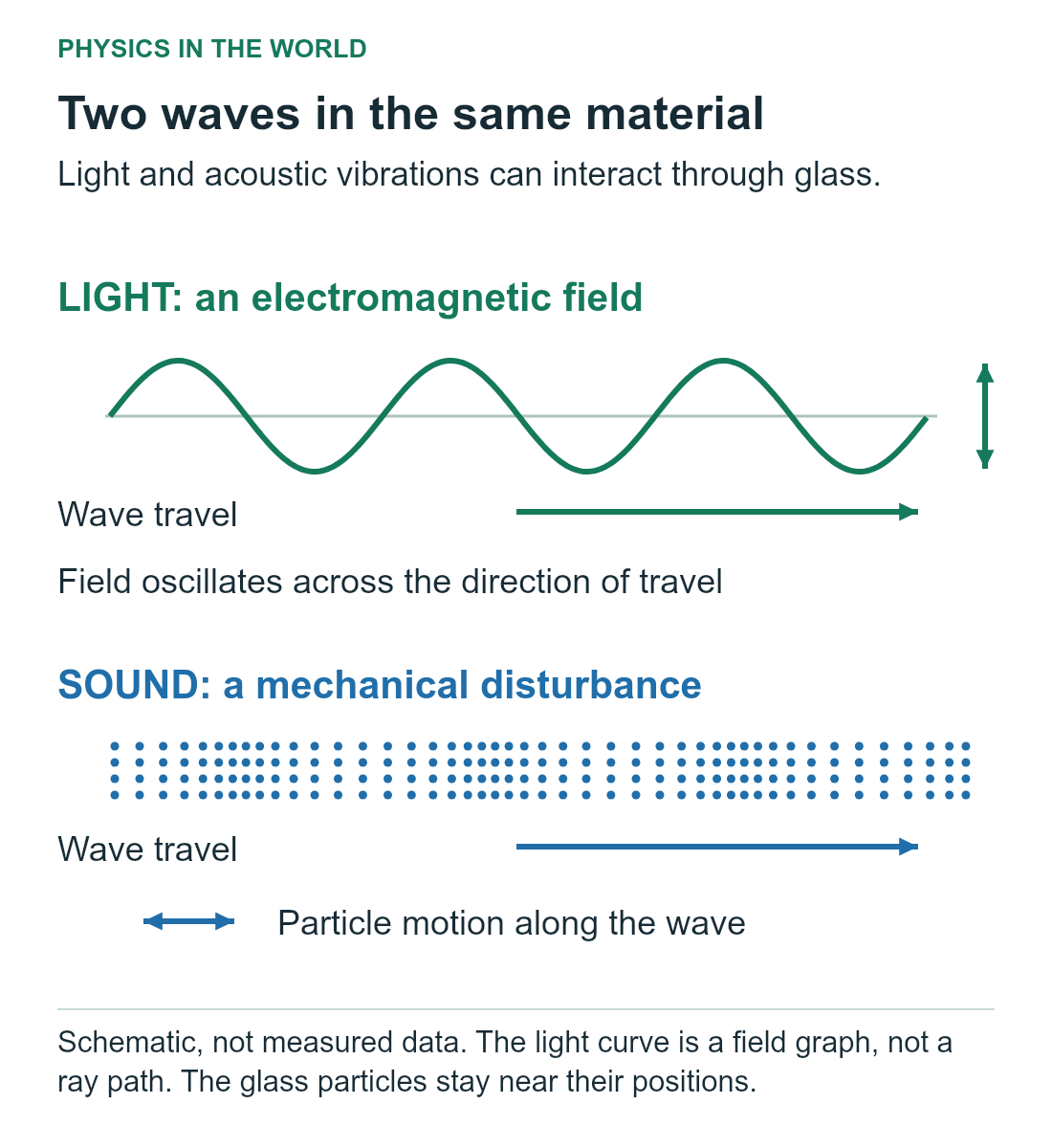
Start with the two kinds of wave. Light is a repeated change in electric and magnetic fields. Sound is a vibration that travels through a material. In air, sound produces compressions and rarefactions: regions where particles are closer together or farther apart. Glass can carry sound waves too.
The waves can interact because they share the material. A density disturbance changes how light propagates through the glass. The optical field can also exert forces that drive a density disturbance. The glass provides a physical link between the light and the vibration.
A related process is called Brillouin scattering. Light interacting with an acoustic disturbance can emerge with a different frequency. Energy and momentum must balance across the optical and acoustic parts of the interaction.
This is not something you would hear by putting your ear to an internet cable. The relevant acoustic frequencies are far above human hearing, and the experiment uses carefully controlled optical fields and a cooled fibre.
A useful school analogy is two connected oscillators. If one is disturbed, the connection lets the other respond. With a sufficiently effective connection, energy exchange becomes a major part of the combined motion. The analogy explains coupling; it does not reproduce all the optics.
Why would we want light and vibrations to interact?
Optical fibres are already useful for transmitting information. If researchers can also control interactions within a fibre, it may become possible to process a signal there as well as carry it from one place to another.
The vibrations and the light respond at different rates. Controlling their interaction could help researchers delay a signal, select particular frequencies or pass information from one system to another. The difficult part is doing this without losing the information.
The researchers identify possible applications in quantum signal processing. That is a direction for further work. The result does not establish a complete quantum processor, a household device or a replacement for existing computers.
An electrical engineer developing communication hardware has to think about signal loss, noise and compatibility with other components. Those same practical questions will determine whether a promising laboratory interaction becomes useful equipment.
The GCSE and A-level waves behind the experiment
The AQA waves worksheet is a good place to check the first distinction: transverse and longitudinal. These words compare the direction of a vibration with the direction the wave travels. Light is transverse: its fields change perpendicular to that direction. In the sound wave considered here, particles in the glass vibrate parallel to the direction the wave travels.
Do not draw the light wave as though a photon follows a wavy path along the cable. A sinusoidal graph can represent how the electric field varies; it is not a photograph of the route taken by a moving object. The diagram keeps that distinction visible.
The ordinary school model of an optical fibre uses a core with a higher refractive index than its cladding. Suitable rays are guided by total internal reflection. That explains guidance; it does not, by itself, explain how light exchanges energy with a vibration.
The photon-model worksheet introduces light energy in discrete amounts associated with frequency. A phonon is the corresponding quantum description of a collective vibration in a material. It is not a tiny sound particle flying independently through empty space.
Both kinds of wave can transfer energy without carrying the whole medium along with them. The glass does not travel from the laser to the detector. Its constituent particles undergo small motions while disturbances and energy propagate.
A Level stretch: what counts as strong coupling?
Two systems can interact weakly without reaching strong coupling. To reach strong coupling, they must exchange energy before losses overwhelm the interaction, while keeping a definite relationship between their phases. Phase tells you where a wave is in its cycle. The word strong does not simply mean that the laser is bright.
Cooling the fibre to about 4 kelvin, roughly minus 269 degrees Celsius, helped the sound waves lose energy more slowly. The vibrations therefore lasted longer while interacting with the light. This is damping: the gradual loss of energy from an oscillation. The damping and resonance worksheet explores that same idea in school experiments.
When oscillators are connected, their motion has to be described together. A useful example is two pendulums joined by a spring: moving one can set the other moving. The optical-fibre experiment is more complicated, but the connection likewise changes the frequencies at which the whole system responds.
Researchers can plot those response frequencies while changing an experimental setting. With strong coupling, two branches approach and then turn away from each other rather than crossing. This pattern is called an avoided crossing. It is evidence about the interaction, not a picture of the paths taken by the waves.
For an A-level pupil, the useful question is how the measured response differs from an uncoupled prediction. A pattern in the data, a model that predicts it and checks against simpler explanations together make a stronger case than a headline about converting light into sound.
Nothing here removes the distinction between a mechanical wave and an electromagnetic wave. The experiment demonstrates a way for them to exchange energy and information through a material under controlled conditions.
Key words
Quick pupil questions
Can light be converted into sound?
Light and acoustic vibrations can exchange energy through a material in controlled experiments. This involves specific interactions and conditions, rather than ordinary visible light simply becoming an audible noise.
What is new about the October 2026 optical-fibre result?
The paper demonstrates optoacoustic strong coupling during a single pass through a cooled optical fibre without an optical or mechanical resonator. Light-sound interactions themselves were already known.
Are photons and phonons the same thing?
No. A photon is a quantum of the electromagnetic field. A phonon describes a quantum of a collective vibration in a material. They can interact, but they are different excitations.
Does this make an optical fibre a quantum computer?
No complete quantum computer is demonstrated. The experiment investigates an interaction that could contribute to future quantum signal processing.